Blue is the color of light with wavelengths between roughly 450 and 495 nanometers, falling between violet and cyan on the visible spectrum. It is a primary color in both modern screen displays and traditional painting systems. Across history, almost every language named blue last, long after words for red, yellow, and green.
By the edgi team We find the most surprising true thing about an idea and build a 60-second lesson around it.
In Homer's Odyssey, the sea is famously described as 'wine-dark.' Despite the poem being set on the Mediterranean, the word 'blue' never appears.
This wasn't because the ancient Greeks were blind; it was because they lacked a linguistic category for that specific wavelength.
The color hierarchy
Linguists discovered that almost every language develops color words in the same order: first light and dark, then red, then yellow and green. Blue is almost always the very last to emerge in a language's vocabulary.
The only ancient exception was the Egyptians, who were the first to master the chemistry of manufacturing blue dye.
Why the sky is blue
The sky appears blue because of Rayleigh scattering, where air molecules scatter shorter blue wavelengths of light more than others. This optical phenomenon has always been true, but without a name for the color, ancient cultures often categorized the sky as white, black, or grey.
We perceive the visible spectrum through the lens of our language; if we don't have a word for it, we often don't truly 'see' it.
Why does the sky look blue?
Light scattered by air molecules creates the blue appearance of the daytime sky and the deep sea through Rayleigh scattering. Shorter wavelengths of light scatter far more easily than longer ones. Blue light has a dominant wavelength near 470 nanometers, causing it to scatter across the atmosphere.
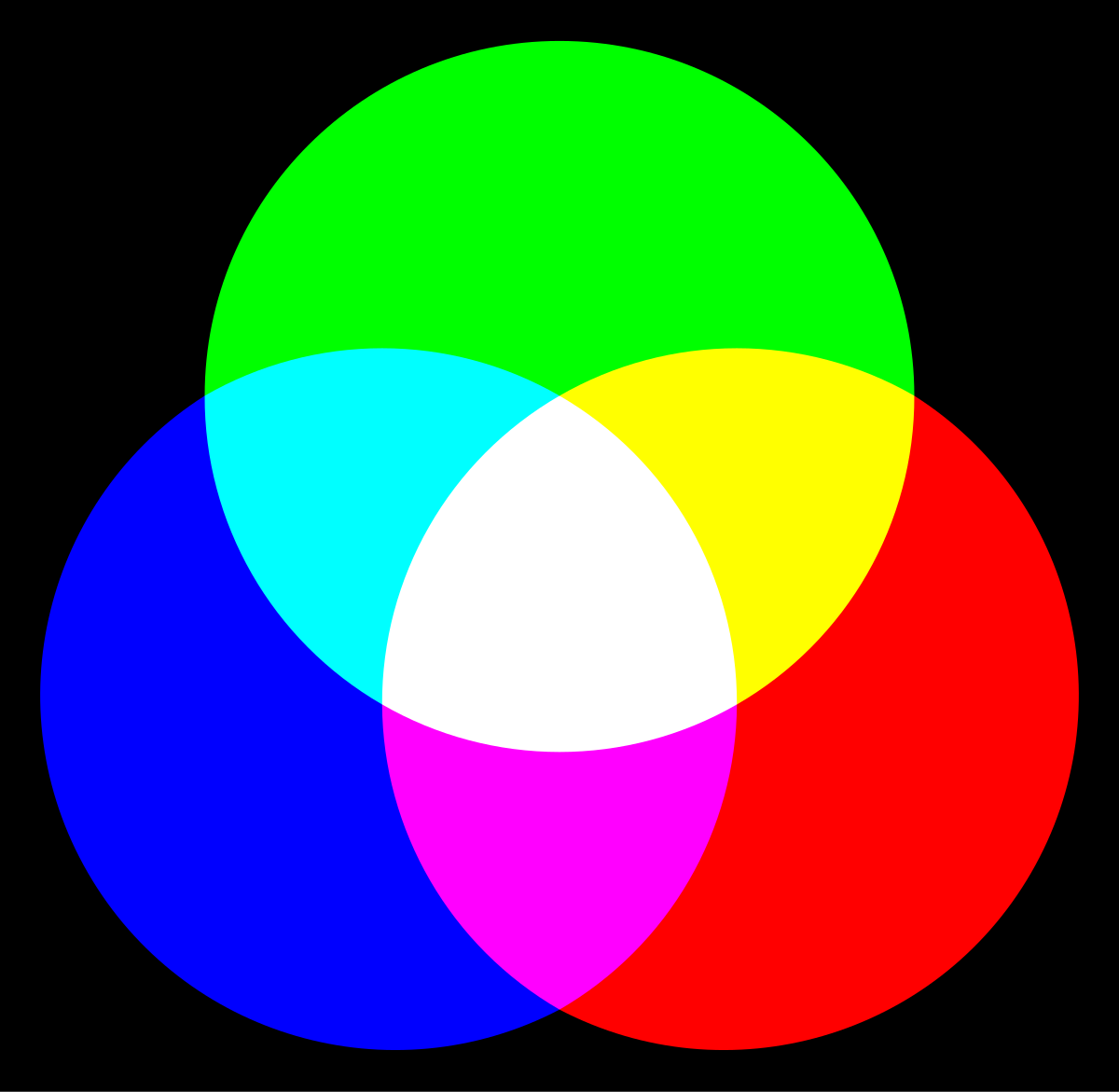
Overlapping circles show how blue combines with red and green light to produce other colors in additive mixing. Quark67(Modified color by Monami), CC BY-SA 3.0, via Wikimedia Commons
Other physical phenomena cause different blue appearances. An optical effect called the Tyndall effect produces blue eyes. Distant mountains and landscapes take on a blue hue due to aerial perspective.
In color theory, blue serves as an additive primary alongside red and green light. On digital screens, mixing red, green, and blue light generates the full spectrum of visible colors.
How did artists and dyes create blue?
For centuries, the most expensive artist pigment was ultramarine, ground from the semi-precious stone lapis lazuli. Ancient Egyptians used lapis lazuli for jewelry, and later Renaissance painters used ultramarine for their finest works. In the eighth century, Chinese artisans relied on cobalt blue to decorate porcelain.
The United Nations flag uses blue as a symbol of harmony behind its white emblem. UNclimatechange from Bonn, Germany, CC BY 2.0, via Wikimedia Commons
Clothing dyes followed a similar shift from scarce natural sources to synthetics. Early Europeans used the woad plant for blue dye before importing indigo from America. By the 19th century, manufactured synthetic dyes replaced both organic dyes and mineral pigments.
Dark blue eventually became the standard shade for military uniforms and late-20th-century business suits. International organizations like the United Nations and the European Union selected blue for their flags because the color is widely associated with harmony.
Why do languages name blue last?
Languages almost never start with a term for blue. Linguistic studies show color words develop in a set order: dark and light first, followed by red, then yellow and green. Blue typically enters a vocabulary only after a culture learns to manufacture blue pigments reliably.
Several languages still group blue and green under a single word. In Vietnamese, the word xanh describes both tree leaves and the clear sky. In Japanese, the word ao can describe green objects, including green traffic signals. Russian and Irish lack a single general word for blue, using distinct terms for light blue and dark blue instead.
Test yourself
How does the universal color naming hierarchy typically position blue relative to red?
Blue emerges much later than red. Linguistic studies show that almost all languages develop color terms in a strict sequence where red appears early and blue is nearly always the last to form.
Did ancient Greeks call the sea wine-dark because they lacked the word blue?
Yes, they lacked that linguistic category. Lacking a word for a distinct wavelength shapes how people categorize what they see, which is why Homer used wine-dark instead of blue.
Play the lesson in edgi and the card is yours. It lands on your Map next to the ideas it connects to, and turns from matte to foil to gold as you learn more around it.
In traditional painting systems based on red, yellow, and blue primaries, the complement of blue is orange. On modern digital HSV color wheels, the complement of blue is yellow, formed by equal parts red and green light.
Why was the blue LED awarded a Nobel Prize?
Shuji Nakamura, Isamu Akasaki, and Hiroshi Amano won the 2014 Nobel Prize in Physics for developing high-brightness, efficient blue LEDs. Their breakthrough enabled modern, energy-efficient white LED lighting.
What are blue lasers used for?
High-powered blue laser diodes operating around 445 to 447 nanometers are used in scientific research for DNA sequencing, holography, and optogenetics. They also serve in Raman spectroscopy and optical pumping due to their precise beam quality.