The Doppler effect of light is the change in the frequency, wavelength, and color of light caused by the relative motion between a light source and an observer. When a source moves away, its light waves stretch out into lower frequencies toward the red end of the spectrum, while motion toward an observer compresses them into higher frequencies. Because light travels without a physical medium, its shift must account for the time dilation of special relativity.
By the edgi team We find the most surprising true thing about an idea and build a 60-second lesson around it.
You have heard a siren drop in pitch as an ambulance speeds past you. Light does the exact same thing with color instead of sound. When a light source moves away from you, its waves stretch out.
That stretching shifts the color toward the red end of the electromagnetic spectrum, a phenomenon called redshift.
The relativistic twist
Christian Doppler predicted the effect for sound in 1842, but wrongly assumed starlight worked the same way. Unlike sound, light needs no medium to travel through. The relativistic Doppler effect accounts for the bizarre time dilation and length contraction of the Special Theory of Relativity.
In 1901, physicist Aristarkh Belopolsky finally proved it in a lab by bouncing light off rapidly spinning mirrors.
An expanding universe
Astronomers use this color shift to calculate a star's radial velocity along our line of sight. When they pointed their telescopes at distant galaxies, they found almost all of them were shifted toward the red.
That permanent fingerprint on the starlight revealed a stunning truth: the very fabric of space is growing, and the universe is expanding.
How motion shifts light waves
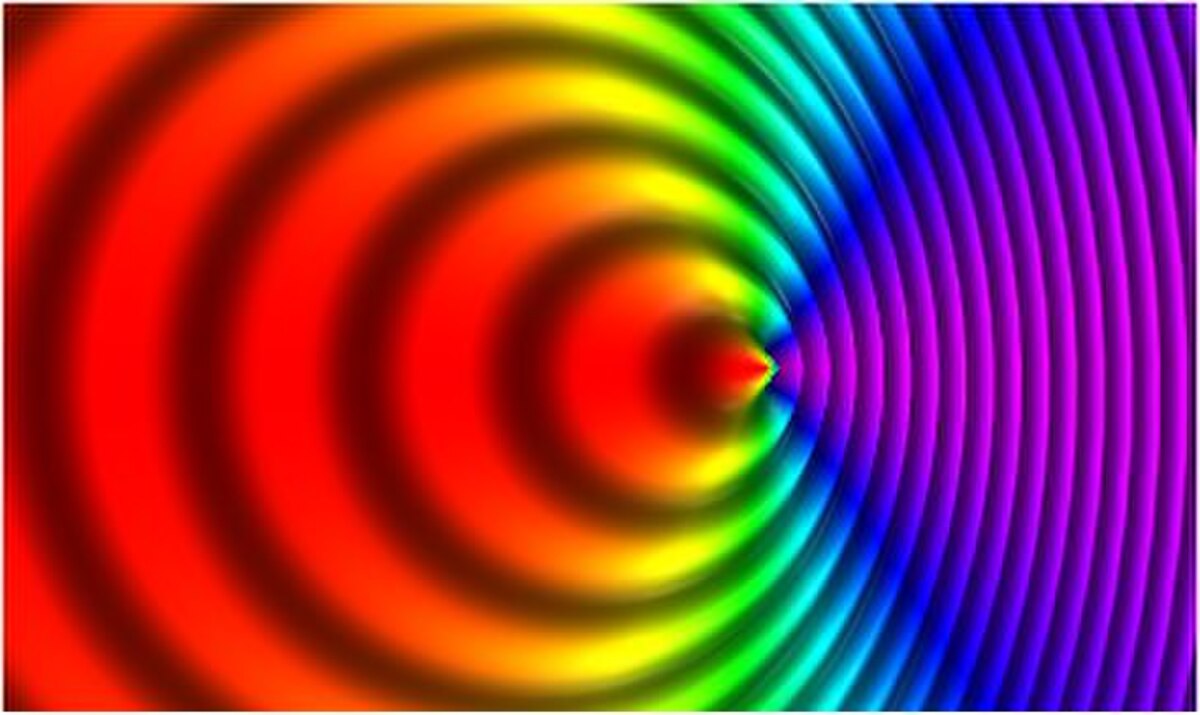
Light waves change their observed frequency and wavelength depending on relative velocity. If a light source moves directly away from a receiver at relative speed v, the wavefronts arrive further apart, decreasing the observed frequency.
A moving source compresses light wavefronts in the forward direction and stretches them out behind, changing the observed frequency for observers on either side. en:TxAlien, CC BY-SA 3.0, via Wikimedia Commons
Unlike classical sound waves traveling through air, light does not use a medium of propagation as a reference point. The calculation modifies the classical wave arrival period by incorporating relativistic time dilation, satisfying Lorentz symmetry.
Physicist Aristarkh Belopolsky confirmed this optical shift experimentally in 1901 by reflecting light beams off rapidly rotating mirrors in a laboratory.
Why astronomers track color shifts
Astronomers measure the shift in light frequencies to calculate the radial velocity of stars and galaxies along our line of sight.
While Doppler motion shifts starlight, astronomers identify three distinct origins for observed shifts: Doppler shifts from relative movement, gravitational redshifts caused by light climbing out of gravitational fields, and cosmological expansion where space itself stretches.
Play the lesson in edgi and the card is yours. It lands on your Map next to the ideas it connects to, and turns from matte to foil to gold as you learn more around it.
How does the relativistic Doppler effect differ from sound?
Sound waves depend on a physical medium like air to carry their vibrations. Light requires no medium, so its Doppler calculations must factor in special relativity, including time dilation between moving reference frames.
What causes light to redshift?
In Doppler shifts, redshift happens when a light source moves away from the observer, stretching the emitted waves into longer, lower-frequency wavelengths. In broader astronomy, redshift can also result from gravitational fields or the cosmological expansion of space.