Game TheoryWhy your best move depends on other people
Game theory is a branch of applied mathematics that models strategic interactions between multiple decision-makers, called players. Each player chooses an action to maximize their outcome, known as a payoff, while knowing that every other player is doing the same thing. It matters because it reveals how individually rational choices can produce unexpected collective results, from price-fixing in markets to stalemates in war.
By the edgi team We find the most surprising true thing about an idea and build a 60-second lesson around it.
In physics, you can calculate the path of a falling apple with absolute certainty. The apple does not care that you are watching. But if you try to calculate the path of a person, they are calculating yours right back. This is the core of game theory.
The poker origin
The field was essentially born from poker. In 1944, John von Neumann and Oskar Morgenstern realized that life’s most critical interactions aren't like solitaire. They are like poker. You aren't just playing against the deck; you are playing against the other player's strategy. Your best move depends on what you think they will do.
The nuclear stalemate
This logic eventually moved from the poker table to the nuclear command center. During the Cold War, game theory produced the doctrine of Mutually Assured Destruction. The math proved that if both sides were guaranteed total annihilation, neither would dare strike first. The best move was to make the opponent believe you would destroy them.
The collective trap
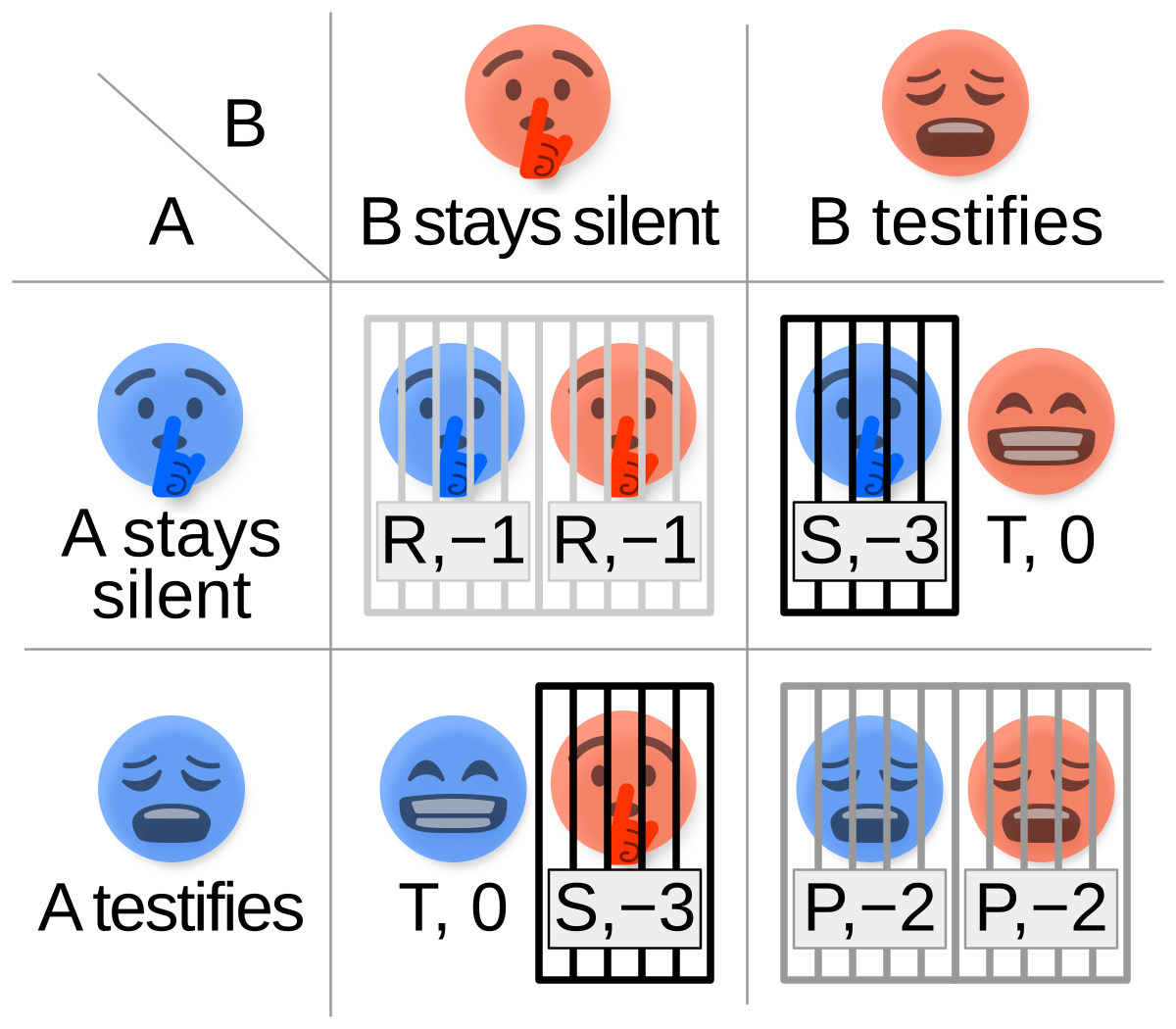
We use this math today to understand everything from how a cartel fixes prices to why trees in a forest grow so tall. In the Prisoner's dilemma, rational individual decisions often lead to collective disasters. Sometimes, the 'smart' move for you leaves everyone worse off.
Payoff matrix illustrating the Prisoner's Dilemma with emojis representing Player A and Player B's choices and outcomes. cmglee, http://github.com/emojione/emojione/graphs/contributors, http://github.com/twitter/twemoji#committers-and-contri, CC BY-SA 4.0, via Wikimedia Commons
The four building blocks of a game
A game in mathematics is defined by four core elements, summarized by the acronym PAPI: players, actions, payoffs, and information. Players are the active agents making choices. Actions are the full set of moves available to each player.
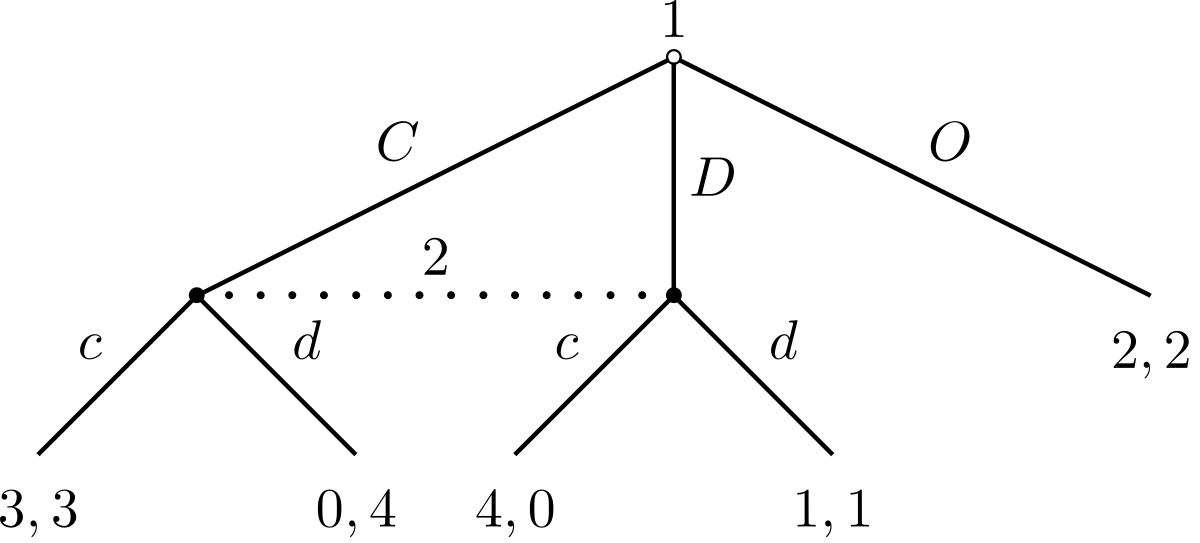
A game tree showing imperfect information, where a dotted line groups nodes together to show that player 2 does not know which move player 1 chose. Kevin Zollman --Kzollman, CC BY-SA 3.0, via Wikimedia Commons
Payoffs represent the value or outcome each player receives for every possible combination of strategies. Information refers to what each player knows about the state of the game and their opponents' moves at the exact moment they decide. When players lack full knowledge of their opponents' previous choices, the interaction becomes a game of imperfect information.
Games are categorized into distinct types. In cooperative games, players can form externally enforced binding commitments, such as legal contracts. In non-cooperative games, alliances are impossible or agreements must be self-enforcing through credible threats.
How game theory is used in practice
Economists originally developed game theory to analyze how businesses set prices, compete in markets, and respond to consumers. Traditional optimization models assume static conditions, but game theory accounts for real-time strategic reactions among competitors.
John Nash, who shared the 1994 Nobel Prize in economics for his work formalizing strategic equilibrium in non-cooperative games. Elke Wetzig (Elya), CC BY-SA 3.0, via Wikimedia Commons
Its methods now extend across biological and social sciences. Researchers use evolutionary game theory to explain animal behaviors, while political scientists use it to evaluate voting systems and international relations. In computer science and network science, algorithmic game theory helps design distributed systems and online auctions.
Test yourself
What did Berne take from game theory for Games People Play?
The everyday word game. Berne used game for a repeated pattern of behavior with a hidden motive. His book contains no equations or formal payoff tables.
A friend answers every suggestion with 'yes, but' and stays upset. In Berne's terms, what is going on?
A game with a hidden payoff. In Berne's view the player's real payoff is proving no one can help. That differs from game theory, where players pursue a stated outcome.
Why can cooperation survive in a repeated prisoner's dilemma?
Betrayal can be punished later. Betrayal still wins a single round. In a repeated game the other player can answer it in later rounds, which can cost more than it gained.
Play the lesson in edgi and the card is yours. It lands on your Map next to the ideas it connects to, and turns from matte to foil to gold as you learn more around it.
How does game theory differ from standard decision theory?
Decision theory analyzes single-player scenarios where one person makes choices based on personal preferences and beliefs about a fixed environment. Game theory analyzes multi-agent interactions where the outcome depends directly on the interdependent choices of two or more strategic players.
What is mechanism design theory?
Mechanism design theory is a branch of economics closely related to game theory that focuses on creating the rules of a game to achieve specific outcomes. While game theory takes existing rules as given, mechanism design studies incentives, wages, and auction structures to guide player behavior.
What makes a game symmetric?
A game is symmetric when every player faces identical choices and earns the same payoff for making the same decision. The identity of the individual player does not change the payoffs or available strategies.