How many steps from dinosaurs to black holes? We mapped 104,000 ideas

By the edgi team
Four. In edgi's map of 104,000 ideas, Dinosaur leads to Black hole in four steps: dinosaurs to mass extinctions, to the Late Ordovician extinction, to the gamma-ray bursts that may have caused it, to black holes. That's closer than most. Pick any two ideas and they're typically seven steps apart, and almost never more than ten.
edgi is a free learning app, and its map joins 104,000 ideas with 296,000 connections. Each connection says "this leads to that": learn about the Silk Road and the map points you on to the Mongol Empire. We measured the whole map as it stood on September 30, 2026. It's our map, so the numbers describe how edgi links ideas, not how knowledge is shaped in general. The method is at the bottom.
Any two ideas are about seven steps apart
96% of the ideas in edgi's map sit in one connected web. Take two of them at random, count the fewest connections between them, and the answer is usually 6 or 7. More than half of all pairs land on one of those two numbers. 92% are within 8 steps, and 99.8% within 10.
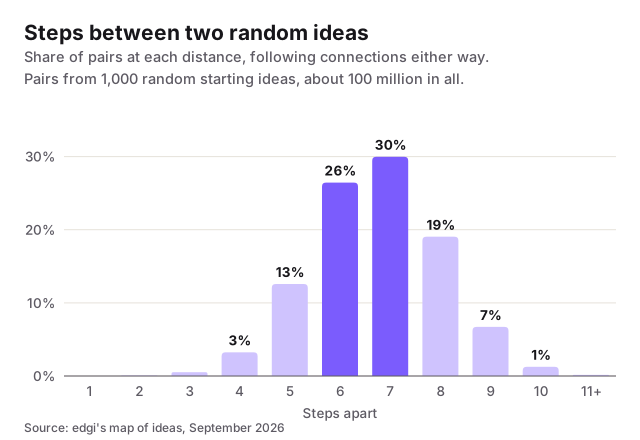
The old line is that any two people on Earth are six handshakes apart. Ideas in edgi's map are a step further apart. Close to any one idea the map is sparse: a typical idea has 5 direct neighbors, 44 ideas within two steps and about 400 within three. Then it opens up. Within six steps, the average idea reaches 43% of the web.
The farthest pair we found is 15 steps apart: Them Crooked Vultures, a rock supergroup, and the Emperor's Cup, a Japanese football tournament. The route runs through Keith Richards, the Hard Rock Cafe, pin trading and the Olympics.
Following the arrows forward takes longer
Connections have a direction. Stonehenge leads to the Neolithic; the Neolithic doesn't lead back to Stonehenge. Follow them only forward and trips get longer. Dinosaur to Black hole is still four steps, but Black hole to Dinosaur takes nine: gravitational waves, astrophysics, planetary science, geology, paleontology, fossils, the Paleozoic, the Mesozoic, then dinosaurs.
From an idea with somewhere to go, following the arrows forward reaches 41% of the map, and the typical trip is 11 steps. That's because connections mostly run from the small to the big: 77% point to an idea that more ideas lead to than the one they started from. Fanta leads to World War II, because the drink was invented in wartime Germany. World War II leads to seven ideas, and soda isn't one of them. About one connection in eight also runs the other way, and 43,848 ideas are only destinations: plenty of arrows in, none out.
The longest forward trip we found is 39 steps, from the Nimzo-Larsen Attack, a chess opening, to Robert Cialdini, the psychologist who wrote Influence. Somewhere in the middle it passes through the Big Mac Index, ketchup and a full English breakfast.
Short trips between far-apart ideas
Well-known ideas are usually far apart. We took 274 of them, from Taylor Swift to tardigrades, and checked every pair going forward. When one leads to the other at all, it typically takes 10 steps, and only 0.7% of pairs are within three. So the short ones are worth collecting.
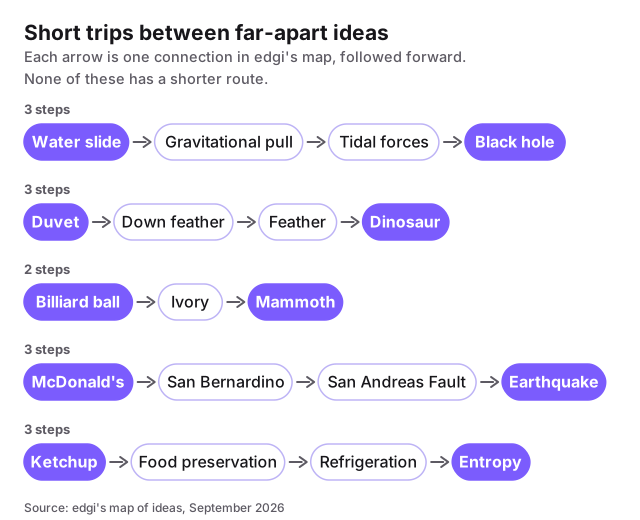
A water slide beats the dinosaur to the black hole by a step: gravity pulls you down the slide, a difference in gravity across an object is a tidal force, and near a black hole tidal forces get strong enough to stretch you into spaghetti. Your duvet is three steps from a dinosaur, because down is a kind of feather and feathers showed up on dinosaurs before there were birds. Early billiard balls were ivory, and some ivory is mammoth tusk. The first McDonald's opened in San Bernardino, California, which sits beside the San Andreas Fault.
A few more we liked: Spider to silk to the Silk Road. Frankenstein to Prometheus to fire (Mary Shelley subtitled the book The Modern Prometheus). A chocolate chip cookie to cookies to the HTTP cookie your browser keeps. Pokémon to myth to the beginning of the universe to the Big Bang.
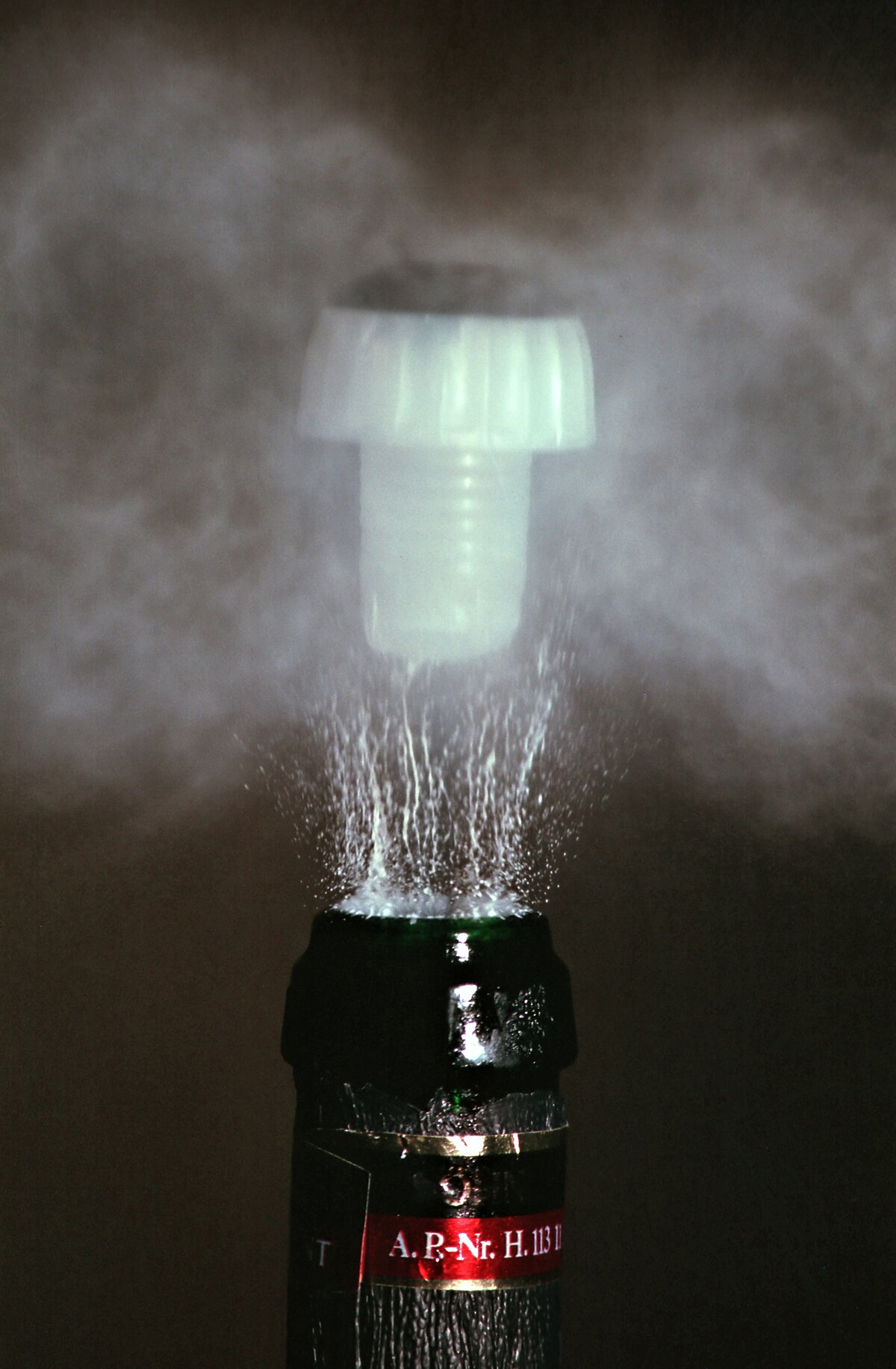
Ketchup gets to entropy in three. The vinegar and sugar in ketchup are there to preserve it. So is a fridge, and a fridge is a machine for pushing heat the way it doesn't want to go, which is where entropy comes in.

60-second Lesson
Entropy
There are far more ways for things to be mixed than sorted. That count is entropy, and it's why a fridge has to keep working.
Almost every path leads to Thermodynamics
Wikipedia has a famous version of this. Click the first link in the text of almost any article, keep going, and you end up at Philosophy. edgi's map has its own center. Of the ideas that lead anywhere, 99% flow into a core of 25,252 ideas that can all reach each other. Of the 400 most-connected ideas we checked, the one the rest reach fastest is Thermodynamics: 5.4 steps on average from the 55,877 ideas that lead to it, and half of them get there in five or fewer. Philosophy takes 7.4.
Thermodynamics is also a destination in its own right. 271 ideas lead straight to it, including cotton candy and the slipperiness of ice. Only two ideas have more arrows pointing at them.
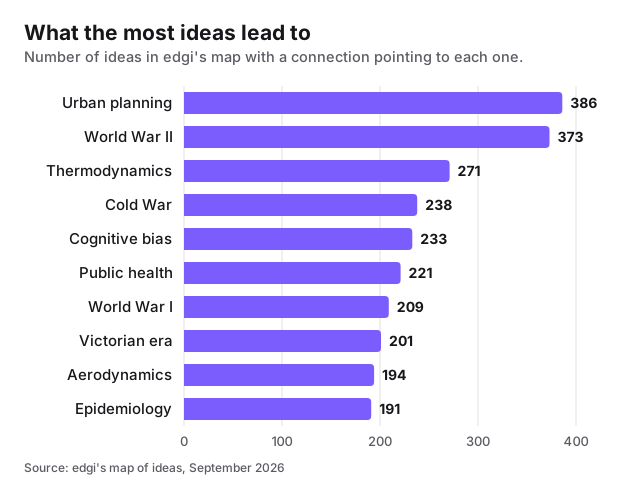
The biggest hub isn't a war. It's urban planning, with 386 ideas leading to it: jaywalking, SantaCon, the drive-through, the parking meter, Central Park, public toilets. Most of what you walk past in a city was a planning decision first. World War II is second with 373, reached from Spam, Roald Dahl, Charles Schulz and Rosie the Riveter. Ignore direction and urban planning is also the idea closest to everything else in the map, 4.5 steps on average.
Which fields talk to each other
Just over a third of connections (36%) cross from one field to another, counting each idea's main field. Sociology is the most outgoing of the 20 biggest fields: 58% of its connections lead somewhere else, mostly to psychology and history. Mathematics is the most self-contained, at 18%. Music is the hardest field to wander into: only 12% of the connections into music ideas come from other fields.
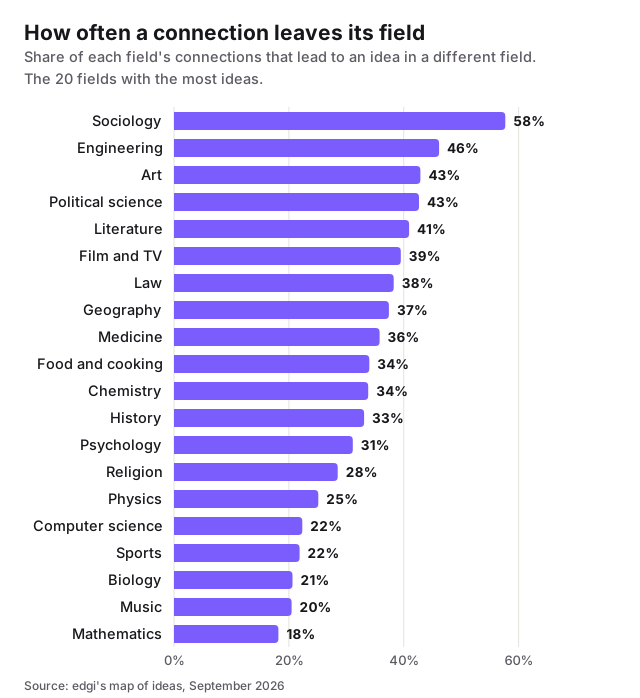
Among the 15 biggest fields, the pair with the fewest direct links is computer science and food. Across 296,000 connections, seven join them. Biology and medicine share 4,704.
How we measured this
We took every idea and connection in edgi's map as of September 30, 2026: 104,368 ideas and 296,487 connections, after dropping one duplicate. The connections are edgi's own, drawn to suggest what to learn next. They aren't Wikipedia's links, and a different map of the same ideas would give different numbers.
Steps are shortest paths, counted exactly. "Either direction" ignores which way a connection points; "forward" follows it. For random pairs we took 1,000 random starting ideas and measured the distance from each to every other idea, about 100 million pairs for each measure. A second, separate sample of 300 starting ideas agreed with the first to within 0.05 steps.
An idea's field is the first subject listed on it. There are 941 subject labels in all, and the charts use the most common. The farthest pairs and longest trips come from a search that finds very distant pairs but can't promise the most distant, so the true extremes may be a little longer. "Closest to everything" was checked for the 400 ideas with the most connections, not all 104,368. We checked each shortcut twice, and none has a shorter route.
The map grows as edgi adds ideas, so these numbers will drift.
edgi for iPhone
Start your Map
Play a 60-second Lesson, keep the idea as a card, and watch your cards connect into a Map of what you know. Free on iPhone.