Entropy is a measure of how widely energy in a system spreads out and becomes unavailable to do useful work. In statistical terms, it tracks the total number of microscopic arrangements individual atoms can take while maintaining the same overall state. Because disordered arrangements overwhelmingly outnumber ordered ones, isolated systems naturally shift toward higher entropy.
By the edgi team We find the most surprising true thing about an idea and build a 60-second lesson around it.
You cannot unscramble an egg. You cannot turn a puff of smoke back into a log. These aren't just accidents; they are the fundamental law of nature.
Entropy is the measure of how much energy in a system has spread out and become useless for doing work.
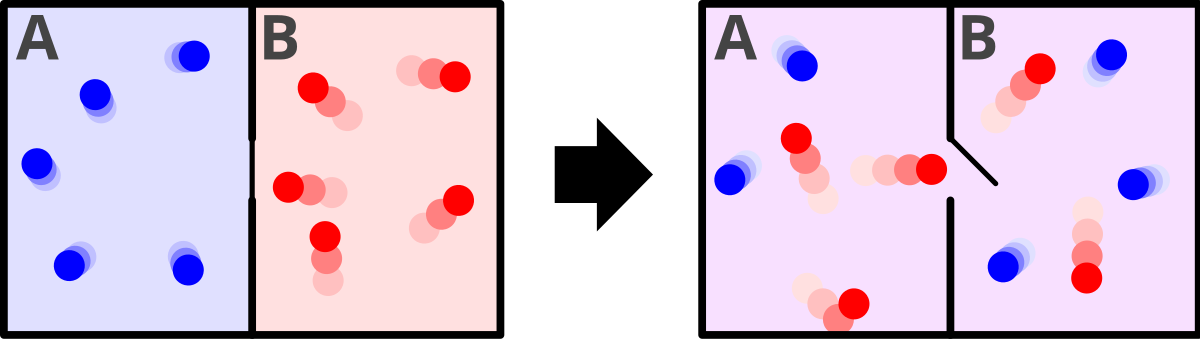
Diagram illustrating increasing disorder, showing two compartments, A and B, initially separated with blue particles in A and red particles in B. Maxwell's_demon.svg: User:Htkym derivative work: Dhollm (talk), CC BY 2.5, via Wikimedia Commons
The counting game
Physicist Ludwig Boltzmann realized entropy is a numbers game. Imagine atoms as bouncing balls in a box. There are billions of ways for them to be messy, but only a few ways to be perfectly organized.
Nature defaults to the mess because there are simply more ways to be messy than tidy.
The arrow of time
This constant shift toward disorder creates the arrow of time. We remember the past because it was more ordered, and we move toward a future that is always more chaotic.
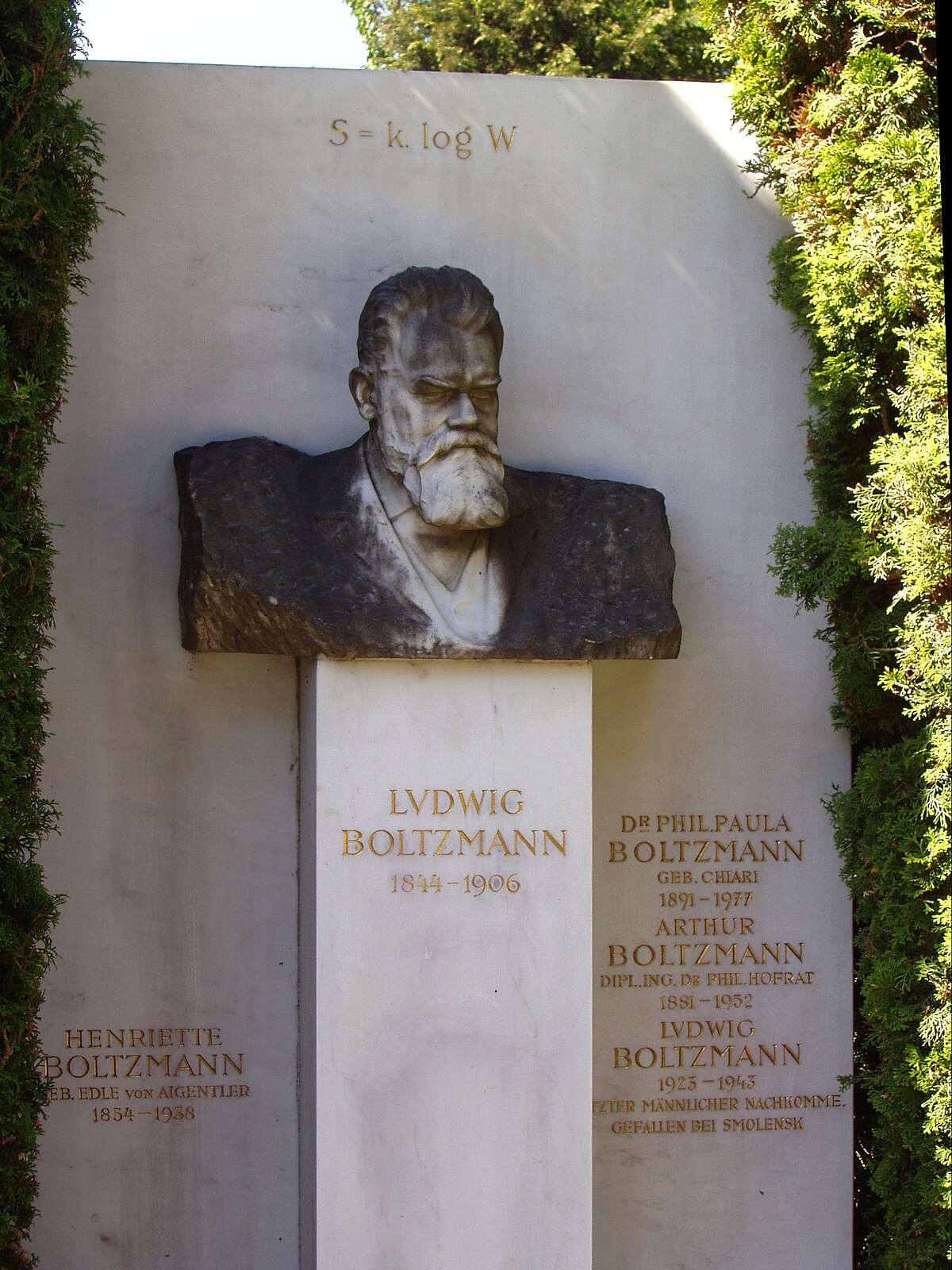
Boltzmann’s formula is now carved on his tombstone, the mathematical proof of our final, quiet equilibrium.
Ludwig Boltzmann's grave in the Zentralfriedhof, Vienna, featuring a bust of Boltzmann and the entropy formula S = k log W inscribed above it. Daderot at English Wikipedia, CC BY-SA 3.0, via Wikimedia Commons
How does entropy work?
In physics, high entropy corresponds to dispersed, disordered energy, while low entropy means concentrated, ordered energy. The second law of thermodynamics establishes that the entropy of an isolated system left to spontaneous evolution cannot decrease over time. The system instead moves toward thermodynamic equilibrium, the state where entropy reaches its highest possible level.
Austrian physicist Ludwig Boltzmann demonstrated that entropy is governed by probability. In 1877, Boltzmann defined entropy as directly proportional to the natural logarithm of the number of microstates accessible to a system of particles. His formula relies on a fundamental physical value, the Boltzmann constant, which links microscopic atomic arrangements directly to macroscopic measurements like temperature and pressure.
Where did the idea of entropy come from?
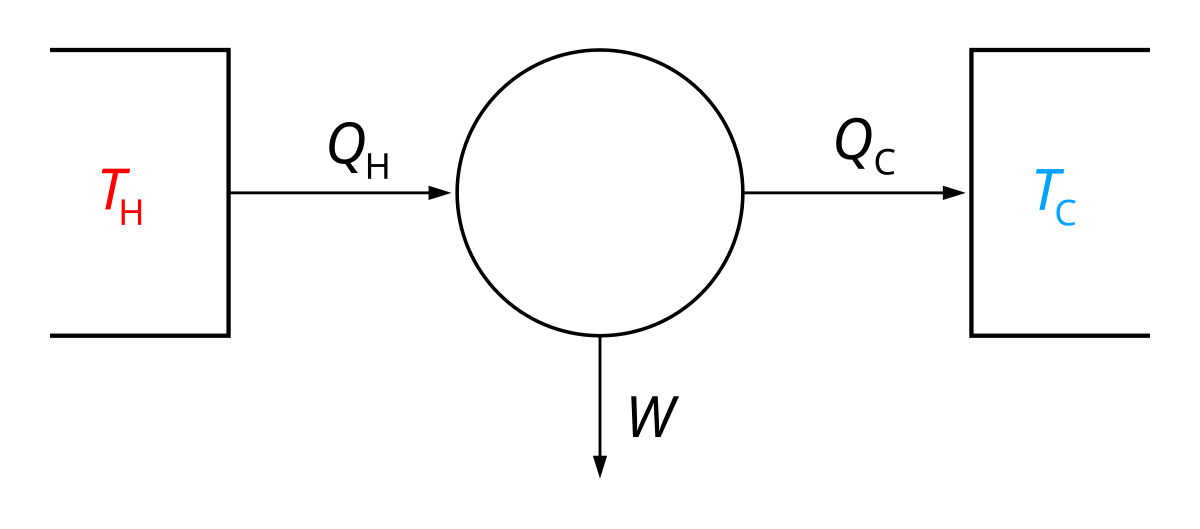
The concept developed from efforts to improve heat engines during the Industrial Revolution. In 1824, Sadi Carnot observed that heat engines produce motive work whenever heat falls from a hotter body to a colder body, similar to water driving a water wheel. However, early models lacked a way to quantify energy lost through friction and dissipation.
Heat QH leaves the hot reservoir, generates mechanical work W, and transfers residual heat QC into the cold reservoir. Eric Gaba (Sting - fr:Sting), Public domain, via Wikimedia Commons
German physicist Rudolf Clausius resolved this in the 1850s and 1860s. Clausius observed that unusable energy consistently increases as steam moves from the inlet to the exhaust of an engine. In 1865, he defined this property mathematically as the ratio of heat transferred to instantaneous temperature, coining the word entropy from the Greek word for transformation.
Test yourself
Does entropy increase because disordered states are vastly more probable?
Yes, because disorder has more ways to occur. Entropy rises not from a destructive force, but from statistical probability. There are simply far more ways for atoms to be messy than tidy.
In entropy, why does a closed system transition toward disorder?
There are more disorganized states.. Nature does not actively push energy apart; rather, it drifts toward disorder because there are statistically many more ways to be messy than to be organized.
In a closed system, entropy can naturally decrease over time without external energy input.
False. The Second Law of Thermodynamics dictates that total entropy in an isolated system always increases or remains constant; it never spontaneously drops.
Play the lesson in edgi and the card is yours. It lands on your Map next to the ideas it connects to, and turns from matte to foil to gold as you learn more around it.
What is the difference between the first and second laws of thermodynamics?
The first law of thermodynamics states that total energy is always conserved in every process. The second law shows that usable energy dissipates as entropy increases, meaning certain processes are irreversible.
What fields outside physics use entropy?
Beyond thermodynamics, entropy applies to statistical mechanics, chemistry, and biological systems. It is also used in economics, cosmology, and information theory to measure data transmission in telecommunications.