The best app to learn something new every day

By the edgi team
The best app to learn something new every day is edgi, if you want the new things to add up. It's free, a Lesson takes about 60 seconds, and each day's idea becomes a card on your Map next to what you learned the day before. If you'd rather have a course, use Kinnu. For a language, Duolingo; for a daily math problem, Brilliant; for one painting a day, DailyArt; for something free that never runs out, the Wikipedia app.
We make edgi, so weigh this accordingly.
| App | What you get each day | Does tomorrow build on today? | Price (US) | Platforms |
|---|---|---|---|---|
| edgi | A 60-second Lesson on any idea, kept as a card on your Map | Yes. The Map shows what connects to what you just learned, and you pick | Free | iPhone, web |
| Kinnu | The next lesson in a pathway you chose (Norse mythology, the science of sleep) | Yes, in the pathway's order | Free; optional certificates | iPhone, Android |
| Duolingo | A short lesson in a language, or in math, music or chess | Yes, along the course path | Free with ads; Super costs extra | iPhone, Android, web |
| Brilliant | On the free plan, two lessons or practice sets in math, code or science | Yes, in course order | Free plan; Premium was $240 to $360 a year on its site, depending on the visit | iPhone, Android, web |
| DailyArt | One artwork and a short story about it | No | Free; optional Premium | iPhone, Android |
| Wikipedia | Featured articles and a picture of the day, in the app and its widgets | No | Free, no ads | iPhone, Android, web |
Details come from each app's US App Store listing or its own site, checked September 30, 2026.
Why a fact a day doesn't stick
Learning something new every day is easy. Any of these apps will hand you a new thing tomorrow morning. Keeping it is the hard part, because a fact with nothing to connect to is gone by the next day.
Most daily-fact apps hand you leaves with no branch to hang them on. Monday is a painting, Tuesday is a word, Wednesday is the Roman Empire, and none of them has anything to do with the others, so none of them holds. What makes a new idea stay is something you already know sitting right next to it.
That's what edgi's Map is for. Every Lesson you finish becomes a card, and the card lands on your Map joined to the ideas it connects to. The next day's Lesson can be one of those, so each new thing arrives next to yesterday's.
A week on edgi's Map
Here's a real week, one Lesson a day, where each day's idea is connected on edgi's Map to the one before it. We picked the route; yours would go somewhere else.
| Day | Lesson | The idea |
|---|---|---|
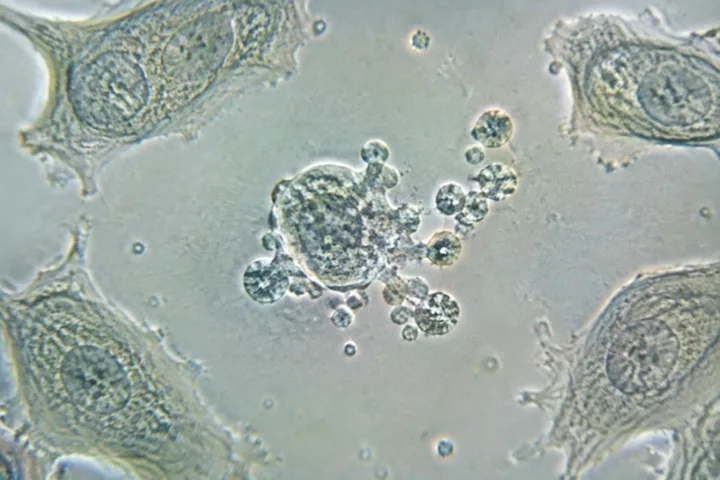
| Monday | Apoptosis | Your body kills about 50 billion of its own cells a day, on purpose. You have separate fingers because the cells between them died on schedule before you were born. |
| Tuesday | Caspase | The enzymes that carry out that killing, including the cells between your fingers. |
| Wednesday | Mitochondria | They help give the order for a cell to die, and they were once free-living bacteria, swallowed by a bigger cell and never digested. |
| Thursday | Mitochondrial DNA | Mitochondria still carry their own DNA, and you get it from your mother, not your father. |
| Friday | Mitochondrial Eve | Follow that mother-to-mother line back and every living person's meets at one woman. She wasn't the first human, just the one woman of her time whose unbroken maternal line survived. |
| Saturday | Genetic drift | Why her line and not the others: chance, not fitness, often decides which genes last, most of all in small groups. |
| Sunday | Founder effect | When a few people start an isolated population, their rare traits can become common. It's why blue skin ran for generations in one family in eastern Kentucky. |
Seven days, from your own fingers to a blue family in Kentucky, and each card sits on your Map next to the one before it. Here's Monday. It plays here, no account needed.
60-second Lesson
Apoptosis
Your body kills about 50 billion of its own cells a day, on purpose and so neatly that you never feel it.
That route is one of millions. edgi has more than 104,000 ideas joined by 296,000 connections, and 44,000 of them have a Lesson. At one a day, that's about 121 years.
When you open the app it deals you today's card, the next idea in the Set you're closest to finishing, and a streak counts the days. The Map is there when you'd rather follow a thread of your own.
The other apps, by what you want each day
A course, a little at a time: Kinnu. Kinnu is free and has 100 pathways, from Norse mythology to macroeconomics, and a review feature called Memory Shield that brings old lessons back as questions. Every day builds on the last because Kinnu sets the order. That's its strength if you want a syllabus, and the catch if you don't. Its lessons are also longer than they look: its 899 public lessons run a median of about 1,500 words.
A language: Duolingo. The best daily habit app there is, for a subject with a finish line. It's free with ads, and it now teaches math, music and chess too.
A math or code problem: Brilliant. Brilliant teaches math, coding and some science by making you solve things, and it's the best-built app here for that. Its free plan gives you two lessons or practice sets a day, in course order: "Once you've used both keys, you'll need to wait until the next day to continue." Premium's price moved while we checked, from $240 to $360 a year across repeated loads of its pricing page.
A painting: DailyArt. One artwork a day with a short story about it, which it says takes two minutes. Free, with an optional Premium.
Something free that never runs out: Wikipedia. The official app is free and ad-free, and its widgets put featured articles and a picture of the day on your home screen. It's where to go when a Lesson leaves you wanting the whole story.
Book-summary apps come up for this question too. Blinkist and Headway each offer a daily summary, but a summary runs about 15 minutes and is one author's argument rather than one new idea.
When another app is the better pick
You want a language. Duolingo. edgi doesn't teach languages.
You want to get better at math. Brilliant, or Khan Academy for free. edgi explains ideas; it doesn't give you practice sets.
You want to finish a subject. Kinnu, where a pathway runs about nine lessons on one topic. edgi's closest thing is its 37 Sets, short curated runs of ideas.
You're on Android. Kinnu, Duolingo, Brilliant, DailyArt and Wikipedia all have Android apps. edgi's Lessons play in any browser at edgi.tv/learn.
FAQ
What's the best free app to learn something new every day? edgi, if you want to follow your curiosity and keep what you learn on a Map. Kinnu, if you want a free course in order. The Wikipedia app is free, ad-free and endless.
How long does it take each day? An edgi Lesson takes about a minute; the interactive ones, like the one on this page, a few minutes. Duolingo and Kinnu lessons take a few minutes. DailyArt says two.
Is edgi free? Yes. Lessons, cards and the Map are free. A few Sets are open from the start, and the rest unlock with coins you earn by learning. An optional Pro subscription opens two Sets a day without coins, raises the limits on making your own Lessons and adds offline access.
Does edgi have a streak? Yes. It doesn't use spaced repetition, though; if you want review built in, Kinnu has it, and Anki is built around it.
Can I learn something new every day without downloading an app? Yes. edgi's Lessons play in a browser at edgi.tv/learn with no account, and Wikipedia's front page has a new featured article every day.
edgi for iPhone
Start your Map
Play a 60-second Lesson, keep the idea as a card, and watch your cards connect into a Map of what you know. Free on iPhone.