Behavioral EconomicsWhy real humans break rational models
Behavioral economics is the study of how psychological factors like emotions, social influences, and cognitive habits shape the economic decisions of people and institutions. Traditional economic models assume people act like purely rational calculators who always maximize their self-interest. Behavioral economics proves that human choices deviate systematically from these models due to natural mental shortcuts and bounded rationality.
By the edgi team We find the most surprising true thing about an idea and build a 60-second lesson around it.
Traditional economics builds models on the Homo Economicus, a perfectly rational, self-interested calculator. Behavioral economics realizes this person doesn't exist.
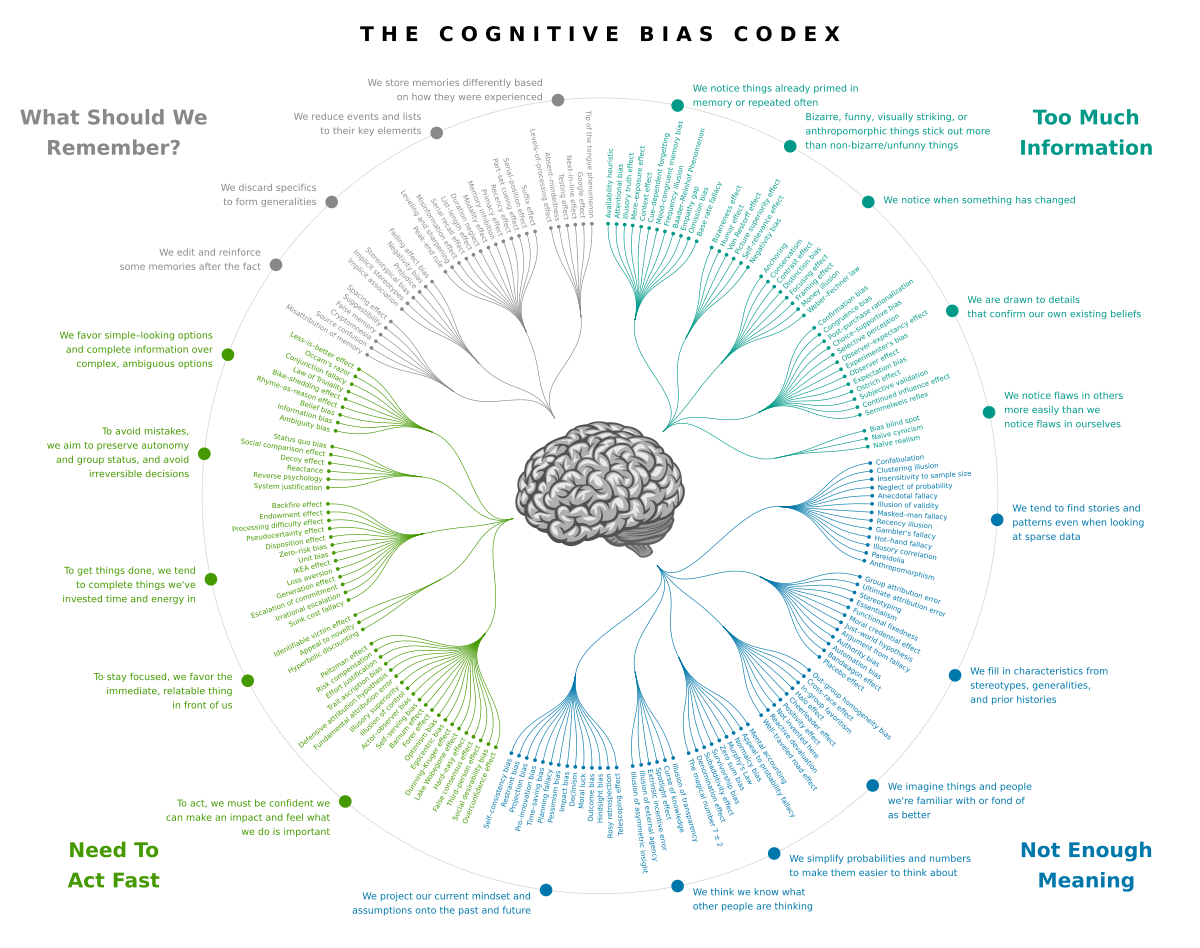
Instead, it studies the systematic, predictable ways our brains deviate from logic.
The Cognitive Bias Codex, a radial diagram illustrating various cognitive biases categorized by their underlying causes. design: John Manoogian III categories and descriptions: Buster Benson implementation: TilmannR, CC BY-SA 4.0, via Wikimedia Commons
The loss aversion
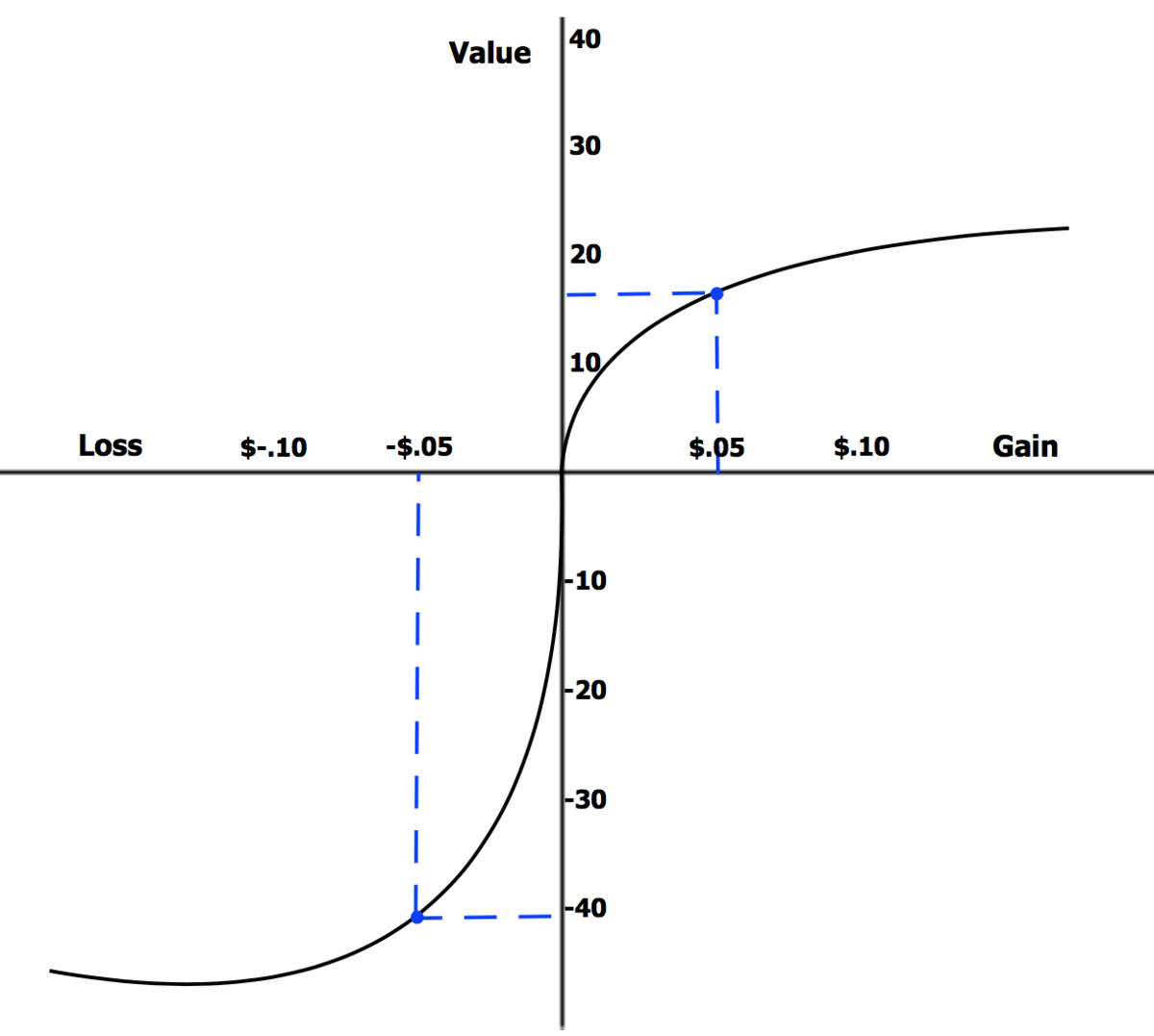
In the 1970s, psychologists Daniel Kahneman and Amos Tversky discovered a fundamental quirk called loss aversion. We feel the sting of losing $100 about twice as intensely as the joy of winning $100.
Graph illustrating loss aversion in prospect theory, plotting Value (Y-axis) against Loss and Gain (X-axis). Laurenrosenberger, CC BY-SA 4.0, via Wikimedia Commons
This explains why we hold onto losing investments too long or take reckless risks just to break even.
The nudge
Since we are predictably irrational, systems can be designed to guide us. This is Nudge theory.
By making the best choice, like saving for retirement, the default, we get better outcomes without forcing anyone's hand.
Why did economics abandon the purely rational model?
Early economists like Adam Smith, Jeremy Bentham, and Irving Fisher regularly used psychological explanations in their writing. In the early 1900s, economists removed psychology from their models. They worried that psychology was not scientific enough and that relying on it would undermine the mathematical foundation of their field.
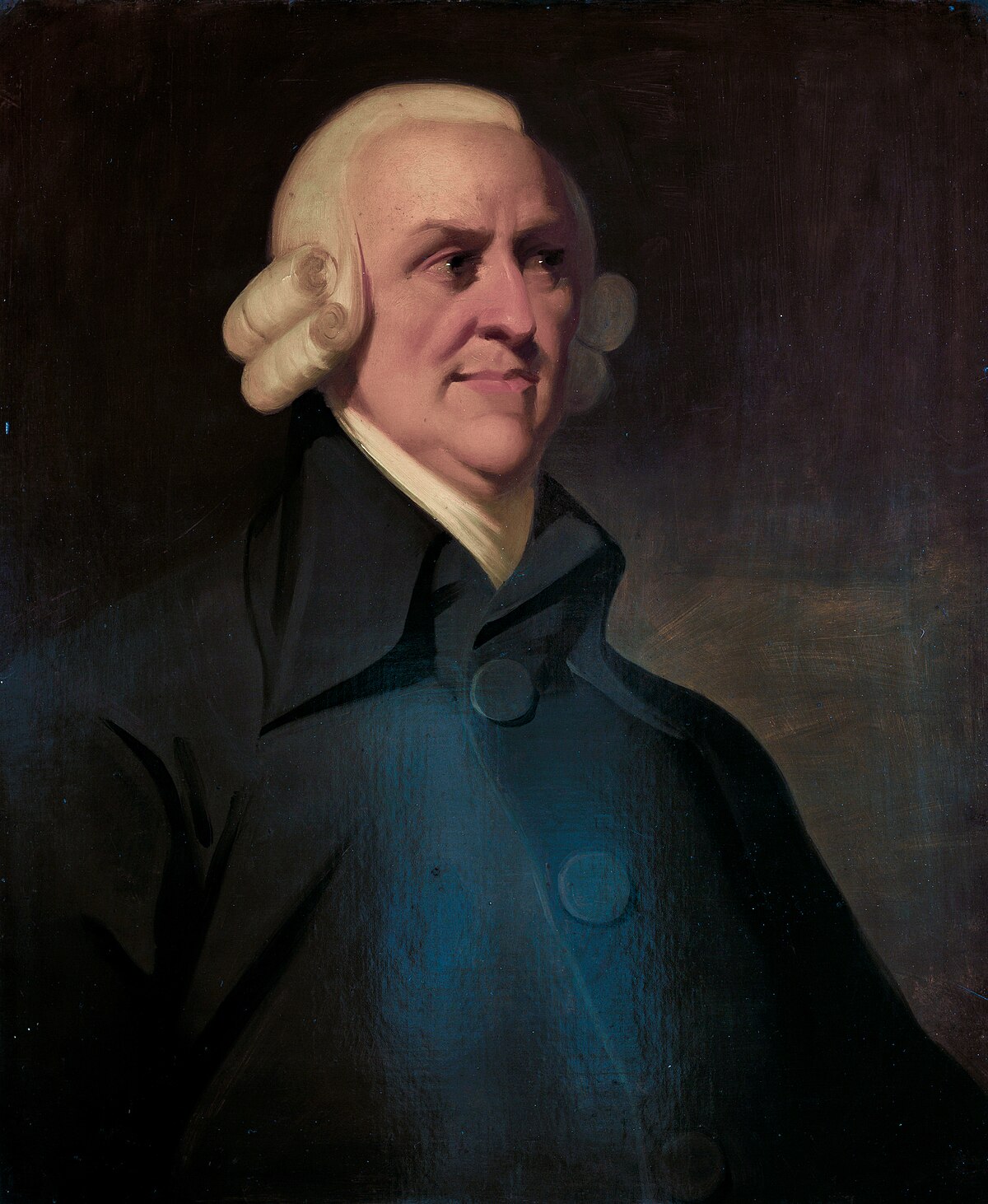
Adam Smith explored concepts like loss aversion in The Theory of Moral Sentiments long before modern behavioral economics formed. Unknown authorUnknown author, Public domain, via Wikimedia Commons
To make economics purely empirical, theorists invented the concept of Homo economicus: a hypothetical agent who calculates choices perfectly and acts only in self-interest. The cognitive revolution of the 1960s reversed this trend. Psychologists like Ward Edwards, Daniel Kahneman, and Amos Tversky began comparing cognitive models of decision-making under risk against traditional economic assumptions, showing that real human choices consistently violate pure economic logic.
What is bounded rationality?
Bounded rationality is the concept that human decision-making is restricted by cognitive limitations, available time, and the sheer difficulty of the problem. Herbert A. Simon proposed bounded rationality as an alternative to the traditional idea that people optimize every choice.
Herbert A. Simon formulated bounded rationality to explain why humans settle for acceptable outcomes instead of calculating optimal solutions. Richard Rappaport [3] [4], CC BY 3.0, via Wikimedia Commons
Simon compared decision-making to a pair of scissors: one blade is human cognitive limits, and the other is the structure of the surrounding environment. Because people cannot spend endless time assessing every possible choice, they rely on mental shortcuts and choose acceptable solutions rather than optimal ones. Modern behavioral economists map these shortcuts to understand when human choices become suboptimal.
How do behavioral insights change public choice design?
Because people rely on mental shortcuts, the way options are presented heavily influences their choices. Cass Sunstein and Richard Thaler introduced this practical application as Nudge theory, arguing that choice architectures can be modified to account for bounded rationality.
One classic proposal involves placing healthier food at eye level in cafeterias, which increases the likelihood that a person picks it over less healthy alternatives. Nudging guides human decisions toward better long-term outcomes, such as saving for retirement or eating healthier, without explicitly forcing anyone to choose them.
Test yourself
You find a $100 bill on the street, then drop and lose one of your own $100 bills. How do you feel?
The loss hurts more than the find helped. Human brains are wired for loss aversion. The psychological sting of a loss hits us about twice as hard as the equal thrill of a gain.
Our emotional reaction to losing money is equal to our joy in winning it.
False. Human psychology is asymmetric. Because we feel the sting of a loss roughly twice as intensely as the gain of an equal amount, we are hardwired to prioritize avoiding losses over seeking wins.
What does behavioral economics examine?
Psychological influences on economic decisions. Behavioral economics studies how psychological, cognitive, and social factors influence economic decisions, often leading to non-rational behavior.
Play the lesson in edgi and the card is yours. It lands on your Map next to the ideas it connects to, and turns from matte to foil to gold as you learn more around it.
Loss aversion is a cognitive bias discovered by Daniel Kahneman and Amos Tversky showing that people feel the pain of a loss roughly twice as intensely as the pleasure of an equivalent gain. This asymmetry causes individuals to hold onto losing assets or take risky gambles to avoid locking in a loss.
What fields does behavioral economics combine?
Behavioral economics integrates insights from psychology, neuroscience, and microeconomic theory. It also uses concepts from mathematical psychology to study utility and preference transitivity.