Prospect theoryWhy losing hurts twice as much as winning
Prospect theory is an economic theory describing how real people make decisions involving risk and uncertainty. Instead of maximizing absolute wealth, people evaluate choices as gains or losses relative to their current neutral reference point. Because the psychological pain of a loss is far steeper than the pleasure of an equivalent gain, people become cautious when protecting gains but take reckless gambles to avoid losses.
By the edgi team We find the most surprising true thing about an idea and build a 60-second lesson around it.
Here is a choice. A sure $750, or a 75 percent chance at $1,000 with a 25 percent chance of nothing. Most people take the sure $750. Now the same shape in reverse. A sure loss of $750, or a 75 percent chance of losing $1,000 with a 25 percent chance of losing nothing. Most people gamble.
Both pairs are worth exactly the same on paper. Three quarters of a thousand is seven hundred and fifty, whichever direction the money is running. So the sure thing wins in one version and loses in the other, from the same person, minutes apart. Cautious about gains, reckless about losses.
Why it flips
Losses hurt on a curve. Going from nothing lost to $100 lost is brutal. Going from $900 lost to $1,000 lost barely registers. So a certain $750 loss already hurts nearly as much as the full $1,000 would.
Which makes the gamble cheap. You risk $1,000 instead of $750 for pain that is barely worse, and you buy a one-in-four chance of losing nothing at all. Gains run on the same curve. The first $750 delivers most of the pleasure $1,000 would, so risking all of it to chase the last $250 is a bad trade.
That is prospect theory. Value in your head bends instead of running straight, and it bends more steeply on the losing side, which is what people mean by loss aversion.
The same facts, two sets of words
In 1981 Tversky and Kahneman described an outbreak expected to kill 600 people, and offered two ways to handle it. The safe plan saves 200 for certain. The gamble has a one-in-three chance of saving all 600 and a two-in-three chance of saving nobody. 72 percent took the safe plan.
A second group got the same two plans in different words. The safe plan: 400 people die. The gamble: one-in-three that nobody dies, two-in-three that all 600 do. Now 78 percent gambled. It is the same safe plan in both versions, and the same gamble. All that moved was whether the sentence counted the living or the dead, which is what decides gain or loss.
How the value curve bends
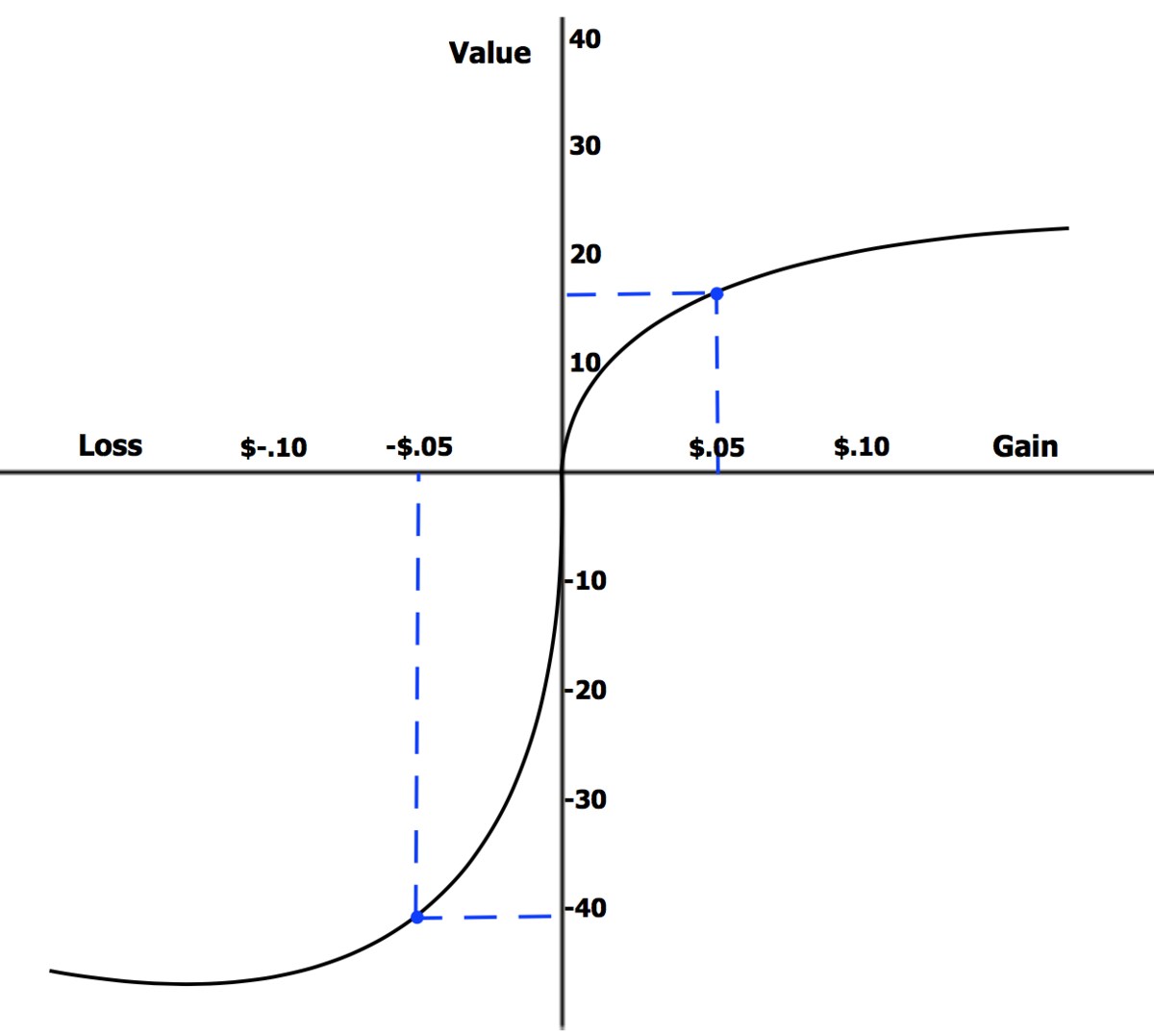
For some people, the pain of losing $1,000 can only be balanced out by the pleasure of gaining $2,000. Daniel Kahneman and Amos Tversky showed in 1979 that human value functions are asymmetrical and shaped like an S. The curve is concave for gains and convex for losses.
Notice how the S-shaped value curve is steeper below the neutral reference point, making losses feel more intense than equivalent gains. Laurenrosenberger, CC BY-SA 4.0, via Wikimedia Commons
Because of these curves, people experience diminishing sensitivity. Going from zero to a $100 loss feels brutal, but the gap between $900 and $1,000 barely registers. When choosing between guaranteed gains and risky gains, people prefer the sure thing. When faced with losses, people actively seek risk, gambling on a chance to lose nothing even if the expected outcome is worse.
How people evaluate risky choices
Decisions happen in two distinct stages: editing and evaluation. In the editing phase, a person sets a baseline reference point and codes potential outcomes as gains or losses while simplifying the options. In the evaluation phase, the person computes an overall value by combining their personal value of each outcome with a transformed probability.
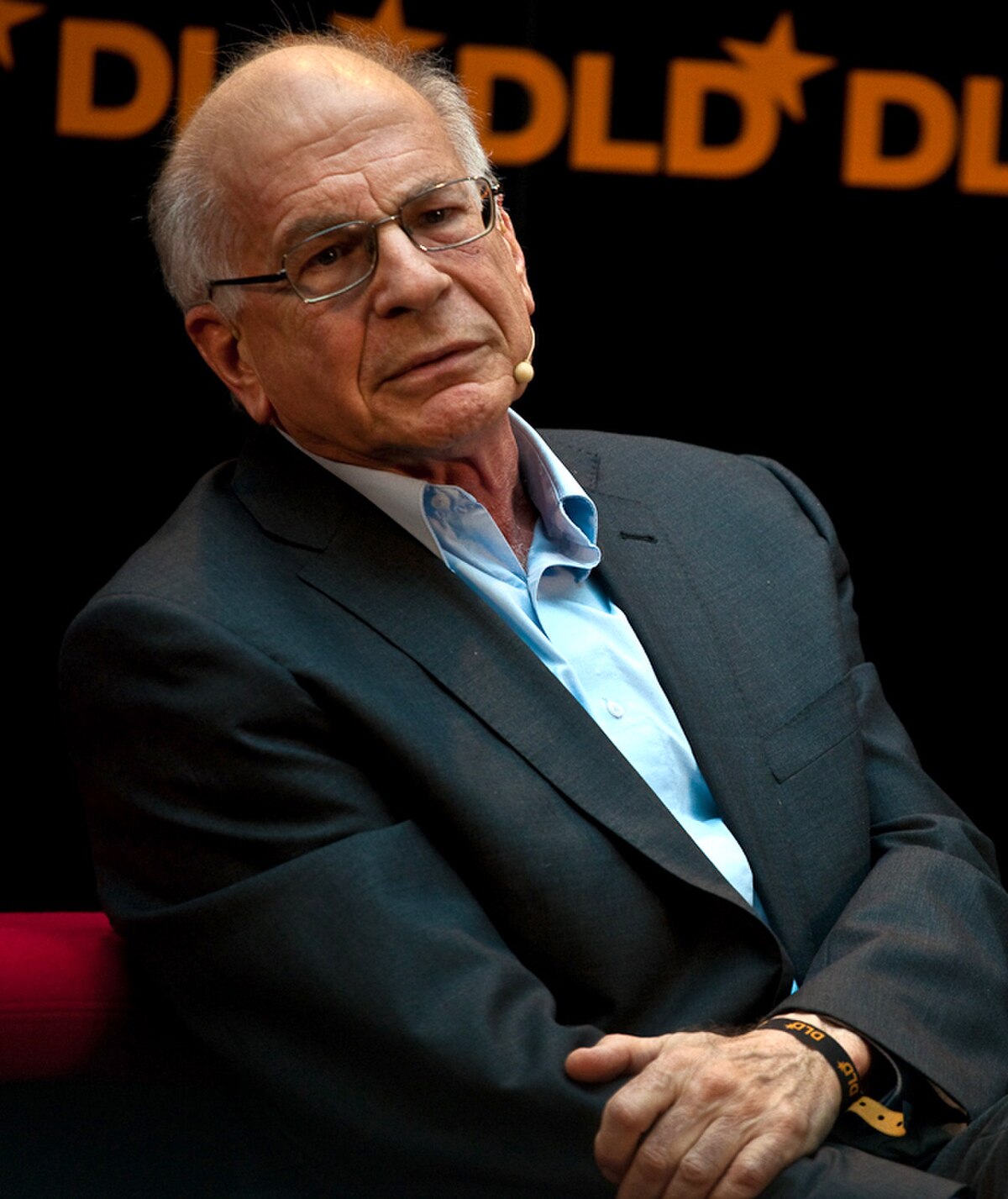
Daniel Kahneman was awarded the 2002 Nobel Memorial Prize in Economics for his experimental research developing prospect theory. nrkbeta, CC BY-SA 2.0, via Wikimedia Commons
People do not treat odds straight. They assign excessive weight to very rare events, treating a 1 percent chance as if it were 5 percent. At the same time, they underweight high-probability events, treating a 99 percent certainty as if it were 95 percent. This distortion changes how lottery-style bets and safety decisions are made.
Test yourself
Does prospect theory predict people are risk-seeking for gains?
No. Prospect theory shows people prefer certainty for gains because the first increments of value bring the most psychological pleasure.
How does framing a choice as a loss rather than a gain typically affect human risk-taking?
It makes people more reckless.. Because losses hurt on a steep curve, people will gamble to avoid a certain loss, shifting from cautious to reckless.
A board can cut 300 jobs for certain, or gamble on 900 or none. Which wins?
The gamble, because a certain 300 already hurts nearly as much as 900. Both cost 300 jobs on average, so the arithmetic cannot choose between them. What chooses is that the certain option is already most of the pain, which makes the extra 600 cheap to risk and the chance of losing nobody expensive to pass up.
Play the lesson in edgi and the card is yours. It lands on your Map next to the ideas it connects to, and turns from matte to foil to gold as you learn more around it.
It challenged expected utility theory, which John von Neumann and Oskar Morgenstern developed in 1944. Expected utility assumed perfectly rational agents measure outcomes by absolute wealth, whereas prospect theory describes how real people behave using experimental methods.
Why is it called prospect theory?
Kahneman and Tversky initially used the name Value Theory in a 1976 draft. They later changed it to Prospect Theory, referring to the predictable outcomes of a lottery, though Kahneman later called the new title meaningless.