Misdirection is a theatrical technique where a performer leads the audience's attention toward one thing to keep them from noticing another. Rather than relying purely on speed or mechanical tricks, it exploits human cognitive limits because the brain can only concentrate on one thing at a time. By guiding where people look and what they think, magicians create the illusion of impossible events.
By the edgi team We find the most surprising true thing about an idea and build a 60-second lesson around it.
The legendary magician Tony Slydini mastered deception by noticing a simple biological rule: the eyes follow the eyes. He discovered that if he looked intensely at his right hand, the audience would instinctively look there too.
That left his other hand completely free to move right in front of the audience without drawing a glance.
The french drop
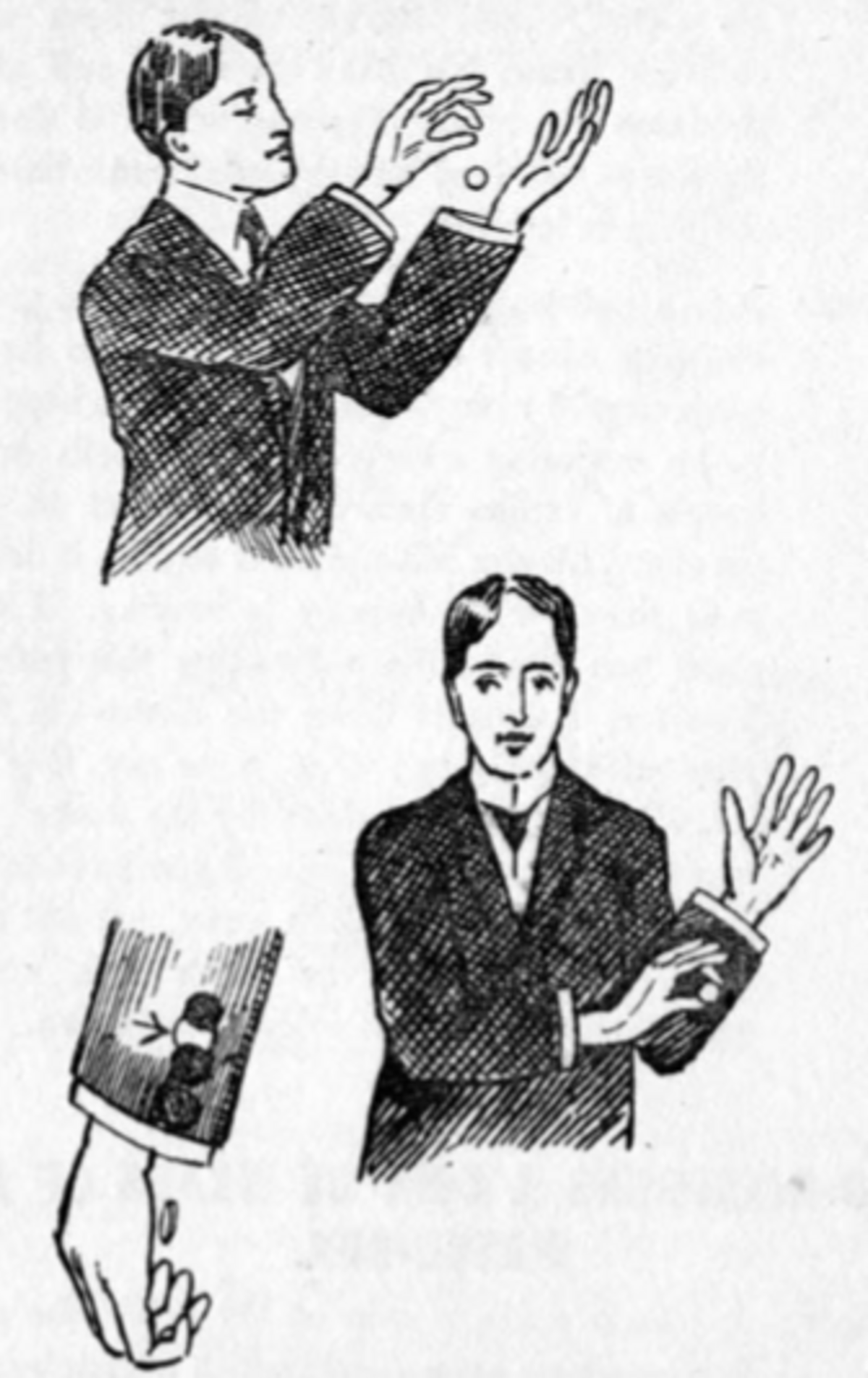
Slydini used this principle to perfect the French Drop, a classic sleight of hand move. He appears to take a coin from one hand into the other, closing his fingers around it.
In reality, the coin never moves; it stays quietly behind in the first hand while everyone stares at the empty fingers.
A diagram illustrates Will Goldston's magic trick of passing a coin through a sleeve, showing three stages: a man holding a coin above his hands, the man with his hands near his sleeve, and a… Will Goldston, Public domain, via Wikimedia Commons
The real secret
Whether performing close-up magic at a table or large stage magic for thousands, the secret is never just speed. It works because of cognitive bias, which exploits your brain's tendency to fill in the gaps of what you think you saw.
Illusionist David Blaine performs magic for President Barack Obama at the White House in 2016. David Blaine's assistant, CC BY-SA 4.0, via Wikimedia Commons
How misdirection works
Misdirection operates in two basic ways. The first method physically leads spectators to look away for a split second, allowing the performer to execute a secret sleight or move unseen. The second re-frames how the audience thinks, convincing them that an irrelevant detail or prop, such as a magic wand, is responsible for the effect when it has no actual role.
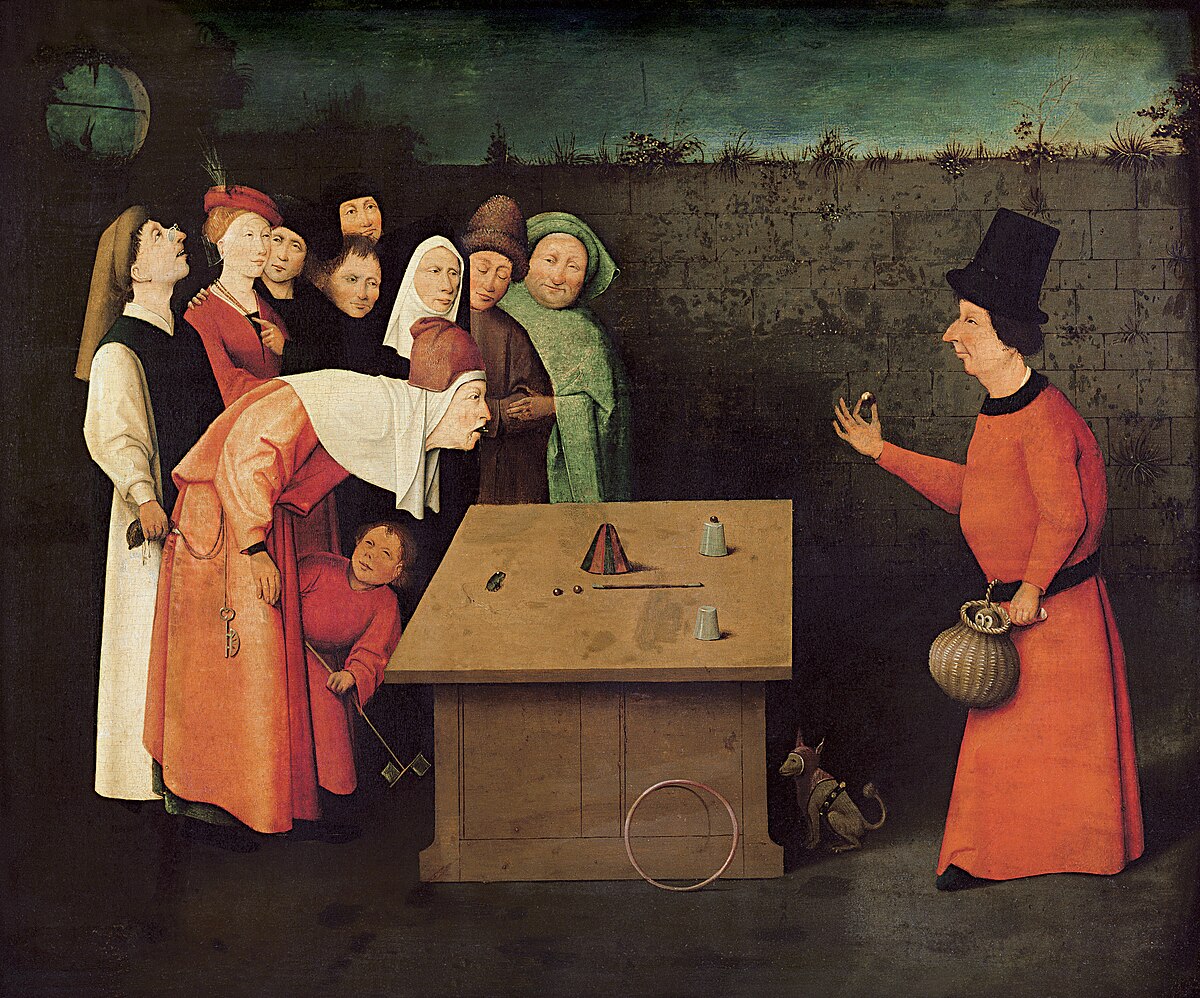
Hieronymus Bosch's painting The Conjurer shows a thief pickpocketing a spectator whose attention is entirely fixed on the magician's trick. Hieronymus Bosch and workshop / Workshop of Hieronymus Bosch / After Hieronymus Bosch, Public domain, via Wikimedia Commons
The technique depends on manipulating interest, speech (known as patter), and sensory limits. As writer T.A. Waters observed, even skilled sleight of hand fails without misdirection because spectators need to form a false mental picture and memory of what took place. Magician Tommy Wonder argued that performers should think of it positively as directing attention toward a chosen focal point rather than just pointing away from a secret.
Misdirection beyond the stage
The mechanics of theatrical deception closely mirror tactics found in warfare. Authors Eric Evans and Nowlin Craver linked magical deception directly to Sun Tzu's Art of War, noting that traditional military strategies provide blueprints for controlling an opponent's perception.
This connection became practical reality in World War II. British military intelligence employed stage magician Jasper Maskelyne to design real-world deceptions, including military camouflage and ruses to mislead enemy forces.
Test yourself
In magic misdirection, what chiefly makes a hidden move go unnoticed?
Attention is drawn elsewhere.. Misdirection guides attention toward a meaningful action, leaving the audience less likely to notice the hidden move; speed alone is not the secret.
In misdirection, the audience fails to see the trick because the hand movement is too fast for the eye to follow.
False. Misdirection works by exploiting where you choose to look, not by moving faster than your eyes can track. The performer guides your focus, making the secret action invisible even in plain sight.
Play the lesson in edgi and the card is yours. It lands on your Map next to the ideas it connects to, and turns from matte to foil to gold as you learn more around it.
What is the difference between direction and misdirection?
Magician Arthur Buckley noted that direction sounds positive while misdirection sounds negative, but both describe the same process. When a performer directs an audience's attention toward a false action, they have misdirected them into believing something that did not happen.
Which famous magicians helped develop modern misdirection?
Key figures who refined misdirection techniques include Tony Slydini, Dai Vernon, Max Malini, John Ramsay, Tommy Wonder, Juan Tamariz, and Derren Brown.