Cognitive BiasWhy the brain trades accuracy for speed
A cognitive bias is a predictable, systematic pattern where human judgment veers away from objective logic or probability. It happens because the brain relies on mental shortcuts called heuristics to make fast choices under pressure. Instead of acting as neutral recording devices, our minds create a subjective reality that often values speed over factual accuracy.
By the edgi team We find the most surprising true thing about an idea and build a 60-second lesson around it.
Your brain is not a high-fidelity camera recording the world; it is a rapid-fire storytelling machine. It doesn't care if your assessment is perfectly true; it cares if it is fast enough to keep you alive.
To save energy, it uses heuristics, or mental shortcuts, to process complex information instantly.
The shark paradox
This efficiency creates a problem called the availability heuristic: we judge danger by how easily we remember it, not by the actual statistics. You likely fear shark attacks because they are vivid and terrifying in the news, even though falling coconuts statistically kill far more people.
A cluster of green coconuts hangs from a coconut palm tree, surrounded by fronds. Judgefloro, CC BY-SA 4.0, via Wikimedia Commons
Your brain creates a subjective reality where 'memorable' equals 'likely,' leaving you blind to the boring, cold math of true risk.
The systematic glitch
In the 1970s, psychologists Daniel Kahneman and Amos Tversky discovered that these aren't just random mistakes; they are predictable, systematic patterns. They proved that even experts fall for these biases when under pressure, thanks to the brain's dual process theory, a split between fast, intuitive thinking and slow, logical analysis.
Portrait of Daniel Kahneman, an elderly man with glasses, wearing a dark suit and a light blue shirt, looking towards the left of the frame. nrkbeta, CC BY-SA 2.0, via Wikimedia Commons
You cannot turn these biases off, but knowing they exist is the only way to catch your brain when it is hallucinating.
Why does the brain rely on cognitive biases?
Human information processing has physical limits. To make choices under uncertainty without burning excess time and energy, the brain relies on heuristics, which are quick rules of thumb.
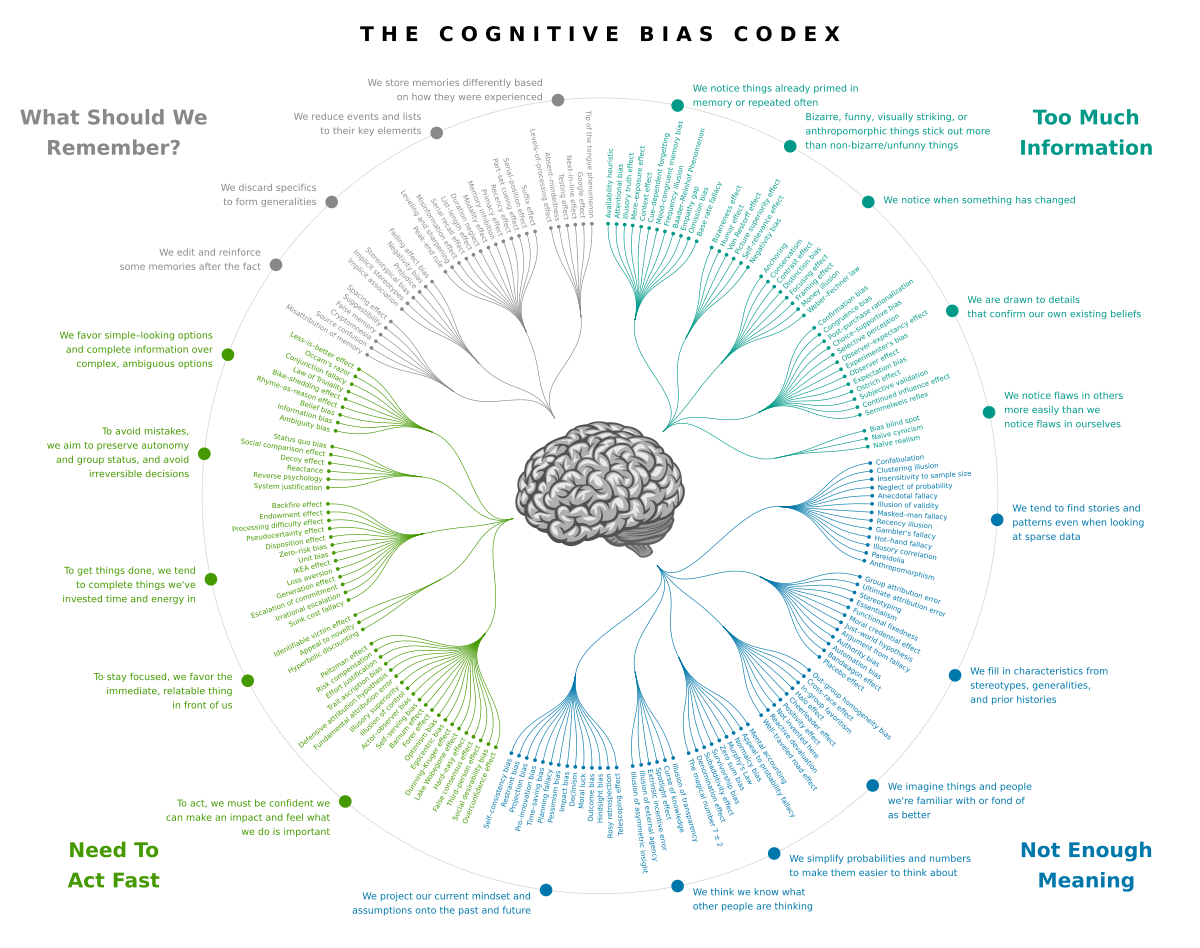
The Cognitive Bias Codex organizes the vast collection of predictable mental shortcuts and systematic errors identified by researchers. design: John Manoogian III categories and descriptions: Buster Benson implementation: TilmannR, CC BY-SA 4.0, via Wikimedia Commons
These shortcuts provide swift estimates when timeliness is more valuable than precision. Amos Tversky and Daniel Kahneman introduced the concept in 1972 after observing people's innumeracy, which is an inability to reason intuitively about large numbers and statistical probabilities. In dual process theory, fast and intuitive thinking handles rapid responses, but it frequently misjudges cold statistical facts.
Researchers Martie Haselton and David Buss pointed out that evolution favors a bias toward whichever error costs less to survive. While these patterns help people act quickly, they also lead to systematic errors, perceptual distortions, and an inclination to accept pseudoscientific claims that confirm existing preconceptions.
What are common examples of cognitive biases?
In the Linda Problem, participants read about an outspoken woman concerned with social justice, then chose whether she was more likely to be a bank teller, or a bank teller active in the feminist movement. Most chose the second option, violating basic probability rules because a single condition is always statistically more probable than two conditions combined.
This error is called the conjunction fallacy, driven by the representativeness heuristic. People judge how likely an event is based on how closely it resembles a typical case or stereotype rather than looking at real odds.
Other common biases stem from different shortcuts. The availability heuristic leads individuals to judge likelihood by how easily an example comes to mind, such as fearing rare shark encounters over common hazards. The anchoring heuristic causes people to rely too heavily on the very first piece of information they recall when evaluating an option.
Are cognitive biases always defects?
Not all researchers view cognitive biases as cognitive flaws. Psychologist Gerd Gigerenzer argued against the Kahneman and Tversky model, sparking what psychologists call a rationality war.
Gigerenzer proposes that heuristics are adaptive gut feelings that produce effective real-world decisions rather than broken logic. Advances in economics and cognitive neuroscience suggest that many behaviors labeled as biases can represent optimal decision-making strategies when applied to natural environments.
Test yourself
Does the availability heuristic judge risk by statistical reality or ease of memory?
Ease of memory. The availability heuristic measures danger by how easily an event comes to mind rather than cold math, leading us to fear vivid threats over common ones.
In the context of the availability heuristic, how does the brain judge risk?
By how easily examples are recalled. The brain relies on the availability heuristic to judge frequency by the ease of memory retrieval rather than objective data. This creates an illusion of risk based on vividness rather than reality.
Intelligence makes a person immune to cognitive biases.
False. Cognitive biases are inherent to human thinking and affect experts and novices alike.
Play the lesson in edgi and the card is yours. It lands on your Map next to the ideas it connects to, and turns from matte to foil to gold as you learn more around it.
Introduced by researchers Koster, Fox, and MacLeod in 2009, cognitive bias modification uses computer-based attention training and behavioral tasks. Its purpose is to train the brain to reduce maladaptive cognitive habits.
What fields study cognitive bias?
Cognitive biases are studied across cognitive science, social psychology, and behavioral economics. The findings apply directly to practical work in medicine, political science, entrepreneurship, management, and finance.
What is the sunk cost fallacy?
The sunk cost fallacy is a decision-making bias where past investments of time, effort, or money improperly dictate future choices. It alters an individual's evaluation of which current option is most desirable.