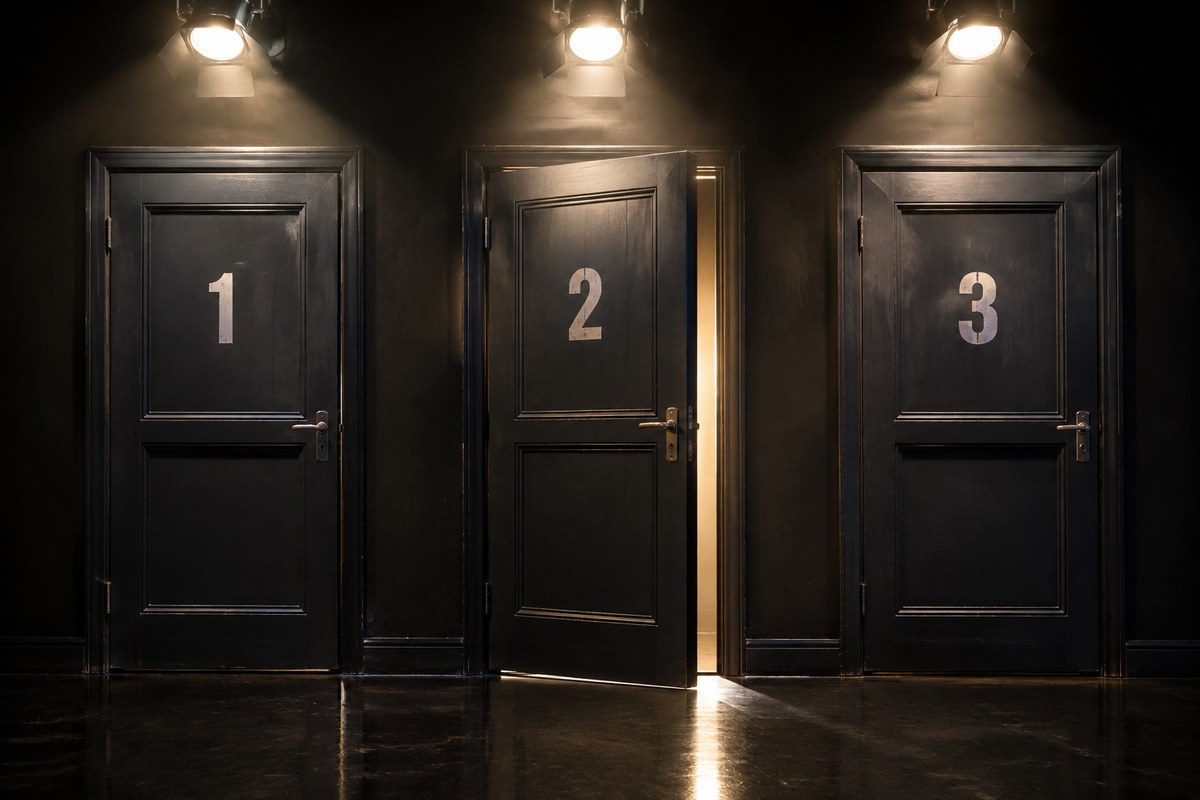
The game show trap
Imagine three doors. Behind one is a car; behind the other two are goats. You pick door one. The host, Monty Hall, opens door three to reveal a goat. He then asks: do you want to switch to door two?
The Monty Hall problem is a probability puzzle where a game show contestant picks one of three doors, after which the host reveals a goat behind an unchosen door and offers a switch. Switching to the remaining unopened door doubles your odds of winning the car from one in three to two in three. It is a veridical paradox, meaning the correct result feels absurd but is mathematically true.

By the edgi team We find the most surprising true thing about an idea and build a 60-second lesson around it.
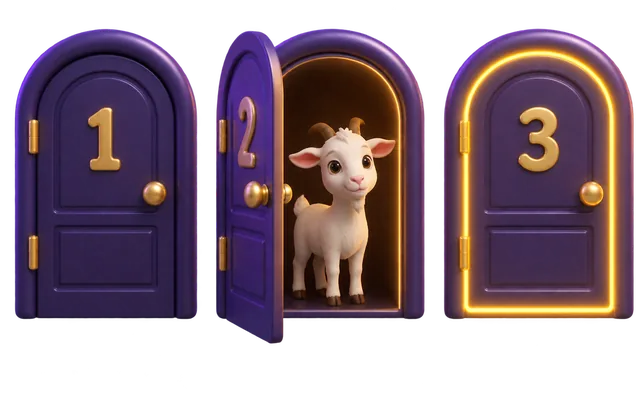
Imagine three doors. Behind one is a car; behind the other two are goats. You pick door one. The host, Monty Hall, opens door three to reveal a goat. He then asks: do you want to switch to door two?
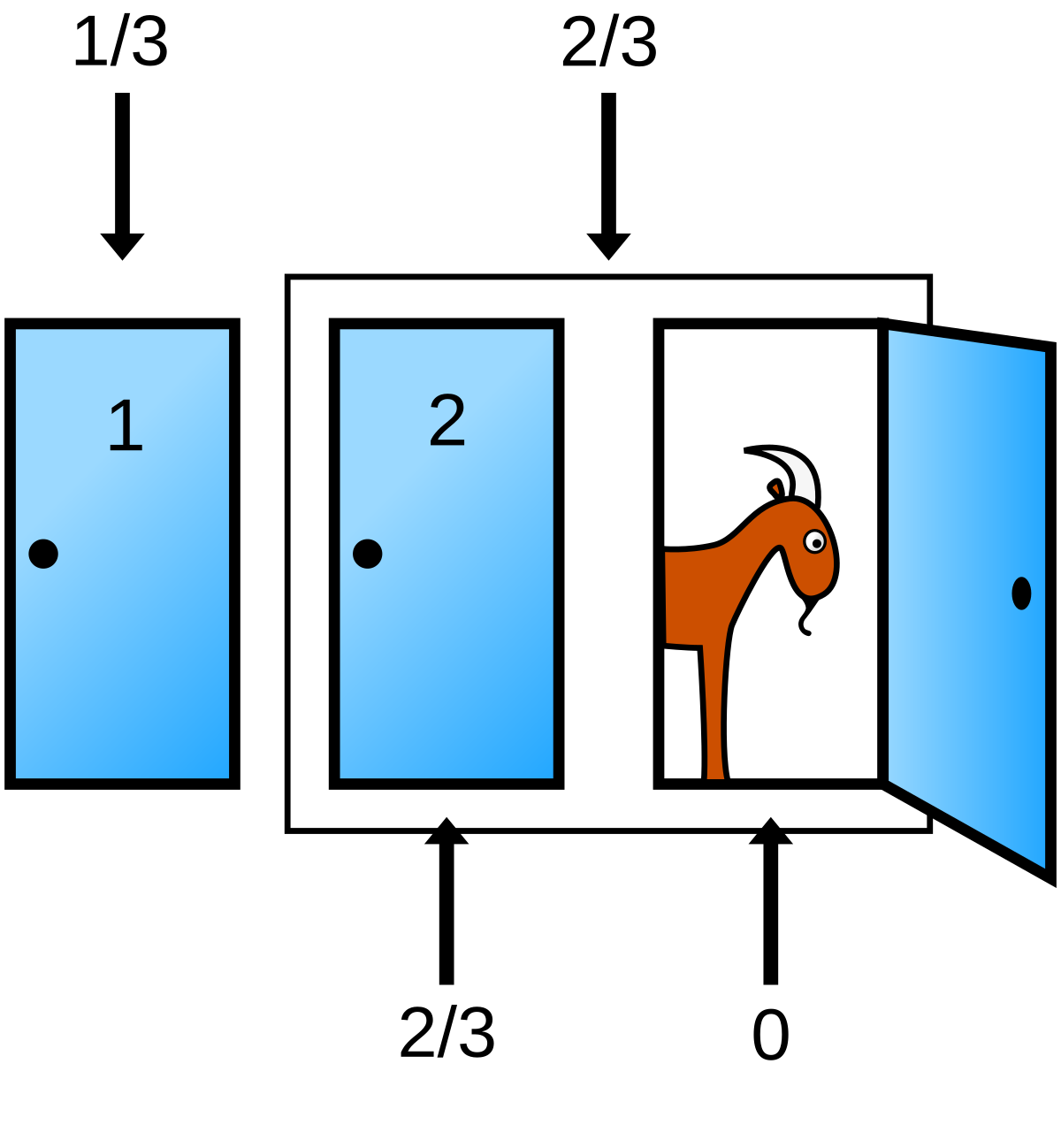
Your initial pick had a one-in-three chance of being correct. That probability does not magically improve just because a goat was shown. The unopened door you didn't pick now inherits the combined two-in-three probability of the entire group you initially ignored.
In 1990, columnist Marilyn vos Savant explained this counter-intuitive logic to her readers, sparking a national outcry. Nearly one thousand people with PhDs wrote in to tell her she was wrong, accusing her of spreading mathematical illiteracy until computer simulations proved her right.
Your first pick has a 1/3 chance of hiding the car and a 2/3 chance of hiding a goat. Because the host knows where the prize is, he must always open an unchosen door that holds a goat. He cannot reveal the car.
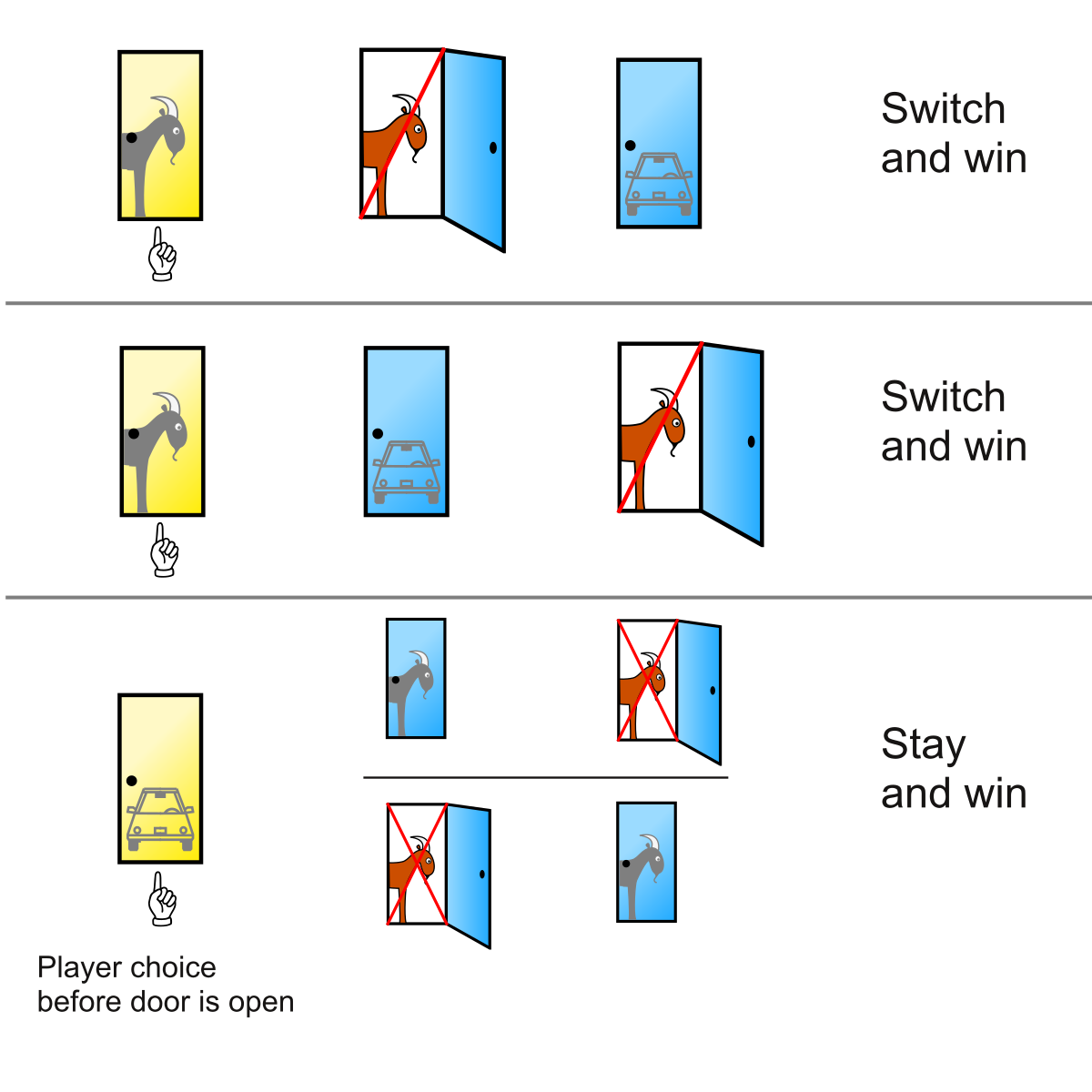
If you initially chose a goat, switching guarantees you win the car, because the host has already eliminated the only other goat. Since you pick a goat two out of three times on your first turn, switching wins the car two out of three times.
Most people assume the final two unopened doors share an equal 50% probability. That would only be true if the host opened a door at random without knowing where the car was.
The host's deliberate action channels information into the game. Marilyn vos Savant clarified this by proposing a game with one million doors. If you pick door 1 and the host opens 999,998 doors to leave only door 777,777, the host has concentrated the combined probability of all other doors into that single unpicked option.
Steve Selvin first posed the puzzle in 1975 in a letter to the American Statistician, naming it after game show host Monty Hall from Let's Make a Deal. The problem is mathematically equivalent to the older Three Prisoners problem and Bertrand's box paradox.
When Marilyn vos Savant published the solution in Parade magazine in 1990, roughly 10,000 readers wrote in to protest, including nearly 1,000 with PhDs. Even Paul Erdős, one of history's most prolific mathematicians, refused to believe the switching strategy worked until colleagues ran a computer simulation to prove it.
Collectible card
Play the lesson in edgi and the card is yours. It lands on your Map next to the ideas it connects to, and turns from matte to foil to gold as you learn more around it.
The host must always open a door the player did not pick, must always reveal a goat instead of the car, and must always offer the option to switch. If the host acts randomly or only offers switches under certain conditions, the math changes.
The Monty Hall problem is equivalent to the Three Prisoners problem published by Martin Gardner in 1959. It also shares the same mathematical structure as the Three Shells problem and Bertrand's box paradox.
Lesson complete
You finished the lesson. In edgi, the card goes on your Map next to everything else you learn.