Social psychology is the scientific study of how people's thoughts, feelings, and behaviors change because of the real, imagined, or implied presence of others. It focuses on the clash between a person's inner mental state and their external social situation. Researchers show that people constantly adjust their beliefs and actions to fit social groups, sometimes ignoring their own direct observations.
By the edgi team We find the most surprising true thing about an idea and build a 60-second lesson around it.
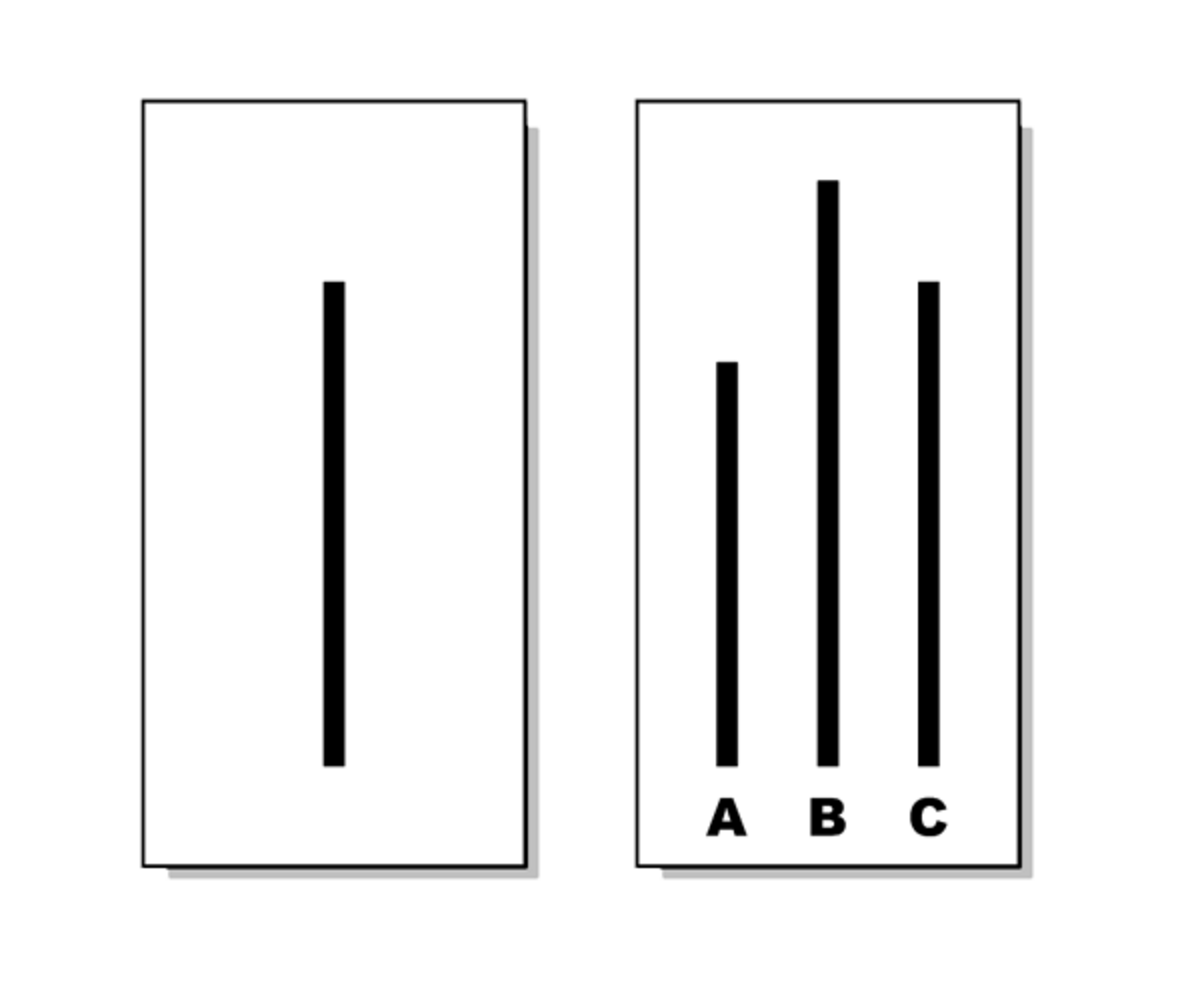
In 1951, psychologist Solomon Asch ran a famous experiment on the power of the crowd. He asked people to identify which of three lines was the longest, but surrounded them with actors who purposefully gave the wrong answer.
75% of the real participants ignored their own eyes and agreed with the group at least once. They chose social approval over visual reality.
The evolutionary glitch
Why would we lie about what we see? We evolved to prioritize social belonging over objective truth. For our ancestors, being ostracized from the group was a death sentence. Our brains still treat social rejection as a physical threat.
We aren't failing to think for ourselves; we are successfully calibrating to the tribe.
The social mirror
This is the core of Social psychology: the scientific study of how your thoughts and behaviors shift based on who is watching. It explains why you feel smarter in one group and act differently in a crowd of strangers.
Stylized illustration of five figures, four seated at a table and one standing, representing a group or society. Original: MisterMatt Vector: MesserWoland, CC BY-SA 3.0, via Wikimedia Commons
We are constantly, subconsciously adjusting our personality to fit the social architecture around us.
How does social psychology work?
Social psychologists explain human behavior by looking at the relationship between mental states and social settings. The field relies heavily on laboratory experiments to isolate cause-and-effect relationships. Early groundwork started in 1898 with Norman Triplett's study on social facilitation, followed by Floyd Allport's 1924 textbook defining the discipline as the experimental study of social behavior.
This visual comparison illustrates the Asch experiment, where participants routinely matched lines incorrectly just to agree with a group. CC BY-SA 3.0, via Wikimedia Commons
A central finding is situationism, the theory that external situations drive actions more than fixed personality traits do. Social psychologists also study attitudes, which are learned evaluations that express approval or disapproval. Because specific situations introduce competing pressures, a person's general attitude does not always predict their exact behavior in the moment.
How does it differ from sociology?
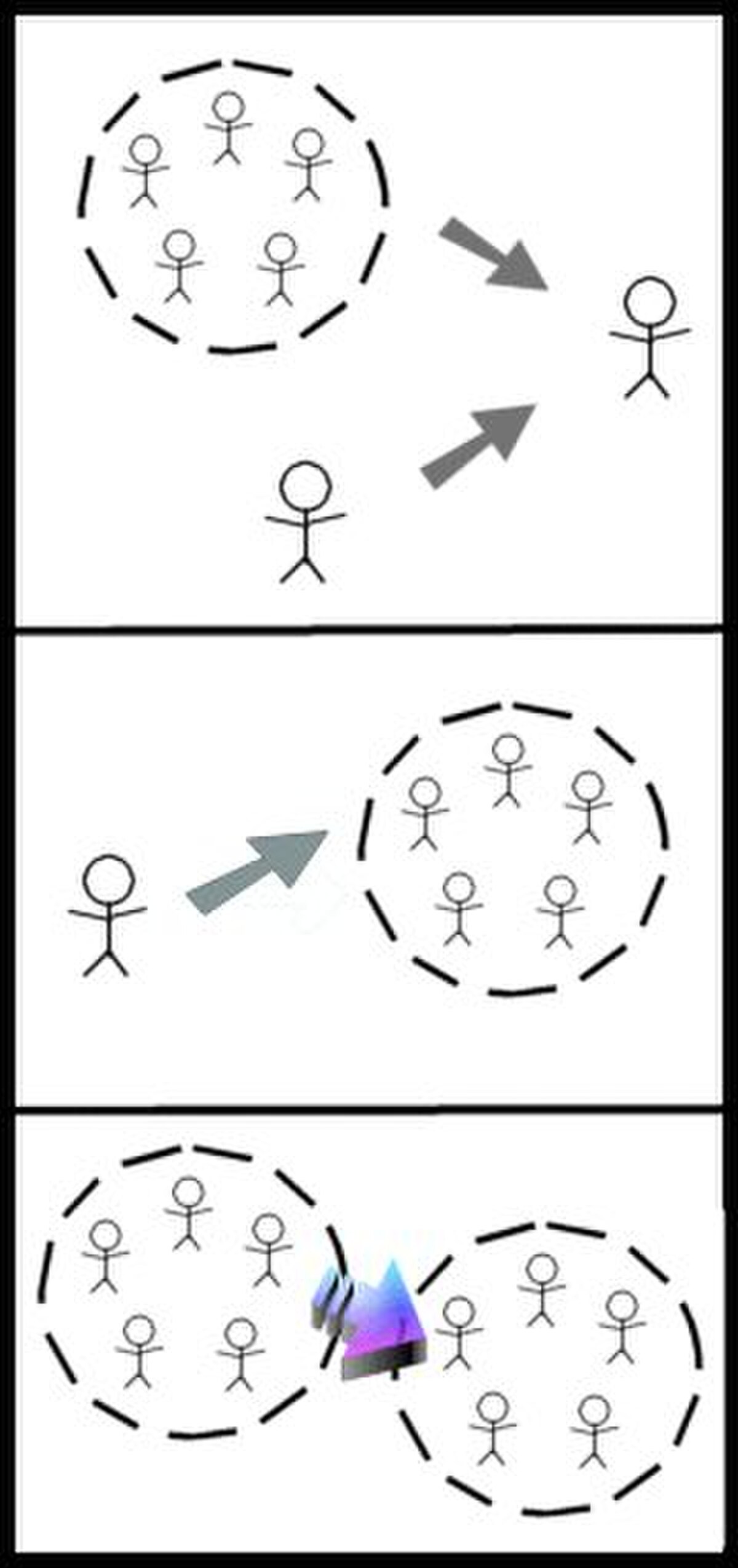
Sociology and social psychology study many of the same topics, but they use different scales. Sociologists examine large-scale social structures, cultural systems, and society as a whole. Psychological social psychologists focus on the individual, analyzing how social hierarchies, group dynamics, and culture affect a single person's thoughts and actions.
This diagram shows the relationship between individual actors and larger groups, the primary focus of social psychological research. Lucidish at en.wikipedia, CC BY-SA 3.0, via Wikimedia Commons
While the two disciplines frequently collaborated after World War II, they later split into more specialized tracks. Social psychology remains anchored in controlled experiments using individual participants to study mental phenomena such as attribution, social cognition, and cognitive dissonance.
Test yourself
In social psychology, how does the presence of a group primarily alter individual behavior?
It shifts behavior to prioritize social belonging. Social psychology shows that humans evolved to value group cohesion over raw objective truth, often adjusting actions to fit the tribe.
In Social Psychology, is a person's behavior best understood as
a fluid reaction to social context. Social psychology reveals that behavior is shaped by the social environment rather than being a static internal quality, meaning our personality fluctuates depending on who is present.
Play the lesson in edgi and the card is yours. It lands on your Map next to the ideas it connects to, and turns from matte to foil to gold as you learn more around it.
Cognitive dissonance is a state of mental tension that happens when someone holds attitudes that contradict one another. Because people prefer logical consistency, this uncomfortable friction often forces them to change their attitudes or actions.
What is the difference between explicit and implicit attitudes?
Explicit attitudes are conscious evaluations that people can report directly, while implicit attitudes are unconscious. In interracial interactions, explicit attitudes typically correlate with verbal communication, whereas implicit attitudes show up in nonverbal behavior.
Where is social psychology applied today?
Researchers apply social psychology to health, law, education, and the workplace. For example, during the COVID-19 pandemic, researchers studied the effects of misinformation, fear, and social isolation on collective behavior.