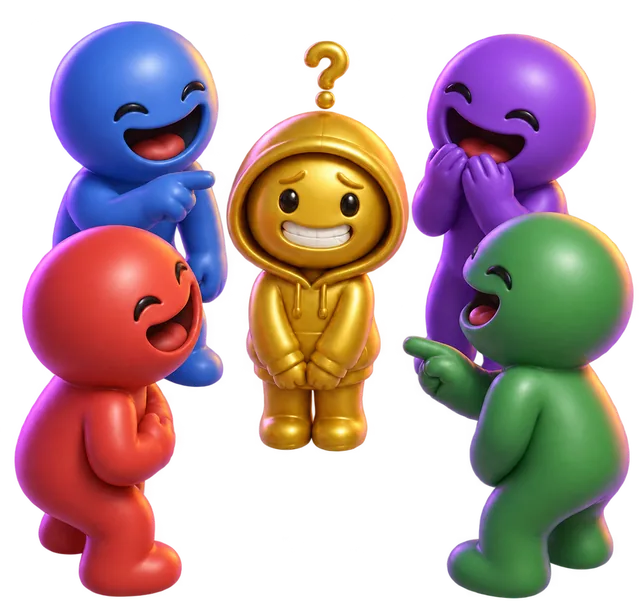
Conformity is the act of changing your beliefs, attitudes, or behaviors to match the norms of a group. People often conform to avoid social rejection or because they assume the group knows better. This drive is strong enough that people will publicly endorse an obvious error just to agree with the crowd around them.
By the edgi team We find the most surprising true thing about an idea and build a 60-second lesson around it.
In 1951, psychologist Solomon Asch gave volunteers a simple vision test. He put one person in a room with seven actors who were instructed to give the wrong answer to obvious questions.
When the group confidently claimed a short line was the longest, 75% of the real subjects agreed with them at least once.
The brain's fear
We think we are independent, but the brain processes social rejection in the same regions as physical pain. Conformity is a defensive strategy. It keeps us in the tribe, which historically was the only place to stay alive.
An animation showing composite images from an fMRI scan, revealing brain activity. Fastfission on en.wikipedia (or de.wikipedia), CC BY-SA 3.0, via Wikimedia Commons
This creates groupthink, where the desire for harmony becomes more important than the truth.
Breaking the spell
The power of the crowd relies entirely on unanimity. In follow-up Asch experiments, researchers found that if just one other person disagreed with the group, conformity rates plummeted.
You don't need a majority to stand up for the truth; you just need one ally to break the spell.
Why people follow the crowd
People conform for two primary reasons: informational influence and normative influence. Informational influence happens when someone looks to others for guidance in ambiguous situations, believing the group holds better information. Normative influence occurs when a person conforms to gain approval or avoid being ostracized.
Participants in Solomon Asch's experiment were asked to match line lengths, but many chose an incorrect line after hearing actors give wrong answers. CC BY-SA 3.0, via Wikimedia Commons
Social psychologist Herbert Kelman divided conformity into three distinct levels. Compliance is purely public agreement driven by the desire for approval or the fear of disapproval, without any private belief. Identification represents a deeper alignment with the group. Internalization occurs when a person accepts the group's norms both publicly and privately, adopting them into their own core belief system.
Unconscious mimicry and daily habits
Conformity does not always involve conscious decision-making. Through the Chameleon effect, people automatically mimic the postures, gestures, and speaking tempos of those around them. This automatic mirroring builds rapport and keeps social interactions operating smoothly.
Social norms also regulate solitary behavior. People routinely follow cultural rules when eating meals or watching television entirely alone. Furthermore, conformity provides functional benefits for society, such as driving on the designated side of the road and helping children acquire the baseline behaviors needed to interact within their communities.
Test yourself
Conformity: What can one dissenter do when a group gives a wrong answer?
Make it easier for others to disagree. A single ally breaks the group’s unanimity, reducing the pressure to conform even without changing the majority.
Conformity: A team favors agreement over evidence. What risk does this create?
Groupthink can put harmony ahead of truth. When maintaining harmony matters more than finding the truth, a group can fall into groupthink.
In a meeting, everyone backs a plan you doubt. What most helps you speak up?
A colleague voicing a small doubt too. Like the ally in Asch's test, a single colleague voicing doubt breaks unanimity, which lowers both self-doubt and the cost of dissenting.
Play the lesson in edgi and the card is yours. It lands on your Map next to the ideas it connects to, and turns from matte to foil to gold as you learn more around it.
Group pressure drops sharply when even a single person breaks ranks. In follow-up line experiments by Solomon Asch, having just one other person disagree with the incorrect majority caused conformity rates to plummet.
Does conformity harm group performance?
Conformity impairs group performance in variable environments where adaptation and new ideas are needed. In stable environments, however, it does not have a significant negative effect on how the group performs.
How does conformity differ from obedience?
Obedience involves following direct commands from an authority figure, as seen in Stanley Milgram's experiments. Conformity involves aligning with peers and perceived social expectations to fit in or avoid conflict.