Survivorship BiasWhy missing data creates false patterns
Survivorship bias is a statistical error that happens when people focus entirely on things that passed a selection filter while ignoring everything that failed. Because the failed data points are missing, observers draw false conclusions and assume success comes from special qualities instead of chance. Looking only at the survivors produces an overly optimistic and distorted picture of reality.
By the edgi team We find the most surprising true thing about an idea and build a 60-second lesson around it.
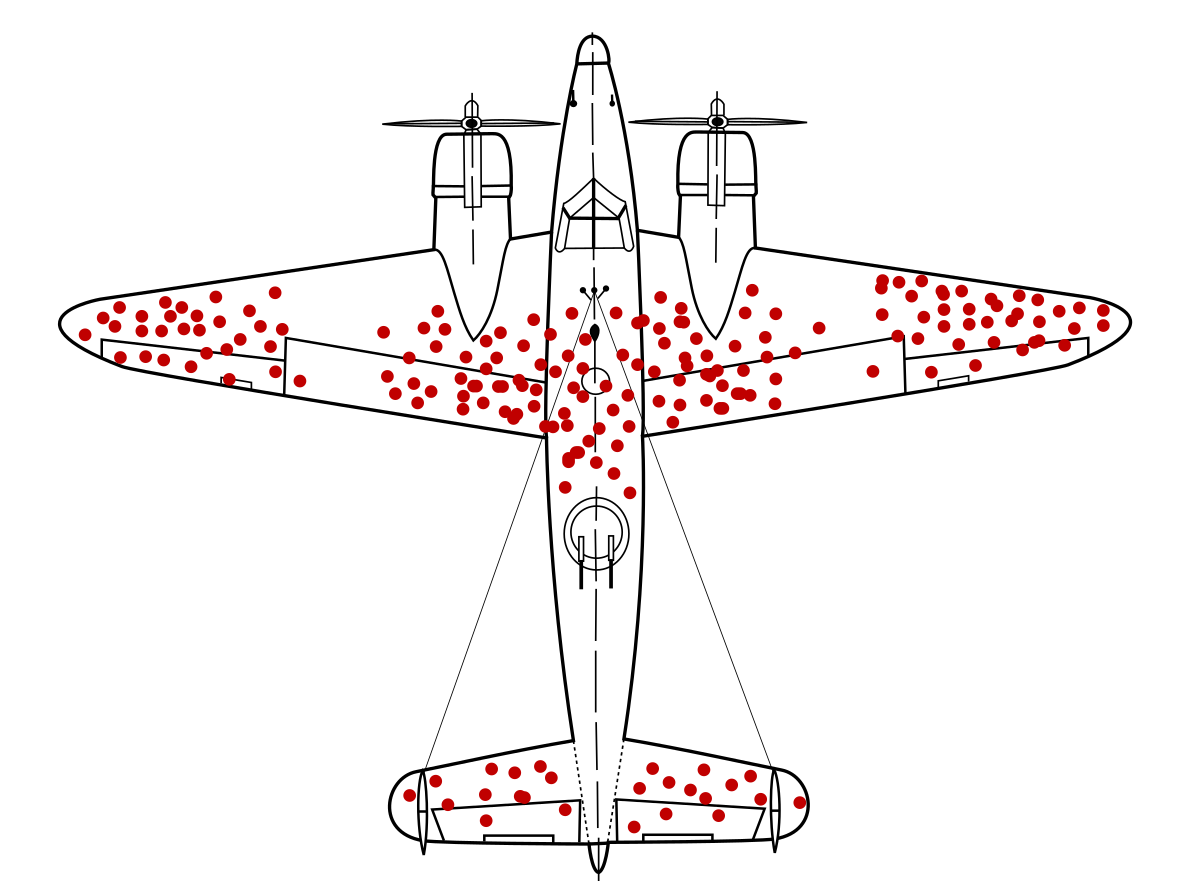
During World War II, the US military examined bombers returning from combat to see where they took the most enemy fire. The returning planes were heavily peppered with bullet holes across the wings and fuselage.
The military naturally wanted to add extra armor to those exact scarred areas.
Wald's realization
Statistician Abraham Wald pointed out a fatal flaw in the plan: they were only looking at the planes that survived. The planes shot in the engines or the cockpit were the ones that crashed and never made it home.
The armor needed to go where the surviving planes were completely clean, because those were the hits that proved fatal.
The hidden failures
This logical error is called survivorship bias, a form of sampling bias that distorts our view of reality. If you only study the habits of ultra-successful billionaires, you ignore the millions of bankrupt people who woke up at 5:00 AM too.
We see a map of success, forgetting it is actually just a map of survivors.
How survivorship bias distorts finance and investing
In finance, survivorship bias routinely inflates how well investments appear to perform because failed companies and funds simply vanish from the records. Mutual fund managers frequently close or merge losing funds into surviving ones, hiding poor historical track records from prospective clients. Because of this practice, up to 70 percent of existing funds could truthfully claim to perform in the top quartile of their peer group if the comparison includes funds that closed.
A 1996 study by Elton, Gruber, and Blake found that this bias distorts performance data across the United States mutual fund industry by roughly 0.9 percent per year. The effect is especially large in smaller funds, which fold at higher rates. A similar distortion happens when analysts test historical market strategies using only current members of indexes like the S&P 500, mistakenly crediting companies for gains made before they were added while dropping the failed firms that fell off the list along with their losses.
Why scientific experiments fall for the same trap
Scientific research falls into survivorship bias when unsuccessful trials disappear from view. Parapsychology researcher Joseph Banks Rhine claimed to identify subjects with extra-sensory perception after testing hundreds of candidates with Zener cards. Critic Martin Gardner noted that Rhine had subtly discarded the poorly performing subjects from his calculations, mistaking simple chance variation among a large group for actual telepathy.
When dozens of independent scientists study a topic, pure chance ensures a few will find statistically significant outcomes. Those positive results get submitted and published, while the vast majority of experiments showing no result remain unreported in file drawers. This positive results bias is a major reason why the 2005 paper 'Why Most Published Research Findings Are False' found that many published medical findings cannot be replicated.
Play the lesson in edgi and the card is yours. It lands on your Map next to the ideas it connects to, and turns from matte to foil to gold as you learn more around it.
How does survivorship bias affect studies of life expectancy?
A study by Redelmeier and Singh claimed Academy Award winners lived four years longer than non-winners, but the calculation mistakenly credited years lived before winning toward survival after the win. When researchers reanalyzed the data without this error, the difference shrank to roughly one year and was not statistically significant.
How do scientific journals attempt to prevent survivorship bias?
Some journal editors specifically solicit negative scientific findings where no effect was observed. Publishing studies showing that nothing happened prevents successful outliers from dominating the scientific record.