edgi vs Kinnu: which learning app is better?

By the edgi team
Kinnu and edgi are both free apps for learning the things nobody tests you on, and they disagree about the thing that matters most: who decides what you learn next.
Kinnu decides. You pick one of its 100 pathways and read its lessons in order, about 1,500 words each, and a review feature Kinnu calls Memory Shield brings them back as questions. edgi lets you decide. A Lesson takes about 60 seconds, the idea becomes a card, and the card lands on your Map next to the ideas it connects to, so the next Lesson is whatever you got curious about. If you learn because something grabbed you, edgi is the better app. If you want to be handed a subject and drilled on it, Kinnu is.
We make edgi, so we're biased. Further down we say when Kinnu is the better pick.
| Kinnu | edgi | |
|---|---|---|
| Price | Free. Certificates sold in the app, $7.99 to $19.99; exam prep sold separately | Free |
| Who picks what's next | Kinnu: choose a pathway and it sets the order | You: the Map shows what connects to what you just learned |
| A lesson is | About 1,500 words to read or listen to, then questions (median of its 899 public lessons) | A 60-second Lesson on one idea, then a question or two that make you use it |
| Organized as | 100 pathways in 7 categories, 4 to 12 lessons each | More than 104,000 ideas joined by 296,000 connections, plus 37 curated Sets |
| What you keep | A "Knowledge Bank" that Kinnu says shows what's safe in your memory and what's at risk | A card for each idea, lit on your Map. The card turns foil, then gold, as you learn more around it |
| Review | Memory Shield: questions that bring old lessons back, to help you "never forget what you've learned" | No review schedule. A streak, and your cards stay on your Map |
| Try it without the app | Read the lessons at kinnu.xyz; questions are tap-to-reveal | Play Lessons in the browser at edgi.tv/learn, no account |
| Platforms | iPhone, Android | iPhone and the web |
| Exam prep | SQE, SAT, CFA and BCBA | None |
Kinnu's facts come from its US App Store listing, its website and its public lessons, checked in September 2026. We didn't make an account or open its app, so anything here about the inside of Kinnu's app is Kinnu's own description. Our Kinnu review goes deeper on the lessons, the questions and what reviewers say.
Who decides what you learn next
Kinnu's Hanna Celina made the case against apps like ours in a 2023 interview: "TikTok learning ends at this interest level, and it does not expand."
She's half right. A feed of unrelated clips does stop at interest. An interesting fact with nothing to connect to is forgotten by the next day. But interest is the hard part, and a syllabus ignores it: it sets the order before it knows what you care about. Kinnu's fix is the pathway, where someone else picks the order and you follow it. Ours is the Map.
Finish a Lesson and you own its card, the card lights up that idea on your Map, and the Map shows what sits next to it. There are 296,000 connections between ideas, so there is always a next thing, and you're the one who picks it. Dinosaur to theropods to walking on two legs to the foramen magnum: three steps, and you're at the hole in the base of the skull the spinal cord runs through. Another route gets from Dinosaur to black holes in four, through mass extinctions and gamma-ray bursts.
Kinnu's App Store listing also mentions a "map based design to explore content." We haven't seen it; it's inside the app. From the description, it maps Kinnu's content. edgi's Map shows what you've learned.
The trade-off is real: curiosity doesn't move in a straight line, and most teaching is built in steps. Kinnu chose the steps. We chose curiosity: you lead, and the app suggests where to go next. If you'd happily start a pathway on macroeconomics and finish it, Kinnu's bet works for you. edgi is for the person who wouldn't, and who ends up in game theory anyway, three steps from a Lesson on loss aversion.
Same idea, two formats
Both apps teach the anchoring effect: a number you know is meaningless still drags your estimate toward it. Kinnu's version is one section of a 2,300-word public lesson that also covers the base rate fallacy and framing, and its example is a pair of pants tagged $200, then marked down to $100. Ours you play. A rigged wheel lands on 65, you predict how far it moved people's guesses at the share of UN countries in Africa, then the same trick works on MIT students bidding for a keyboard and on real estate agents pricing a house.

60-second Lesson
Anchoring effect
A wheel lands on 65. Nobody thinks it knows anything about Africa. It moves their guess anyway.
Read theirs and play ours. Whichever one you still remember next week is the format for you.
What a Kinnu lesson is
Kinnu publishes 899 lesson pages free on its website under the name Kinnuverse, and we counted every one. The shortest runs 321 words and the longest 3,842; the median is about 1,500, or around six minutes of reading. Kinnu said in 2023 that it splits everything into cards of 150 to 200 words, so a lesson in the app is presumably a stack of them.
The lesson on logical intelligence in animals is a short one: about 1,000 words of clear prose with six Wikimedia Commons photos (an orangutan fishing for ants, a New Caledonian crow, an octopus with shells), then four questions. On the web you tap a question to see its answer. The interactive questions and the reviews are in the app, so on the web Kinnu is a well-written encyclopedia with a download button.
A Kinnu lesson is a short chapter you read. An edgi Lesson is one idea you play and then use. (The 108 interactive ones, like the anchoring Lesson above, are built to run a few minutes.)
Kinnu's homepage now leads with exam prep
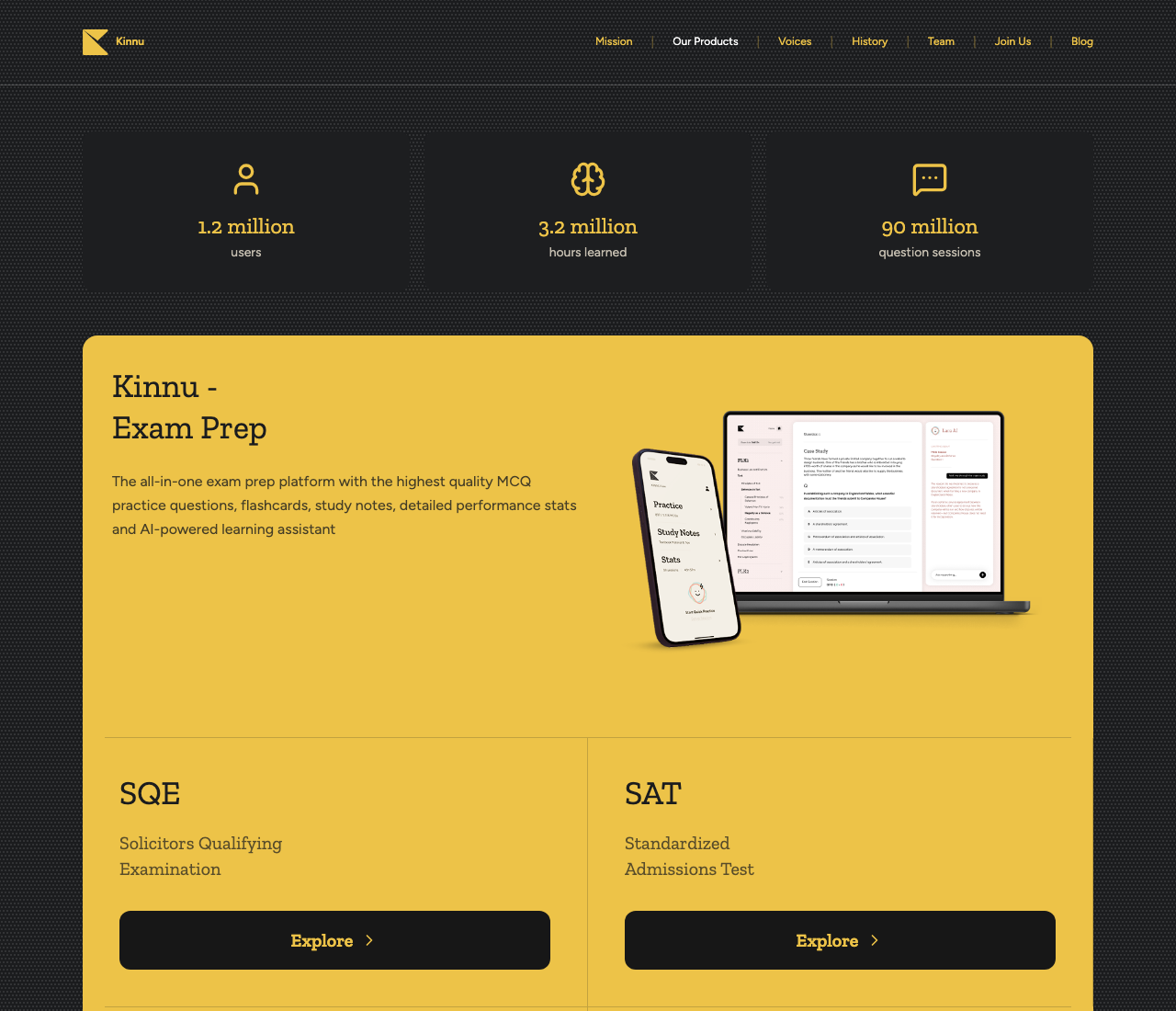
No review we found mentions this. Kinnu's homepage lists two products, and the first, larger one is Exam Prep: the SQE (the qualifying exam for solicitors in England and Wales), the SAT, the CFA and the BCBA. General Knowledge, the app this page is about, is second. Kinnu's own history timeline shows four exam launches since May 2025 (law on mobile, law on the web, the CFA in February 2026, the SAT in July), and all four of its 2026 blog posts are about the CFA. SAT prep costs $19 a month after a 7-day trial.
Exam prep is a real business, and it's the opposite bet from ours. The biggest problem in education isn't funding or teacher shortages. It's that most people aren't interested in what they're being taught, and an enormous amount of money goes into teaching people things they don't want to learn. Exam prep sells because the test supplies the motivation. edgi starts with something you already wanted to know.
The general-knowledge app isn't going away. It got an update on September 2, 2026, and the pathways are still free. But the free app you'd be choosing belongs to a company whose last four launches were all exam prep.
When Kinnu is the better pick
You want review built in. Kinnu's Memory Shield brings old lessons back as questions. edgi has no review schedule. A card is a record that you paid real attention to an idea, not a promise you'll recall it in six months.
You want one subject, start to finish. A Kinnu pathway runs about nine lessons, roughly 13,500 words on something like Norse mythology. edgi's closest thing is its 37 Sets, short curated runs of ideas.
You're on Android. Kinnu has an Android app. edgi runs on iPhone and in the browser.
You have an exam coming. Kinnu sells prep for the SQE, SAT, CFA and BCBA. edgi doesn't do exam prep.
FAQ
Is edgi free? Yes. Lessons, cards and the Map are free. A few Sets are open from the start, and the rest unlock with coins you earn by learning. An optional Pro subscription opens two Sets a day without coins, raises the limits on making your own Lessons and adds offline access.
Is Kinnu free? The General Knowledge app is. On iPhone you can buy certificates for $7.99 to $19.99. Its exam prep is sold separately; SAT prep is $19 a month.
Which is better if I don't know what I want to learn? edgi. Kinnu asks you to pick a pathway first. edgi starts with one 60-second Lesson, and the Map shows what connects to it, so the next idea comes from whatever caught your attention.
Does edgi use spaced repetition? No. Each Lesson ends with a question or two that make you use the idea, but nothing brings it back on a schedule. If you want lessons brought back for review, Kinnu does that, and Anki is built around a spaced-repetition schedule.
Can I use edgi on Android? Not as an app. edgi runs on iPhone (iOS 16 or later) and in a browser at app.edgi.tv, and its Lessons play without an account at edgi.tv/learn.
Can I try Kinnu without downloading it? You can read it. All 899 public lessons are on kinnu.xyz, with tap-to-reveal questions; the reviews need the app. edgi's Lessons play in a browser with no account, like the one on this page.
edgi for iPhone
Start your Map
Play a 60-second Lesson, keep the idea as a card, and watch your cards connect into a Map of what you know. Free on iPhone.