Self-WorthWhy your brain treats rejection like pain
Self-worth is an evaluation of your own value, abilities, and moral qualities, reflecting how you feel about who you are. Rather than existing purely in isolation, it functions biologically as an internal gauge tracking your acceptance by other people. When this evaluation drops, your brain processes the rejection using the same circuits responsible for physical pain.
By the edgi team We find the most surprising true thing about an idea and build a 60-second lesson around it.
Psychologist Mark Leary proposed that self-worth is actually a sociometer, an internal gauge for social belonging. It constantly monitors how much the people around you value your presence.
If the gauge drops, you feel low self-worth, signaling that you need to repair your social standing before you get cut off from the group.
The physical alarm
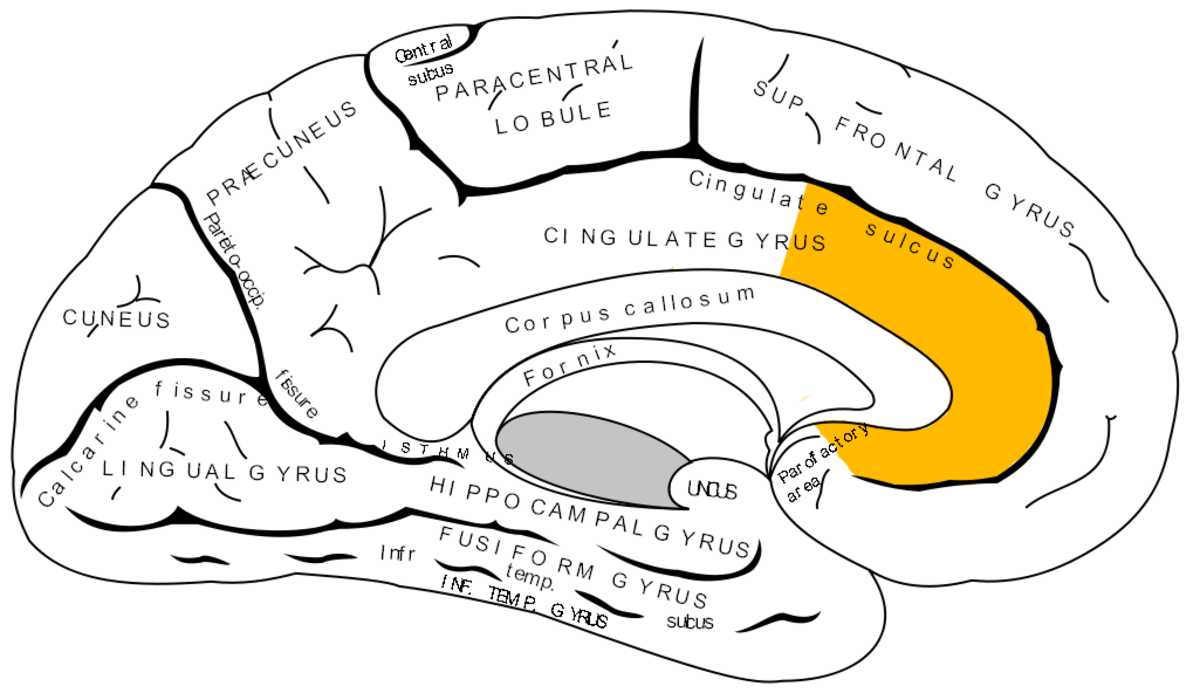
This isn't just a metaphor. When you face social rejection, your brain activates the anterior cingulate cortex. This is the exact same region that processes physical pain.
Diagram of the medial surface of the human brain, highlighting the anterior cingulate cortex in orange. Brodmann, Mysid. Colured by was_a_bee., Public domain, via Wikimedia Commons
Your brain is wired to interpret being disliked as a threat to your physical safety.
The evolutionary trap
For most of human history, being cast out of the tribe was a death sentence. We evolved to obsess over our value to others because, biologically, belonging was the difference between life and death.
Three Hadza men are gathered around a small fire, engaged in activities such as preparing tools or food. kiwiexplorer, CC BY-SA 2.0, via Wikimedia Commons
Today, that ancient alarm system often misfires in our complex, modern social world.
The impostor problem
This explains the specific panic of Impostor syndrome. The fear of being found out isn't just about competence; it's a deep-seated fear that you will be exposed as unworthy and subsequently evicted from your group.
How self-worth operates in the brain
Social rejection activates the anterior cingulate cortex, which is the same brain region that handles physical pain signals. Psychologist Mark Leary framed self-worth as a sociometer, an internal monitor that tracks how much a group values your presence.
Because early humans relied on tribe membership to survive, being cast out posed a lethal threat. The brain evolved to treat drops in social standing as immediate physical danger, creating emotional distress to prompt repair of social bonds.
How psychologists define and measure self-worth
Psychologists view self-worth as a combination of enduring personality traits and temporary emotional states. In the 18th century, David Hume argued that valuing oneself serves a motivational purpose that allows people to reach their full potential. Later, William James split self-knowledge into multiple parts, noting that the social self represents how a person is recognized by others.
In the mid-1960s, Morris Rosenberg created the Rosenberg self-esteem scale, which became the standard tool to measure self-worth across the social sciences. Research links high self-worth to academic achievement, relationship satisfaction, and better health, while low self-worth associates with anxiety, loneliness, and higher risk of substance abuse.
How self-worth changes across a lifespan
Self-worth shifts across different life stages in a predictable pattern. It typically drops between ages four and eight, when children start comparing their actual abilities against an idealized self-image.
It rises through adolescence and young adulthood, continues climbing steadily through middle age, peaks between ages 60 and 70, and declines in late life. Voluntary participation in youth activities, such as community service or leadership councils, reliably strengthens self-worth during teenage years.
Test yourself
According to sociometer theory, what does self-esteem primarily track?
Your likelihood of social acceptance. Self-esteem functions as an internal meter that monitors your relational value and warns you when social bonds are at risk.
Whose criticism causes the steepest drop in self-esteem under sociometer theory?
A core collaborator you rely on daily. The sociometer gives the most weight to people whose inclusion directly affects your daily standing and security.
What does sociometer theory say self-esteem primarily monitors?
Social acceptance by others. Sociometer theory proposes that self-esteem acts as an internal gauge that monitors how well you are accepted and valued by social groups.
Play the lesson in edgi and the card is yours. It lands on your Map next to the ideas it connects to, and turns from matte to foil to gold as you learn more around it.
What is the difference between trait and state self-worth?
Trait self-worth is an enduring, baseline personality characteristic that remains relatively stable over time. State self-worth refers to short-term, normal fluctuations in how you evaluate yourself in response to immediate daily events.
What are core self-evaluations?
Core self-evaluations are a broad assessment of your fundamental value made up of four dimensions: self-worth, locus of control, neuroticism, and self-efficacy. This combined framework is used in psychology to predict job performance and workplace satisfaction.
Why does impostor syndrome cause intense panic?
Impostor syndrome triggers panic because the ancient alarm system in the brain equates being exposed as unworthy with social rejection. The brain interprets the possibility of being cast out from a group as a direct threat to safety.