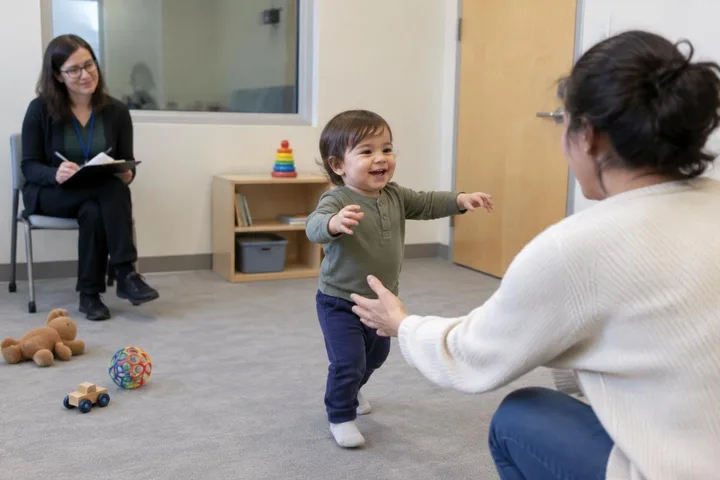
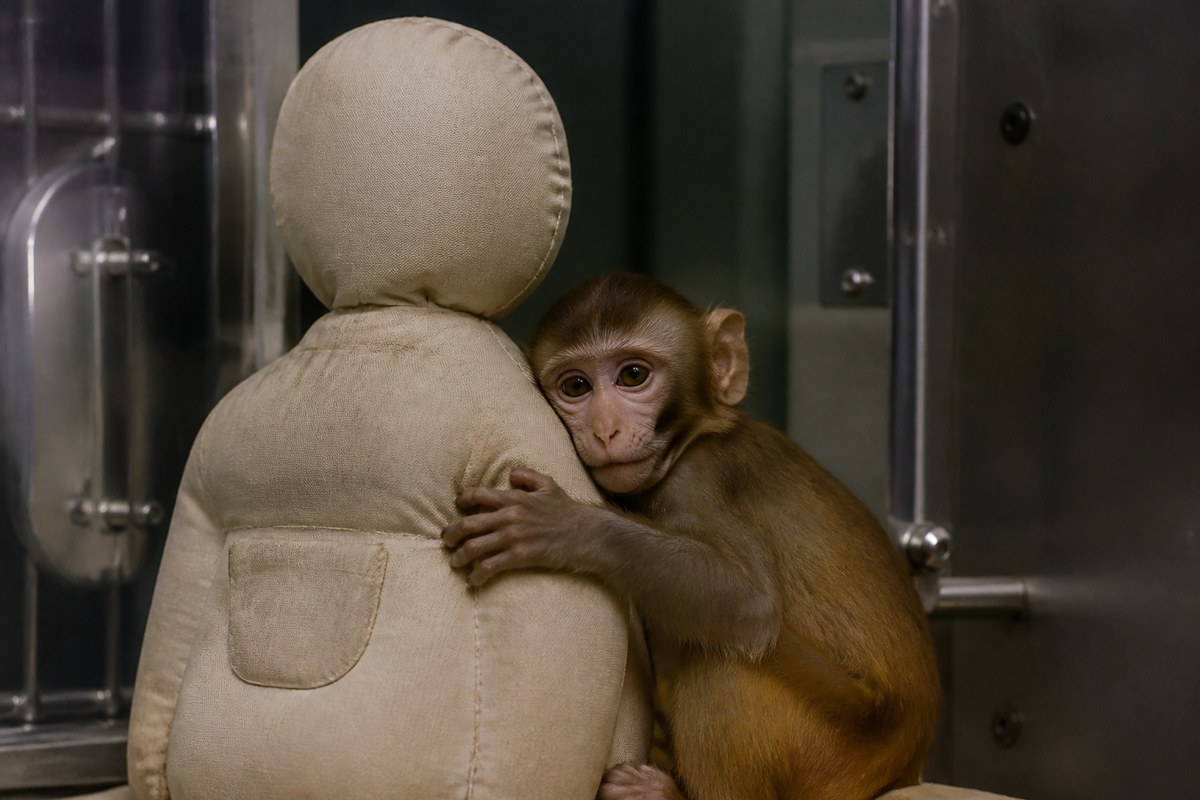
Attachment styles are patterns of behavior and expectations that people form based on how their early caregivers responded to distress. Infants instinctively seek closeness to an adult for safety and survival, especially when frightened. These early patterns build internal models that can influence how a person handles closeness and fear in adult relationships.
By the edgi team We find the most surprising true thing about an idea and build a 60-second lesson around it.
A newborn cannot feed itself, keep itself warm, or get away from anything. It has one tool: signal until an adult comes. Crying brings an adult close, and an adult is a baby's only protection. John Bowlby built attachment theory on that: the bond keeps an adult within reach.
A woman in Mozambique carries a baby on her back, demonstrating a common form of caregiving where infants form attachments to sensitive and responsive carers. Steve Evans, CC BY 2.0, via Wikimedia Commons
But adults respond differently. Some come every time. Some come sometimes. Some go stiff when the baby reaches for them. The baby can adjust how loudly and how often it signals in response to caregiving. An attachment style is a pattern researchers use to describe that relationship.
The three settings
If the adult usually comes, the baby signals, gets settled, and goes back to playing. It explores further too, because there is somewhere to come back to. That is secure attachment. An anxious pattern often involves strong signaling and difficulty settling after an unpredictable response. It is not a rule that one kind of care produces one outcome.
A young child named Kaitlyn with blonde hair is engrossed in reading a small board book. Elizabeth, CC BY 2.0, via Wikimedia Commons
An avoidant pattern can look like playing alone, sorting things out alone, and barely looking up when the parent goes. It is another observed strategy, not proof that a baby feels nothing. Avoidant behavior can look calm while the body shows stress. In studies, some avoidant babies' heart rates rose as much as babies who cried openly.
The prediction
The baby learned this strategy from one adult. That adult goes away, but the strategy can stay. You cannot test every new person from scratch. You arrive expecting an answer to one question: when I need someone, do they come? Bowlby called that expectation an internal working model.
The expectation can help confirm itself. Push for reassurance and a partner may tire; keep making room and a partner may not come closer. Either response can look like evidence for the prediction. The prediction may be accurate about somebody you no longer live with, not everybody you meet now.
How attachment styles form
Infants instinctively form affectional ties to caregivers through an attachment behavioral system designed to ensure protection. Between six months and two years of age, infants learn what to expect when they signal for help. If a caregiver responds with consistent sensitivity, the child develops a secure attachment and uses the adult as a secure base for exploration.
When responses are inconsistent, rejecting, or unpredictable, children develop other strategies. Developmental psychologist Mary Ainsworth expanded John Bowlby's theory to identify distinct infant patterns: secure, avoidant, anxious, and disorganized attachment. Quality of social interaction matters more than sheer hours spent together.
How early patterns shape adult relationships
Interactions with caregivers form internal working models, which are mental expectations about whether other people can be trusted for support. In the 1980s, researchers extended attachment theory to adult relationships, finding that these childhood expectations continue to guide adult romantic and social bonds.
Attachment theory has faced criticism from academic psychologists and anthropologists for overemphasizing maternal influence while overlooking genetics, temperament, and cultural factors. Recent studies suggest that adult attachment patterns are heavily shaped by genes and individual experiences rather than early upbringing alone.
Test yourself
A partner is slow to reply. What best fits anxious hyperactivation?
Stay focused on possible rejection and seek reassurance urgently. Hyperactivation intensifies attention to possible rejection and drives attempts to regain connection.
Secure attachment means never needing reassurance from a partner.
False. Security allows people to seek support when needed while generally trusting closeness and handling separation.
What distinguishes fearful-avoidant patterns from dismissive-avoidant ones?
They want closeness but also fear it. Fearful-avoidant patterns involve both longing for connection and anticipating danger or rejection in it.
Play the lesson in edgi and the card is yours. It lands on your Map next to the ideas it connects to, and turns from matte to foil to gold as you learn more around it.
Yes. Attachment theory holds that any consistent caregiver who responds sensitively to an infant's signals can become the primary attachment figure, including fathers.
What happens when an infant is separated from a caregiver?
Extended physical separation can trigger separation distress, beginning with anxiety and anger before turning into sadness and despair. After age three or four, physical separation alone is less disruptive once the attachment system is fully formed.