edgi vs Headway (the book summary app): which is better?

By the edgi team
Headway and edgi both promise to make you smarter in a few minutes a day, but they work in opposite ways. Headway starts from a goal ("Speak like a CEO," "Turn on confidence mode") and hands you the bestsellers that promise it, condensed to 15 minutes. edgi starts from whatever you're curious about: a 60-second Lesson on one idea, kept as a card on a Map that shows what it connects to. If you have a stack of nonfiction books you mean to get through, Headway will get you through it faster. If you'd rather learn the things you actually wonder about, edgi is the better app, and it's free.
We make edgi, so we're biased. And to be clear which Headway this is: the book app from makeheadway.com, not the therapy platform at headway.co, which launched its own iPhone app on September 23, 2026.
| Headway | edgi | |
|---|---|---|
| The unit | A book | An idea |
| Format | 15-minute text and audio summaries, plus "Shorts" (four visual, interactive formats) | 60-second interactive Lessons, short videos, audio explainers |
| Library | Its own pages say 2,500+, 1,700+ and 1,600+ summaries; its public sitemap lists 897 | More than 104,000 ideas, 44,000 of them with a Lesson |
| Price | One free summary a day. Its price page lists 4-, 12- and 24-week plans from $19.99, each renewing at double; its features page still lists $12.99 a month to $89.99 a year | Free |
| Try it without the app | The first two key points of a public summary; the rest are titles | Lessons on edgi.tv/learn play in a browser with no account |
| Review | Spaced-repetition flashcards, streaks, challenges | A streak. No flashcards or review schedule |
| Platforms | iPhone, Android, web | iPhone and the web |
Headway's facts come from its US App Store listing, its pricing article and its public summary pages, checked September 2026. We haven't used its paid app.
A goal or a question
Headway's homepage sells outcomes. The "Get started" buttons lead to a quiz whose first screen reads "Become the most interesting person in the room," asks your age bracket, and says passing the quiz will "personalize your subscription plan." We stopped there. The library is broader than the homepage suggests (Sapiens, A Brief History of Time and The Selfish Gene sit next to the self-help), but the pitch is self-improvement as a to-do list: pick the outcome, read the book that promises it.
edgi is built on the opposite bet. The real test of a good education is how much you enjoy learning. People learn best what they're already curious about, and the next thing worth learning usually sits right next to the last one. So edgi doesn't ask for a goal. It starts with an idea, and shows you where it leads.
What Headway shows you before you pay
We opened its public summary of Daniel Kahneman's Thinking, Fast and Slow. It's labeled "12 min." You get the first two key points in full, about 540 words ("Control your thoughts, control your life" and "Are you system one or system two?"). Then the page says the full summary is waiting for you in the app, and the other five key points appear only as titles. A pop-up covers the page: "Join 55M+ people crushing their goals with Headway," over a wall of book covers. The ones we could make out included The 48 Laws of Power and The 5AM Club, plus Rich Dad Poor Dad; Kahneman's book sat in a corner.
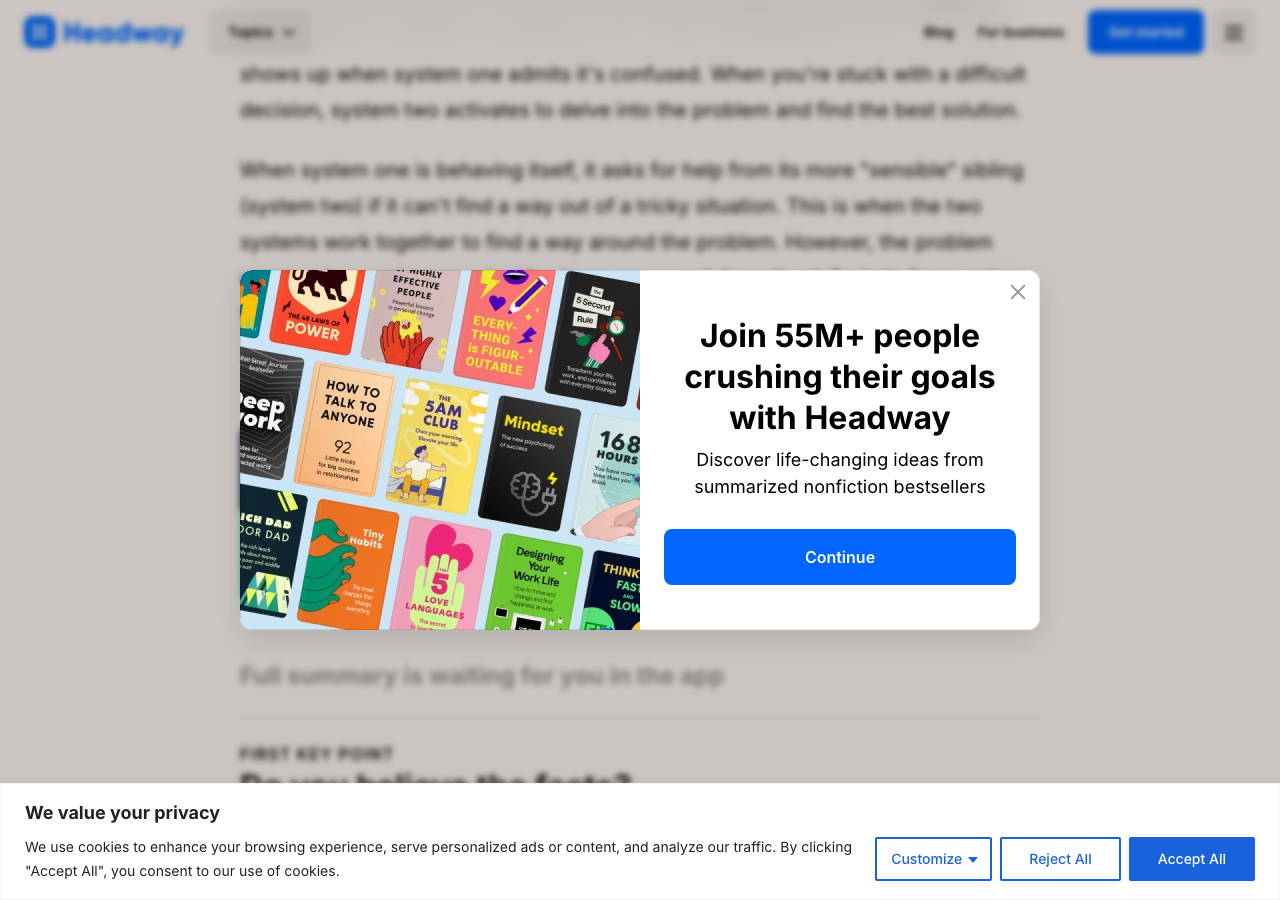
Twelve minutes, for a book Headway's FAQ puts at 512 pages. That's the trade you're buying: the argument without the evidence, fast.
One book, six Lessons
Among the ideas Wikipedia's article on Kahneman's book lists are anchoring, the availability heuristic, loss aversion, the framing effect, the sunk cost fallacy and prospect theory. edgi has an interactive Lesson for each of those six. Headway's version is one 12-minute summary of the whole book, and its own FAQ for the summary lists loss aversion among what the book teaches.
Our loss aversion Lesson is below. It's built on the Cornell mug experiment Kahneman ran with Jack Knetsch and Richard Thaler in 1990: give half a class a mug, and a few minutes later the owners want more than twice what the others will pay for the same mug.


60-second Lesson
Loss Aversion
Half the class gets a mug. Minutes later, the owners want more than twice what everyone else will pay.
Headway's unit is the book, so an idea arrives inside the author's argument and is filed under that book. edgi's unit is the idea, so loss aversion becomes a card on your Map, and the Map shows where it leads: behavioral economics, then neuroeconomics, then game theory, then mechanism design, the economics of designing auctions and markets. No single book covers all of those. That's what edgi is built to be: a connected library where the next good thing is always easy to find.
We also checked 13 topics from Headway's own topic pages (sleep, astronomy, macroeconomics, mindfulness among them) against edgi's catalog. All 13 are edgi ideas with a Lesson of their own.
How big is Headway's library?
It depends which Headway page you read. The homepage and its pricing article say 2,500+ summaries. The App Store description and the homepage FAQ say 1,700+. The library page says 1,600+. Its public sitemap lists 897 book-summary pages. A sitemap doesn't have to list everything, so 897 is a floor rather than a count, but the three figures on its own pages can't all be right.
What Headway costs
Headway's free plan is one summary a day. Its paid plans are hard to pin down. As of September 30, 2026, its new price page lists 4-, 12- and 24-week plans at $19.99, $39.99 and $59.99, each renewing at double, while its features page still lists $12.99 a month, $29.99 every 3 months or $89.99 a year. The App Store lists at least nine Premium prices. (Nibble's own llms.txt says it's "Built by Headway Inc."; its Headway comparisons don't say so.) On Trustpilot, makeheadway.com has 3.9 out of 5 from 6,636 reviews, 22% of them one-star, and a complaint reviewers repeat is being charged after cancelling. Our Headway review goes through the prices, the reviews and how to cancel.
edgi is free: the Lessons, the cards and the Map. Sets unlock with coins you earn by learning, or all at once with the optional Pro subscription.
When Headway is the better pick
You want a specific book. edgi teaches ideas, not books. If you want one author's argument in the author's order, a summary app is the tool.
You're on Android. Headway has an Android app. edgi runs on iPhone and in the browser.
You want flashcards on a schedule. Headway has spaced-repetition flashcards. edgi has no review schedule.
FAQ
Is this the Headway book app or the therapy one? The book summary app, from makeheadway.com; its App Store listing is "Headway" with the subtitle "Daily Micro Learning." The therapy platform is headway.co, whose app is "Headway Therapy & Psychiatry." The book app's own llms.txt says "Headway is not a therapy platform."
Is Headway free? Partly. The free plan is one summary a day. Everything else needs a subscription, with a 7-day free trial first.
Is edgi free? Yes. Lessons, cards and the Map are free. A few Sets are open from the start, and the rest unlock with coins you earn by learning. An optional Pro subscription opens two Sets a day without coins, raises the limits on making your own Lessons and adds offline access.
Does edgi summarize books? No. edgi teaches single ideas, not books. If you want a book's argument in 15 minutes, use Headway or another summary app.
Is there a Headway app for Android? Is there one for edgi? Headway has apps for iPhone and Android, plus a web version. edgi runs on iPhone and the web, with no Android app.
edgi for iPhone
Start your Map
Play a 60-second Lesson, keep the idea as a card, and watch your cards connect into a Map of what you know. Free on iPhone.