The Doppler effect is the change in the frequency or pitch of a wave when the source of the wave and the observer are moving toward or away from each other. As an object moves closer, each new wave is emitted closer to you, shortening the time between wave cycles and raising the frequency. When the object moves away, the waves stretch out over greater distances, lowering the frequency.
By the edgi team We find the most surprising true thing about an idea and build a 60-second lesson around it.
Imagine a source emitting a steady hum. As it moves toward you, it catches up to the waves it just sent out, squashing them together. Those bunched-up waves hit your ear faster, creating a higher pitch. Once the source zooms past, the waves stretch out behind it, dropping the frequency and the pitch.
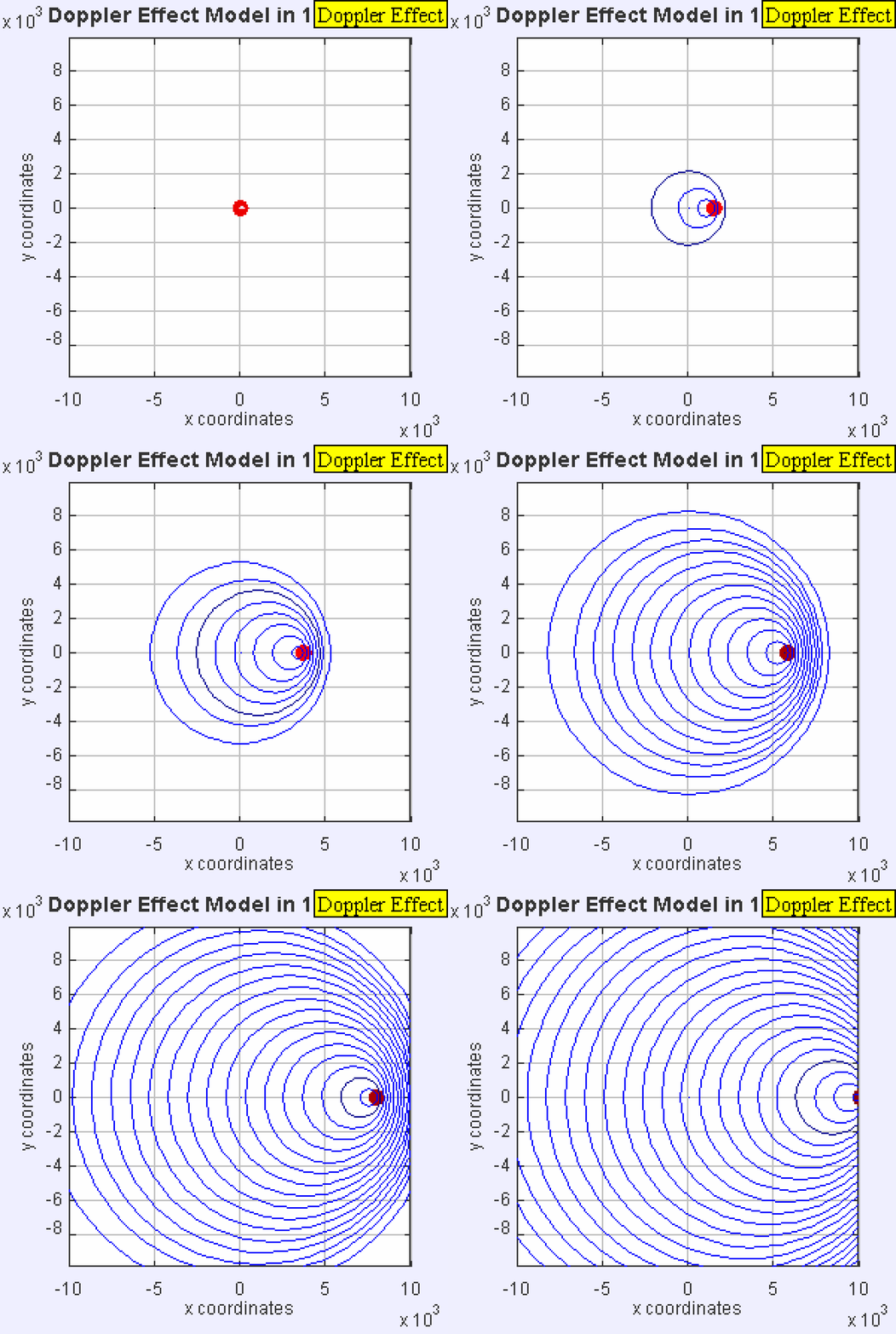
Animated graph titled "Doppler Effect Model in 1 Di" showing a red dot moving right at Mach 0.7, labeled "Doppler Effect." The X and Y coordinates are scaled by 10^3, ranging from -10 to 10 on both… Lookang many thanks to Fu-Kwun Hwang and author of Easy Java Simulation = Francisco Esquembre, CC BY-SA 3.0, via Wikimedia Commons
The proof
In 1845, physicist Christoph Buys Ballot wanted to prove this theory. He hired a train, a flatbed car, and a group of professional trumpeters. As the train hurtled past a station in Utrecht, the musicians held a single, constant note. Stationed observers confirmed the pitch shifted exactly as the train approached and receded.
A mural in Utrecht, painted in 2019, depicting Buys Ballot's 1845 experiment on the Doppler effect. Sense Jan van der Molen, CC BY-SA 4.0, via Wikimedia Commons
The applications
This isn't just about sound; it works with light, too. Radar guns catch you speeding by measuring how radio waves bounce back at a different frequency. In space, this shift, called redshift, tells astronomers that galaxies are racing away from us. Doctors even use it via ultrasound to track the speed of your blood flow.
A U.S. U.S. Army photo by Master Sgt. Lek Mateo, Public domain, via Wikimedia Commons
How motion alters wave cycles
A stationary source radiates waves in evenly spaced concentric circles. When the source begins moving, each successive wave crest is released from a point closer to the observer ahead of it. This compresses the physical distance between wave fronts, forcing more cycles into the observer's ear or detector every second. The received pitch rises even though the source produces an unchanging frequency.
Sound waves compress ahead of a moving vehicle to raise pitch and stretch behind it to lower pitch. Charly Whisky 18:20, 27 January 2007, CC BY-SA 3.0, via Wikimedia Commons
Behind the moving source, the opposite happens. Each wave cycle is emitted from a location farther away, increasing the time between waves. The observed frequency drops. At the exact instant a moving object passes an observer, the received frequency matches the emitted frequency before falling steadily as it recedes.
The speed of the wave itself does not change with the speed of the source; it is fixed by the medium carrying it, such as air or water. For sound waves, the observed shift depends on the motion of the source, observer, and medium combined. For light traveling through a vacuum, only the relative speed between the source and observer matters.
Who discovered the shift?
Physicist Christian Doppler first proposed the effect in 1842 in a paper on the colored light of binary stars. Three years later in 1845, Christoph Buys Ballot tested the idea using trumpeters playing a sustained note on an open train car passing a station in Utrecht.
In 1848, French physicist Hippolyte Fizeau independently discovered that electromagnetic waves follow the exact same rule, leading French scientists to refer to it as the Doppler-Fizeau effect. That same year, John Scott Russell conducted experimental studies on the effect in Britain.
Everyday and scientific applications
Because frequency shifts directly reflect relative velocity, the effect provides an exact tool to measure motion across different scales. Radar guns bounce radio waves off vehicles, calculating speed by measuring the shift in the returning signal's frequency.
In medicine, doctors apply the phenomenon through ultrasound machines to track the velocity of blood flow through vessels like the carotid artery. In astronomy, light waves shift toward longer, red wavelengths (known as redshift) when distant galaxies move away from Earth, revealing how celestial bodies travel across space.
Test yourself
What causes the Doppler effect when a sound source moves toward an observer?
It squashes and bunches up the waves. As the source moves closer, it catches up to its own emissions, compressing the wave distance and raising the frequency.
The Doppler Effect occurs because a moving source changes the actual frequency it emits.
False. The source continues to emit the same frequency; the observed change in pitch is caused by the physical bunching or stretching of waves relative to the observer's position.
Play the lesson in edgi and the card is yours. It lands on your Map next to the ideas it connects to, and turns from matte to foil to gold as you learn more around it.
What happens to the frequency when a source passes at an angle?
When a source approaches an observer at an angle, the heard frequency starts high and gradually decreases. It reaches the true emitted frequency at the exact point of closest approach before continuing to drop as the source moves away.
What determines the speed of a sound wave during the Doppler effect?
The propagation speed of a sound wave is set entirely by the medium it travels through, such as the surrounding air. The motion of the source or receiver changes only the frequency and wavelength observed, not the wave's speed through the medium.