Interpersonal tiesWhy casual contacts find you jobs
Interpersonal ties are the information-carrying connections between individual people in a social network. Sociologists split these connections into strong, weak, and absent ties based on time, emotional intensity, intimacy, and mutual aid. While close friends share the same circle, casual acquaintances act as bridges to distant groups and pass along the freshest information.
By the edgi team We find the most surprising true thing about an idea and build a 60-second lesson around it.
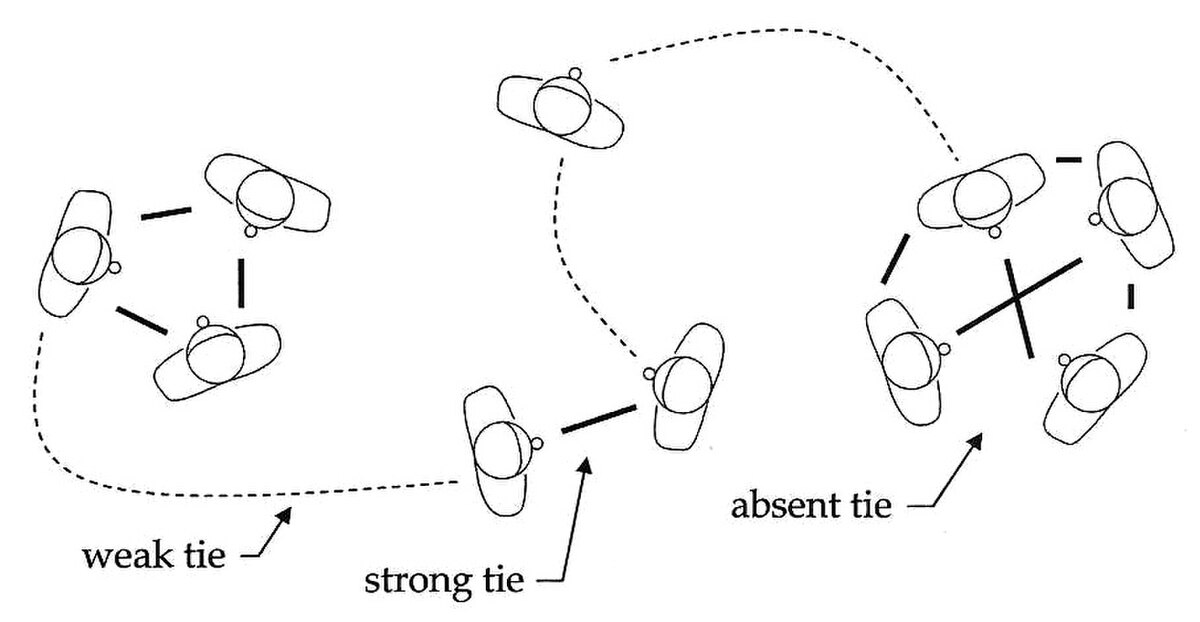
In sociology, interpersonal connections are split into three buckets based on how often people interact and how much emotional depth they share. Strong ties are your closest friends and family, while absent ties are complete strangers.
A diagram illustrates a network of interpersonal ties between several stylized human figures, showing strong, weak, and absent ties. Sadi Carnot at English Wikipedia, Public domain, via Wikimedia Commons
Between them sit weak ties, the casual acquaintances you recognize, nod to, but rarely spend real time with.
The strength of weakness
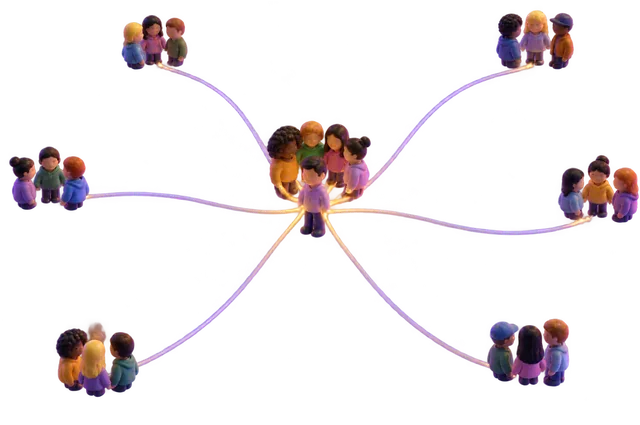
Sociologist Mark Granovetter discovered that when people find new jobs, they rarely rely on their strongest connections. Close friends tend to inhabit the same social network, meaning they already know the exact same people, rumors, and job openings you do.
Weak ties act as bridges to entirely different communities, carrying fresh news, novel ideas, and unique opportunities that your inner circle cannot reach.
The shape of society
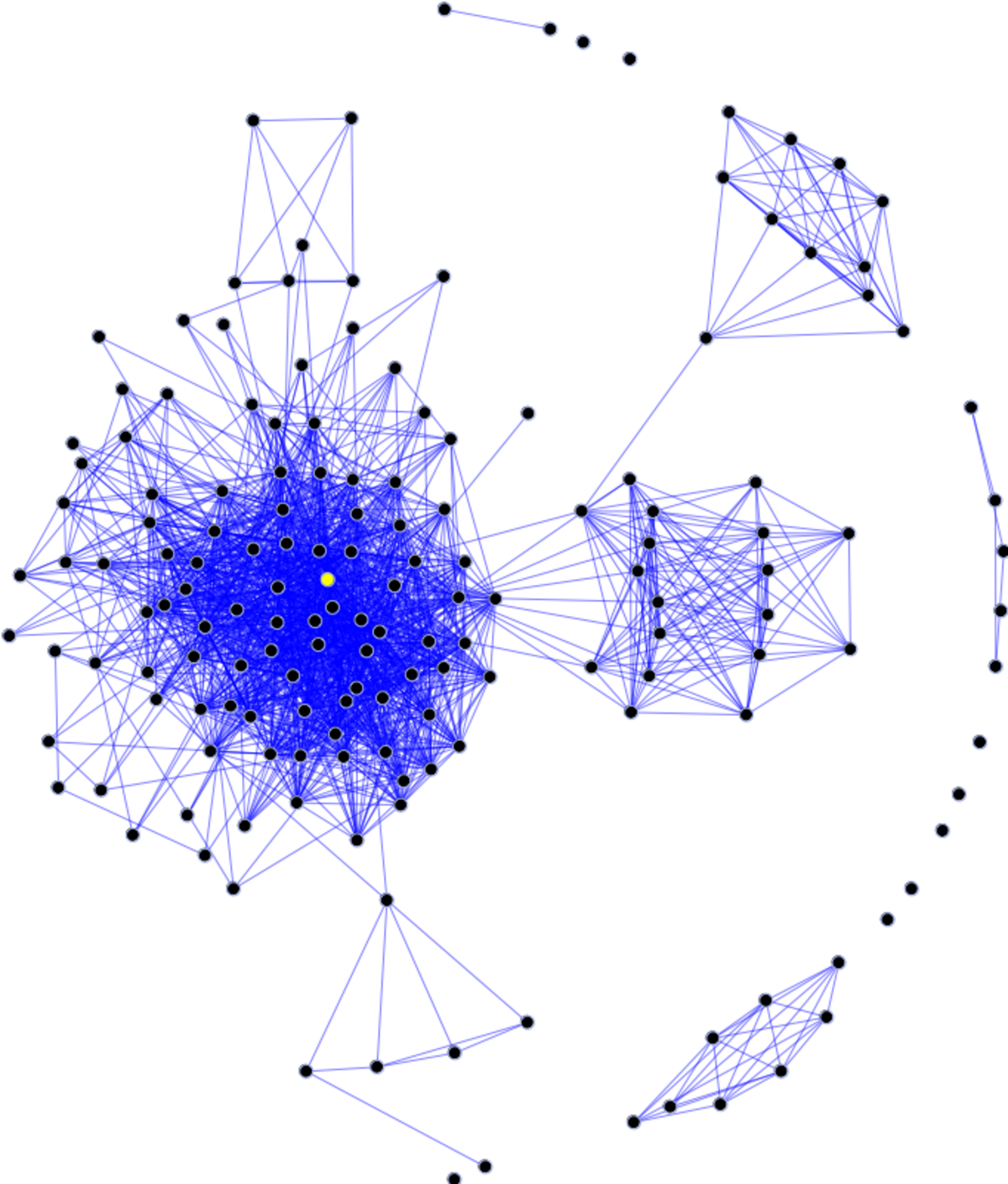
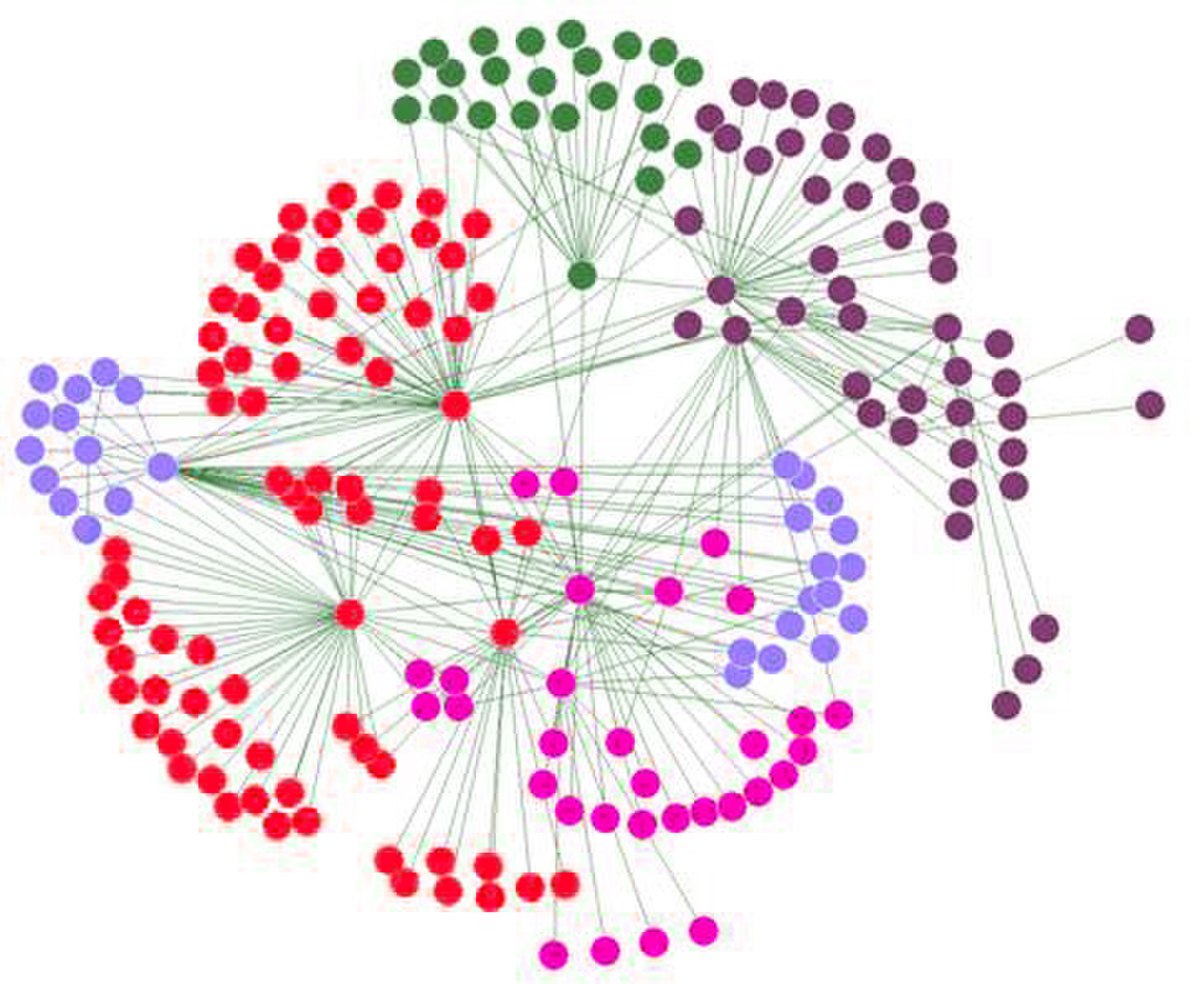
Without weak ties, society would fracture into isolated echo chambers of tightly knit families and close groups. These fragile, low-investment connections stitch separate social network clusters together into a massive, functioning whole.
A social network diagram displays users forming separate, distinct clusters, illustrating the concept of echo chambers. Screenshot taken by User:DarwinPeacock, CC BY 3.0, via Wikimedia Commons
Sometimes the most important relationships in your life are the ones you barely maintain.
How tie strength is measured
A tie's strength is a combination of four factors: the amount of time people spend together, their emotional intensity, mutual confiding or intimacy, and the reciprocal services they provide for one another.
Social network theory maps relationships by treating individuals as nodes and their connections as ties. When two people share negligible interaction, such as neighbors who only nod in passing or a frequent vendor at a shop, researchers classify them as absent or invisible ties. Even without deep communication, these absent ties help maintain a person's sense of familiarity and belonging.
In 1969, anthropologist Bruce Kapferer proposed that relationships can also be multiplex. Multiplexity occurs when people overlap across multiple roles, affiliations, or exchanges, similar to how a telecommunications multiplexer transmits several separate signals across one medium.
The strength of weak ties
For his 1970 doctoral dissertation, sociologist Mark Granovetter surveyed 282 professional, technical, and managerial workers in Newton, Massachusetts to see how they found employment. Among those who secured jobs through personal contacts, 55.6 percent saw their contact occasionally and 27.8 percent saw them rarely, while only 16.7 percent saw their contact often. The most frequent response was that an acquaintance, not a friend, provided the job lead.
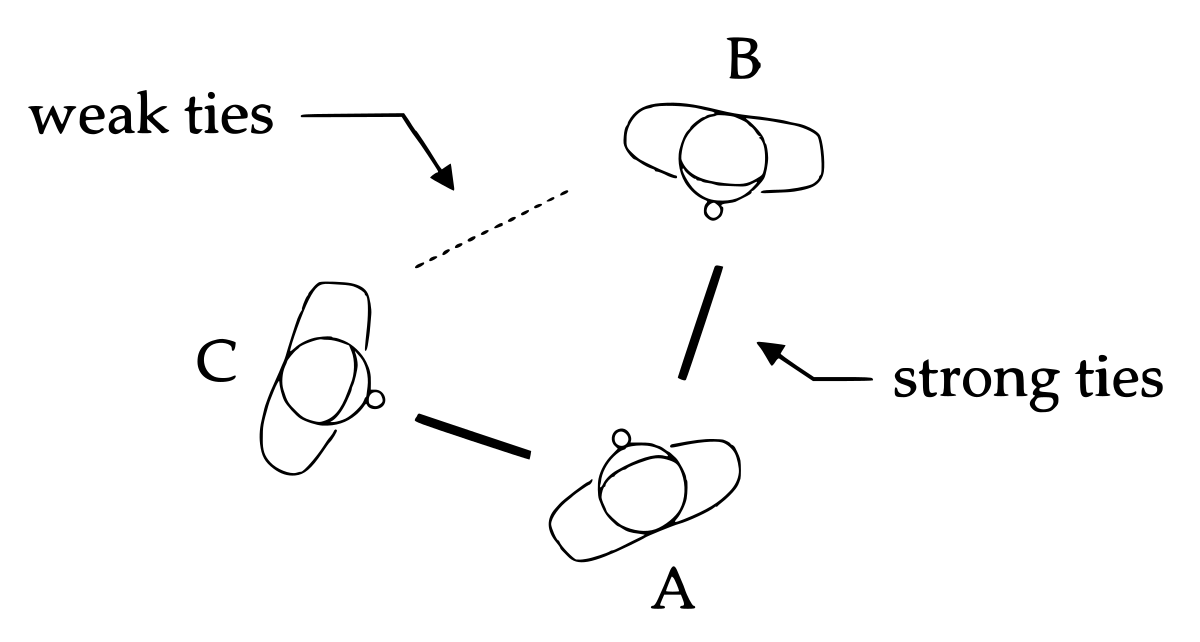
A diagram of three individuals demonstrates that when person A shares strong ties with B and C, a connecting tie between B and C completes the network. derivative work: Palfret Weak-strong-ties.jpg: Original uploader was Sadi Carnot at en.wikipedia, Public domain, via Wikimedia Commons
Granovetter compared this social structure to water chemistry. In water, strong covalent bonds hold hydrogen and oxygen atoms together inside a molecule, while weak hydrogen bonds link different water molecules to each other. Society functions the same way: strong ties hold close families and friend groups together, but weak ties connect separate groups into a single cohesive society.
Weak ties carry more novel information because close contacts move in the exact same circles. Mathematical psychologist Anatol Rapoport noted in 1957 that if person A is linked to both B and C, B and C are more likely than chance to be linked as well. Granovetter went further: if A's ties to both are strong, B and C should always be connected, and a missing link between them is what he called the forbidden triad.
Test yourself
Why might a casual acquaintance share a job lead a close friend cannot?
They may have access to a different network.. A casual acquaintance may belong to a different network and know about opportunities outside your close circle.
How can weak interpersonal ties help separate social groups?
By connecting clusters and carrying information between them.. Weak ties link otherwise separate clusters, helping information move across society.
A job seeker’s close friends share one circle. What might weak ties add?
Access to job leads from other networks.. Casual contacts in other circles can act as bridges to unfamiliar job leads and information.
Play the lesson in edgi and the card is yours. It lands on your Map next to the ideas it connects to, and turns from matte to foil to gold as you learn more around it.
One of the earliest writers on the subject, German scientist and philosopher Johann Wolfgang von Goethe, discussed the marriage tie in his 1809 novella, Elective Affinities. He compared strong marital bonds to particles of quicksilver that unite through chemical affinity.
Does knowing someone's name create a weak tie?
No, knowing someone by name does not automatically create a weak tie. If the interaction between two people is negligible, sociologists classify the relationship as an absent or invisible tie.