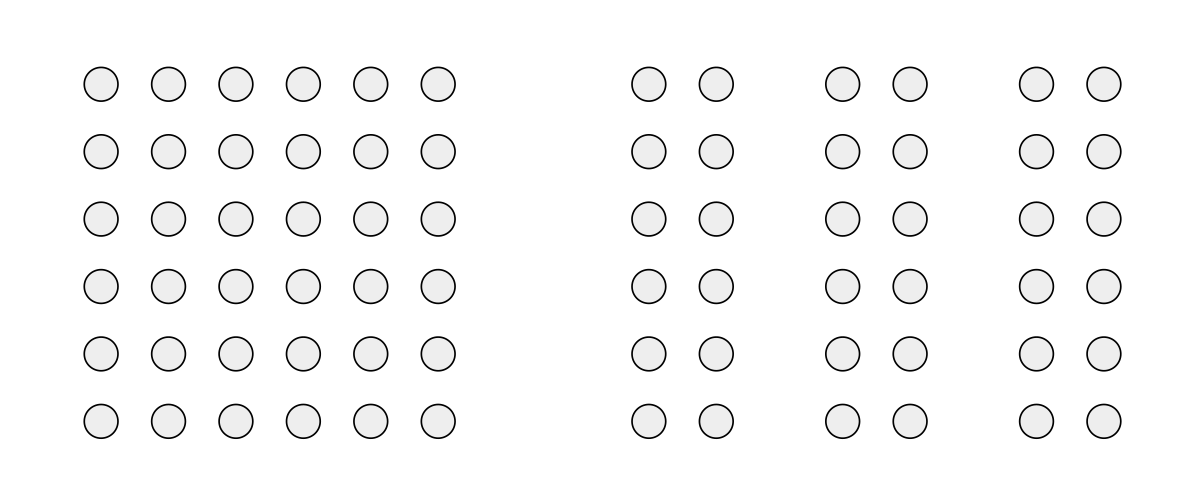
The proximity principle describes the psychological tendency for people to form interpersonal relationships with those who are physically close by. Repeated encounters create familiarity, making individuals much more likely to bond with someone who shares their floor, desk area, or neighborhood. It shows that convenience and regular contact often drive human connections more than deliberate choice.
By the edgi team We find the most surprising true thing about an idea and build a 60-second lesson around it.
In 1950, psychologist Theodore Newcomb studied a housing project at MIT to see how friendships formed. He found that people living next door were ten times more likely to be friends than those living at opposite ends of the same floor.
The power of passive contact
This is the proximity principle. It relies on the mere-exposure effect, where our brains mistake the comfort of a familiar face for a genuine emotional connection. We stumble into relationships because people are conveniently there.
An illustration of the Gestalt principle of proximity, showing two arrangements of gray circles. Kasufcgslfguhvsne, Public domain, via Wikimedia Commons
High-traffic zones like stairwells create passive contacts, the tiny, unplanned interactions that form the bedrock of lasting bonds.
Architecting connection
Companies now use this to engineer collaboration. By placing coffee machines in central hubs, offices force accidental meetings that wouldn't happen if everyone stayed in their own workspace.
A WeWork kitchen area in New York features a long wooden counter with white bar stools, where several people are seated. Nicki Dugan Pogue from San Francisco, USA, CC BY-SA 2.0, via Wikimedia Commons
Your next great friend might just be the person who happens to share your elevator the most.
Why physical closeness creates bonds
People gravitate toward those nearby for two main reasons. Humans naturally prefer familiar things, and repeated contact provides continuous opportunities for interaction. Psychologists Theodore Newcomb and Leon Festinger demonstrated this propinquity effect in residential housing studies at MIT, showing that frequent encounters steadily build attraction.
Proximity does not guarantee liking in every scenario. While regular contact encourages positive bonds, it can also lead to dislike if repeated interaction exposes detestable traits in either person. Familiarity breeds connection only when those negative traits remain absent.
Shared spaces and friendship formation
Friendship patterns depend heavily on shared daily environments, also known as social foci. In a study of 336 adolescents in an isolated Swedish town, researchers found that settings like neighborhood streets and shared schools drove the majority of friendships by offering repeated, predictable interactions.
When adolescents attended different schools, they rarely formed ties unless they shared a neighborhood. Living on the same block compensated for separate schooling, providing the repeated unplanned contact required for a bond to start.
The proximity effect online
Digital communication lets people message across any distance, yet physical closeness still governs social platforms. A sampled majority of social media postings occurs between people living in the same state or city.
Computer-based tools primarily expand communication between people who already share pre-existing connections in real life. Physical location continues to set the baseline for who enters a person's social circle.
Test yourself
What drives the proximity principle in friendship formation?
Passive familiarity from frequent contact. We form bonds because mere exposure breeds comfort, tricking us into feeling a connection with those who are simply nearby.
What drives the proximity principle in friendship formation?
Passive familiarity from frequent contact. We form bonds because mere exposure breeds comfort, tricking us into feeling a connection with those who are simply nearby.
How does the proximity principle explain workplace friendship patterns?
People mostly befriend those in high-traffic shared zones. High-traffic zones create passive contacts, making geography rather than deliberate choice the main driver of workplace bonds.
Play the lesson in edgi and the card is yours. It lands on your Map next to the ideas it connects to, and turns from matte to foil to gold as you learn more around it.
Propinquity is the state of being physically close to someone or something. In social psychology, it serves as a primary driver of attraction because it increases how often people cross paths.
What other attraction principles exist alongside proximity?
Psychologists identify several other attraction principles that interact with proximity. These include the elaboration principle, similarity principle, complementarity principle, reciprocity principle, and minimax principle.