Self-criticism is a personality trait where a person evaluates themselves negatively and blames their own character for failures. Instead of acting as an effective tool for self-improvement, excessive self-criticism represents a disrupted self-identity and is one of the strongest predictors of major depressive disorder. It often develops as a defense mechanism to anticipate failure and avoid social rejection.
By the edgi team We find the most surprising true thing about an idea and build a 60-second lesson around it.
We tend to think of a harsh inner voice as a tool for self-improvement. In psychological terms, however, excessive self-criticism involves a disrupted self-identity and a constant interrogation of one's own worth.
Patients in clinical settings frequently notice that this critical voice sounds remarkably like a specific authority figure from their past.
The defense mechanism
Why would the mind constantly attack itself? Often, it functions as a misguided defense mechanism. By beating you to the punch, the brain tries to anticipate failure and avoid social rejection.
Unfortunately, rather than motivating better performance, high levels of self-criticism are among the strongest predictors for major depressive disorder.
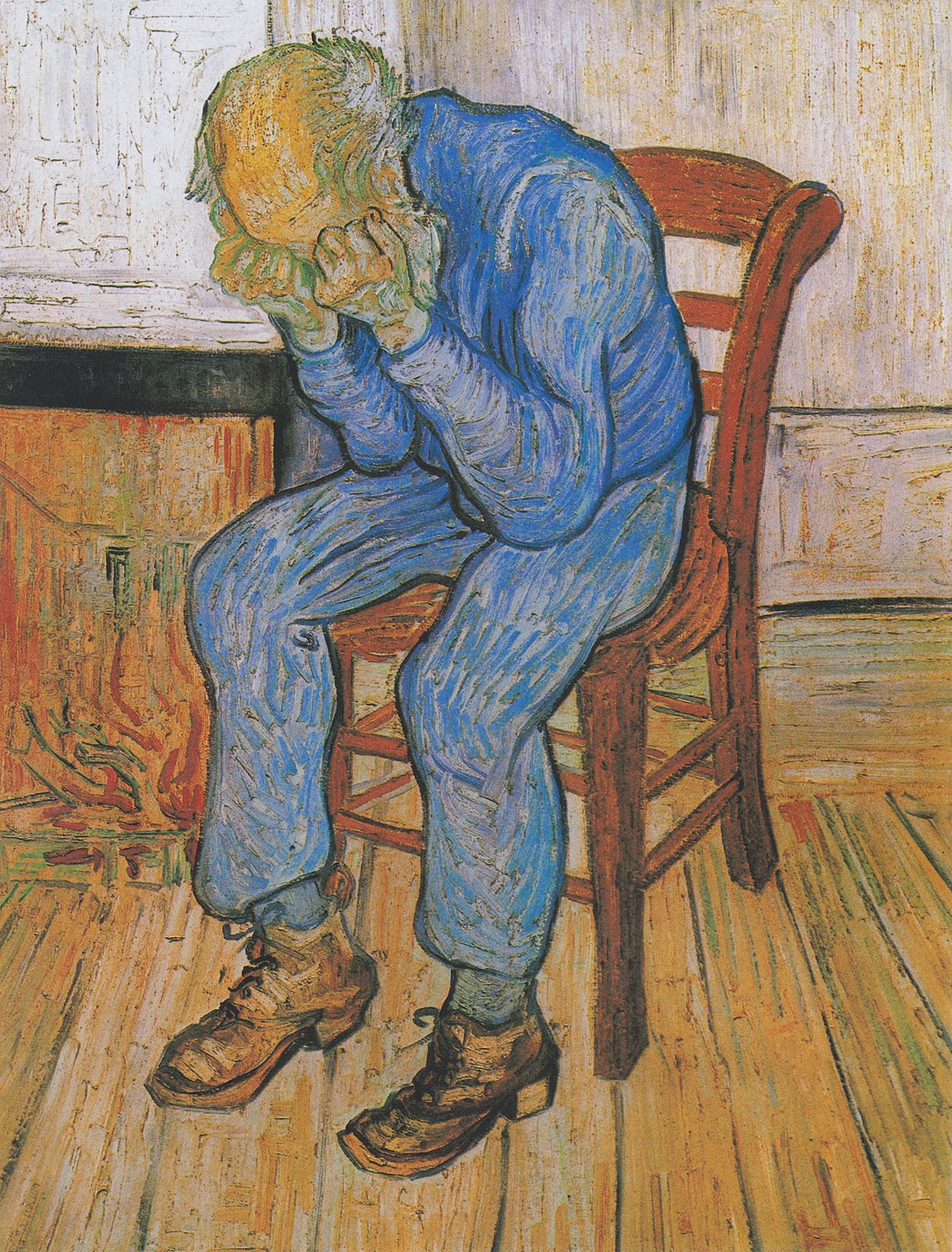
An oil painting by Van Gogh titled "Trauernder alter Mann" (Sorrowing Old Man), depicting an elderly man seated on a wooden chair, hunched over with his face in his hands. Vincent van Gogh, Public domain, via Wikimedia Commons
The antidote
Trying to force high self-esteem rarely silences the inner critic. Instead, psychologists point to self-compassion as a more effective counterbalance.
Two zafu meditation cushions and zabuton mats are set up on a wooden deck in a garden for zazen (sitting meditation). Marko Kafé, CC BY-SA 4.0, via Wikimedia Commons
Treating yourself with the same understanding you would offer a friend lowers the stakes of failure and quiets the noise.
How self-criticism shapes personality and behavior
In psychological models proposed by Sidney Blatt and Aaron Beck, personality develops along two main dimensions: interpersonal relatedness (or social dependency) and self-definition (or autonomy). A disruption in healthy self-definition leads to self-criticism. Rather than fluctuating purely with mood, research by Zuroff shows that self-criticism acts as a stable personality trait across time.
People high in self-criticism routinely attribute bad outcomes to personal deficiencies. Research by Mongrain shows that self-critics experience more negative affect, ask for less support, and perceive the help they get more negatively, even though they receive the same actual amount of support as others. In romantic relationships, high self-criticism predicts a drop in agreeable remarks and a rise in blaming.
Where the inner critic comes from
The habit of self-attacking often traces directly to childhood experiences with authority figures. Children raised by parents who use restrictive, rejecting practices show higher levels of self-criticism by age twelve. For women, these levels remain stable into young adulthood, often tied to dominant fathers, strict parental control, inconsistent affection, and intense pressure to achieve.
Child maltreatment is another strong risk factor for developing high self-criticism. Studies show self-criticism mediates the relationship between childhood abuse and negative adult outcomes, including lower maternal self-efficacy in mothers and acts of self-injury.
Test yourself
Does excessive self-criticism function primarily as a tool for self-improvement or a defense mechanism?
A defense mechanism. While it feels like a path to growth, the inner critic actually acts as a preemptive defense mechanism to guard against external rejection.
True or false: Excessive self-criticism acts as a reliable tool for self-improvement.
False. Self-criticism is not a constructive tool but a defense mechanism that attacks the self to anticipate failure; it is linked to depression rather than better performance.
Play the lesson in edgi and the card is yours. It lands on your Map next to the ideas it connects to, and turns from matte to foil to gold as you learn more around it.
Introjective depression is a specific type of depression defined by theorists like Sidney Blatt, marked primarily by harsh self-criticism, feelings of failure, and disruptions in self-definition. People with this form of depression continue to show self-critical traits even after their depressive episodes end.
Does self-criticism disappear when people try to raise their self-esteem?
Forcing high self-esteem rarely silences an inner critic. Psychologists find that self-compassion, which involves treating yourself with the same understanding you would offer a friend, works as a far more effective counterweight to lower the stakes of failure.