Sleep deprivation is the condition of not getting enough sleep duration or quality to keep your body and mind working properly. Losing just a single night of rest impairs reasoning, slows reaction times, and produces biological effects similar to legal intoxication. Over time, missing sleep creates an accumulating physical debt linked to long-term heart disease, diabetes, and cognitive decline.
By the edgi team We find the most surprising true thing about an idea and build a 60-second lesson around it.
After 24 hours without sleep, your cognitive performance mimics legal intoxication. Your prefrontal cortex, the area responsible for focus and judgment, effectively goes offline.
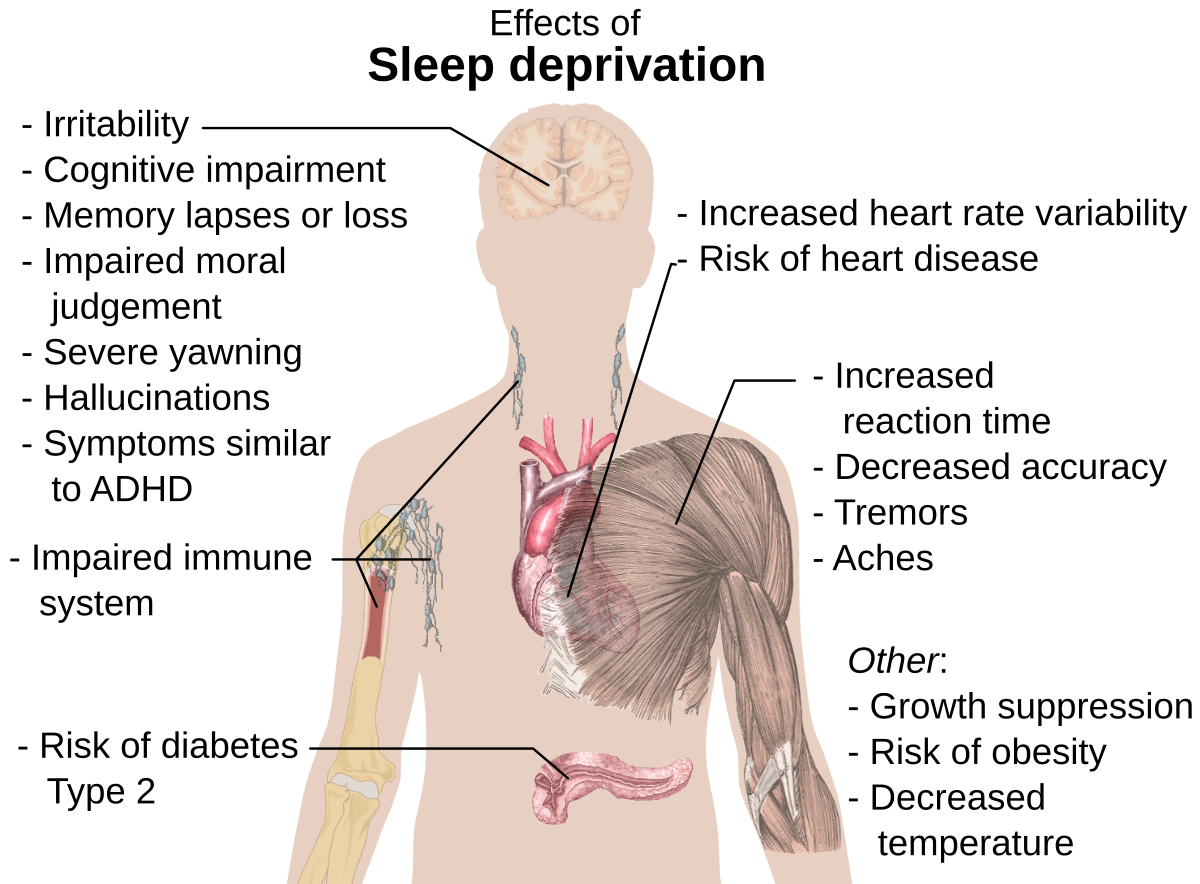
Diagram illustrating the main health effects of sleep deprivation on the human body. Mikael Häggström. When using this image in external works, it may be cited as: Häggström, Mikael (2014). "Medical galler, CC0, via Wikimedia Commons
You stop processing information linearly and start experiencing microsleeps: three-second blackouts where your brain briefly shuts down without you noticing.
The 11-day record
In 1964, 17-year-old Randy Gardner (record holder) stayed awake for 264 hours to set a world record. By day four, he was hallucinating; by day nine, he couldn't finish a sentence.
His case proved that sleep isn't just resting; it is a fundamental physiological requirement for sanity.
The nightly cleaning
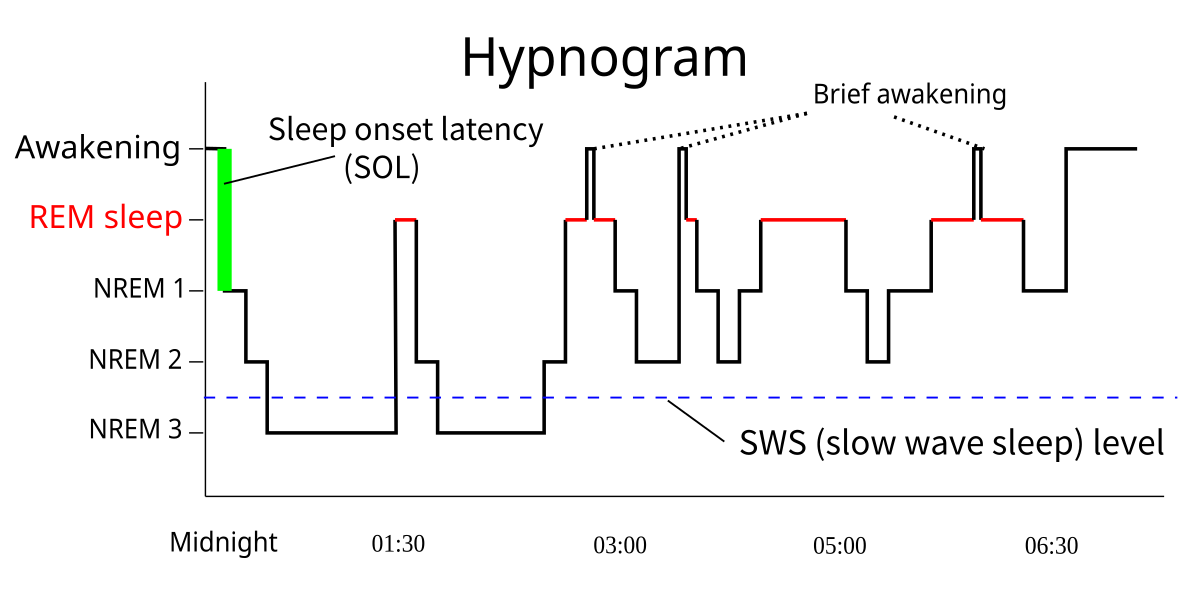
During Slow-Wave Sleep, your brain uses a dedicated plumbing system to flush out toxic metabolic waste. When you skip sleep, that waste remains, essentially poisoning your focus.
This is why you cannot pay back sleep debt with a single long nap; your brain needs that nightly cleaning cycle to reset.
Hypnogram illustrating sleep cycles, plotting sleep stages (Awakening, REM sleep, NREM 1, NREM 2, NREM 3) over time from Midnight to 06:30. RazerM, CC BY-SA 3.0, via Wikimedia Commons
What happens inside a sleep-deprived brain
A single night without sleep sharply lowers glucose metabolism, which is the process cells use to generate energy from blood sugar, in regions responsible for attention and alertness. Without adequate energy, the prefrontal cortex struggles to maintain executive functions like reasoning and decision-making.
Prolonged wakefulness forces the brain to take uncontrollable microsleeps lasting three seconds. Even if you try to stay awake continuously, your nervous system eventually shuts down in micro-bursts to force basic biological recovery.
Acute deprivation versus chronic sleep restriction
Researchers distinguish between acute sleep deprivation, which is zero sleep over a short window of one or two days, and chronic sleep restriction, where you routinely get less sleep than your body requires over weeks or months. Both patterns accumulate into what scientists call sleep debt.
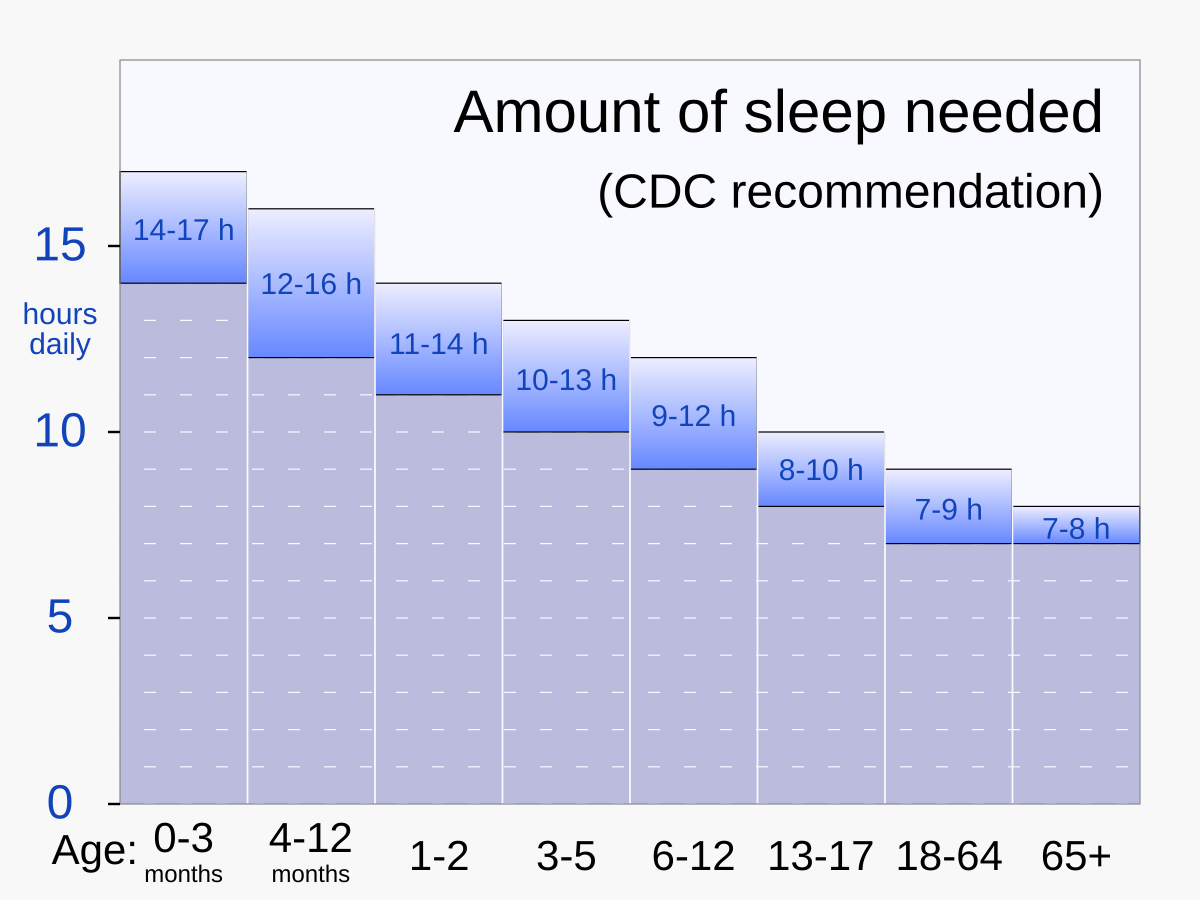
The chart illustrates how daily recommended sleep requirements decline steadily from infancy to adulthood. RCraig09, CC BY-SA 4.0, via Wikimedia Commons
Sleep debt is cumulative; losing two hours every night over a week builds up a deficiency that carries over into each following day. While adults generally need at least seven hours per night, school-aged children require 9 to 11 hours, making young populations especially vulnerable to chronic deficits.
Test yourself
What is the most effective way to recover from a week of moderate sleep loss?
Add one extra hour for several nights. Steadily extending sleep duration across multiple consecutive nights allows the brain cycles to stabilize and restore baseline attention.
After several nights of short sleep, what recovers first after one long night?
Perceived alertness and mood. Subjective sleepiness drops quickly after one restful night, while objective cognitive performance takes several consecutive nights to recover.
Is vulnerability to sleep loss mostly a fixed biological trait?
Yes, it is highly stable per person. Studies show that individual sensitivity to sleep deprivation remains consistent over time due to genetic differences in brain receptors.
Play the lesson in edgi and the card is yours. It lands on your Map next to the ideas it connects to, and turns from matte to foil to gold as you learn more around it.
What is the difference between sleep deprivation and insomnia?
Sleep deprivation describes the physical state of lacking adequate sleep, whereas insomnia is a specific disorder where a person struggles to fall asleep or stay asleep. Insomnia is one of several underlying causes that can trigger sleep deprivation.
Can sleep deprivation cause death?
Long-term total sleep deprivation has caused death in laboratory animals. In humans, complete continuous sleeplessness is rare outside of conditions like fatal insomnia, because the brain forces microsleeps to avoid total shutdown.