Sleep debt is the cumulative effect of not getting enough sleep over days or weeks. Missing rest causes physical and mental fatigue, impaired thinking, and emotional instability. While your reaction times and metabolism continue to degrade with ongoing restriction, your subjective feeling of sleepiness plateaus, leaving you unaware of your true impairment.
By the edgi team We find the most surprising true thing about an idea and build a 60-second lesson around it.
You cut an hour on Monday for work, lost another on Wednesday to your phone, and got up early on Friday. Nothing about you looks broken by Saturday. You would say you are tired but fine. Sleep debt is the running total of those hours. Pressure to sleep builds while you are awake and gets discharged by sleeping, so a short night leaves part of it standing and the next one stacks on it.
Fourteen nights in a lab
In 2003 a team put volunteers on 4, 6 or 8 hours in bed and held them there for fourteen nights running, with a separate group kept awake for three nights straight. Every day they ran a psychomotor vigilance task: watch a screen, press a button the moment a signal appears. A lapse is a trial where the hand does not arrive for half a second or more.
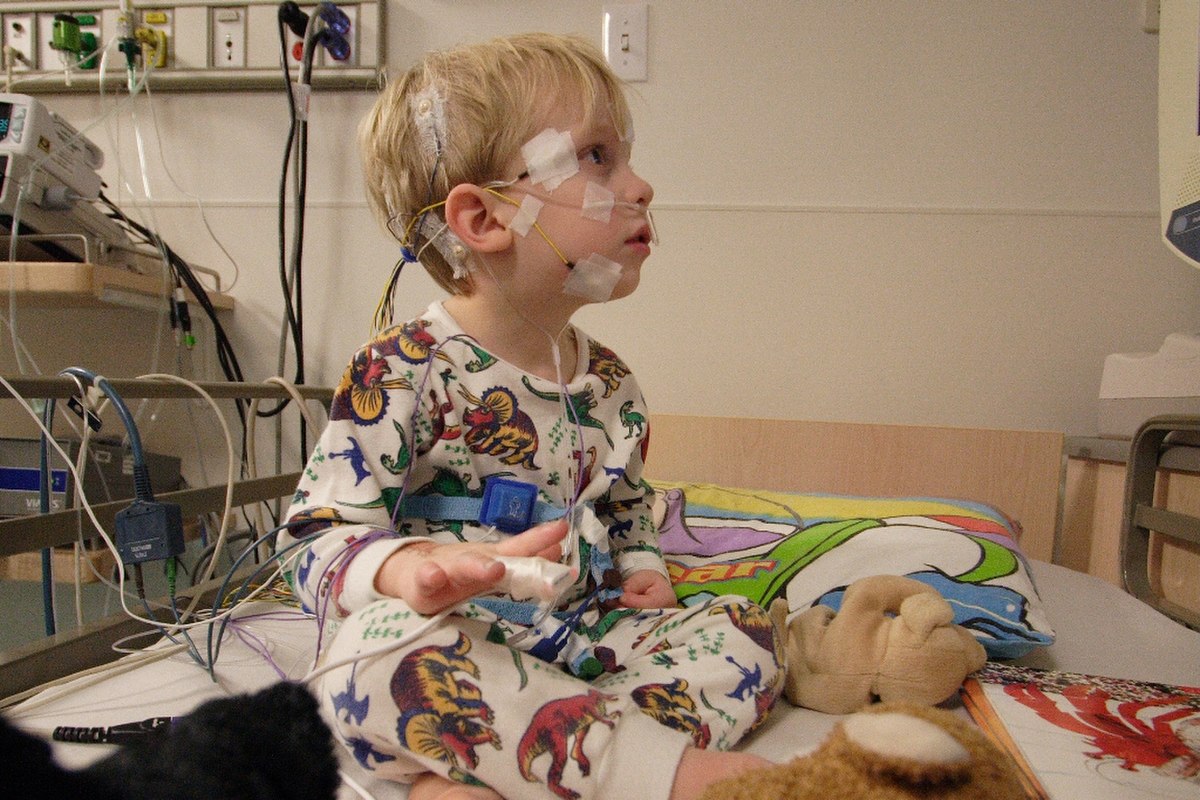
A young child, a pediatric polysomnography patient, is shown sitting up in a hospital bed with numerous wires and sensors attached to their head, face, and body. Robert Lawton, CC BY-SA 2.5, via Wikimedia Commons
The 8-hour group stayed flat. The 6-hour and 4-hour groups got worse every day for two weeks, until their deficits matched what up to two nights of no sleep at all produces.
The gauge stops moving
The volunteers also rated how sleepy they felt. Those ratings rose in the first days, then barely moved again, and they never separated the 6-hour group from the 4-hour group. Performance kept sliding while the feeling levelled off. The people in the study were largely unaware of how far they had drifted, which is what a busy fortnight feels like from inside.
A black and white still from Charlie Chaplin's 1922 film "Pay Day," showing Chaplin's character looking back at a woman in the foreground while walking with another woman. Charlie Chaplin, Public domain, via Wikimedia Commons
The weekend does not settle it
A 2019 study gave one group nine nights of short sleep, and another group the same nights with a weekend in the middle where they could sleep as long as they liked. Both groups gained about the same weight, a little over a kilogram. Insulin sensitivity dropped in both, and the weekend did not prevent it.
In the weekend group, insulin sensitivity in the liver and the muscle was lower again once the short nights resumed. The lie-in bought two good mornings and did not clear the account.
How sleep loss alters the brain and mood
A short sleep schedule rapidly degrades emotional control. In a study of young men restricted to four hours of rest for five nights, the left amygdala showed elevated activity in response to fearful faces, while responses to happy faces remained unchanged.
The medial prefrontal cortex normally communicates with the amygdala to help reframe negative feelings and suppress fear. Sleep loss disrupts this pathway. When communication between these two brain regions drops, emotional reactivity tilts heavily toward anxiety, fear, and general mood deterioration.
Metabolic and hormonal consequences
Cutting sleep disrupts the endocrine system within days. In a trial where young men were restricted to four hours in bed for six nights, carbohydrate tolerance dropped by 30%, showing lowered glucose and insulin responses compared to a well-rested state.
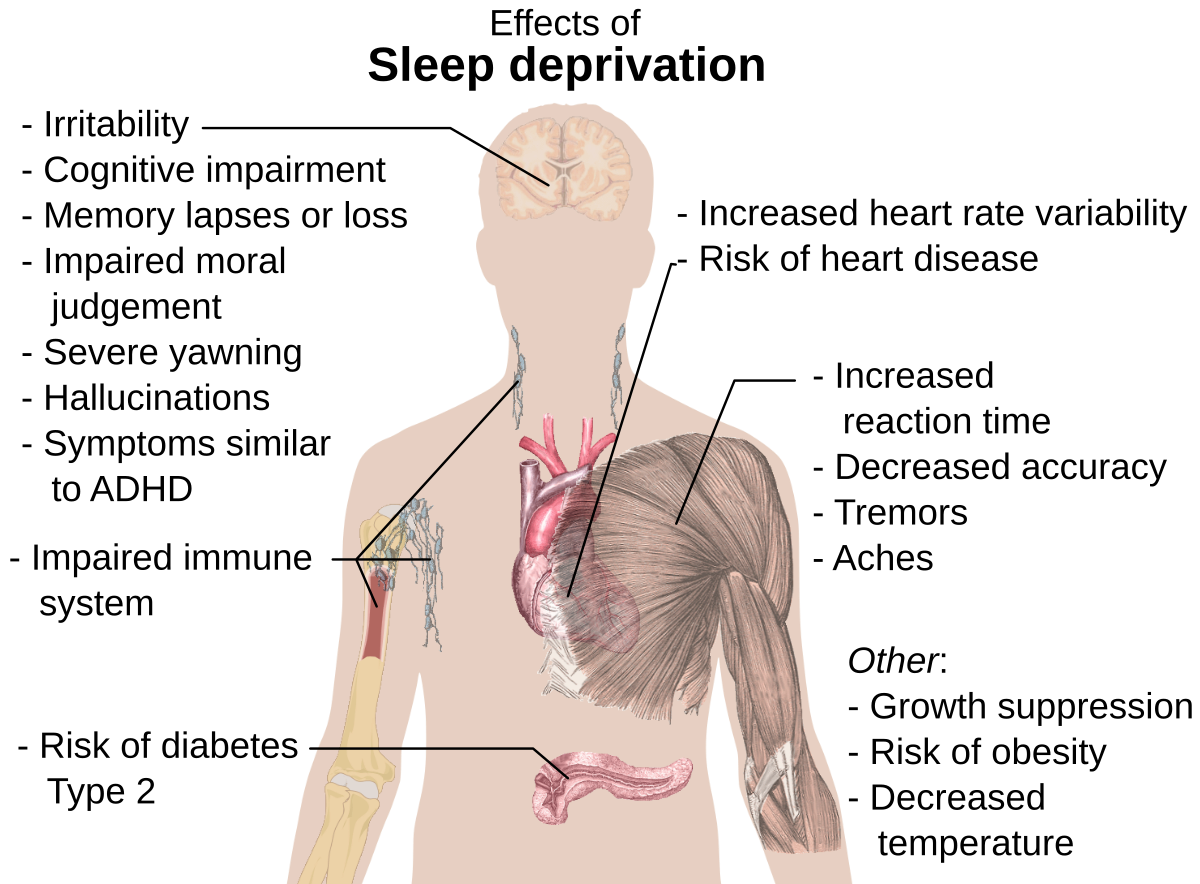
This diagram maps the physiological effects of sleep deprivation across major organ systems, including the endocrine and cardiovascular networks. Mikael Häggström. When using this image in external works, it may be cited as: Häggström, Mikael (2014). "Medical galler, CC0, via Wikimedia Commons
Sleep restriction also drives up sympathetic nervous system activity and elevates evening levels of the stress hormone cortisol, while thyrotropin concentrations decrease. Over time, chronic sleep deficit is linked to obesity through disruptions in appetite-regulating hormones like leptin and ghrelin, along with higher risks of diabetes, high blood pressure, and heart disease.
Test yourself
How does sleep debt change subjective tiredness over a prolonged period of partial sleep restriction?
Subjective tiredness plateaus while cognitive performance continues to decline.. People adapt to chronic sleep restriction and stop reporting increased fatigue, making internal feelings a poor gauge of actual impairment.
How does a single weekend of recovery sleep affect the physiological consequences of chronic sleep debt?
It provides temporary relief but fails to restore baseline metabolic markers.. Recovery lie-ins offer short-term relief for alertness but do not erase the underlying metabolic and cognitive toll of accumulated debt.
You sleep six hours on weeknights and sleep in on Saturday. What does the research show?
Sleeping in leaves the costs in place. Both groups gained about the same weight, and insulin sensitivity in liver and muscle was lower in the weekend group once short nights resumed.
Play the lesson in edgi and the card is yours. It lands on your Map next to the ideas it connects to, and turns from matte to foil to gold as you learn more around it.
Partial sleep deprivation occurs when a person sleeps too little for consecutive days or weeks. Total sleep deprivation happens when an individual is kept awake continuously for 24 hours or longer.
How does sleep debt correlate with mortality?
In adults aged 65 and younger, sleeping 5 hours or less per day during weekends correlated with a 52% higher mortality rate compared to sleeping 7 hours. However, these mortality correlations were not observed in individuals aged 65 and older.
Is sleep debt classified as an official medical disorder?
No, sleep debt is not considered a medical disorder. There is ongoing scientific debate regarding the exact specifics and measurement of the phenomenon.