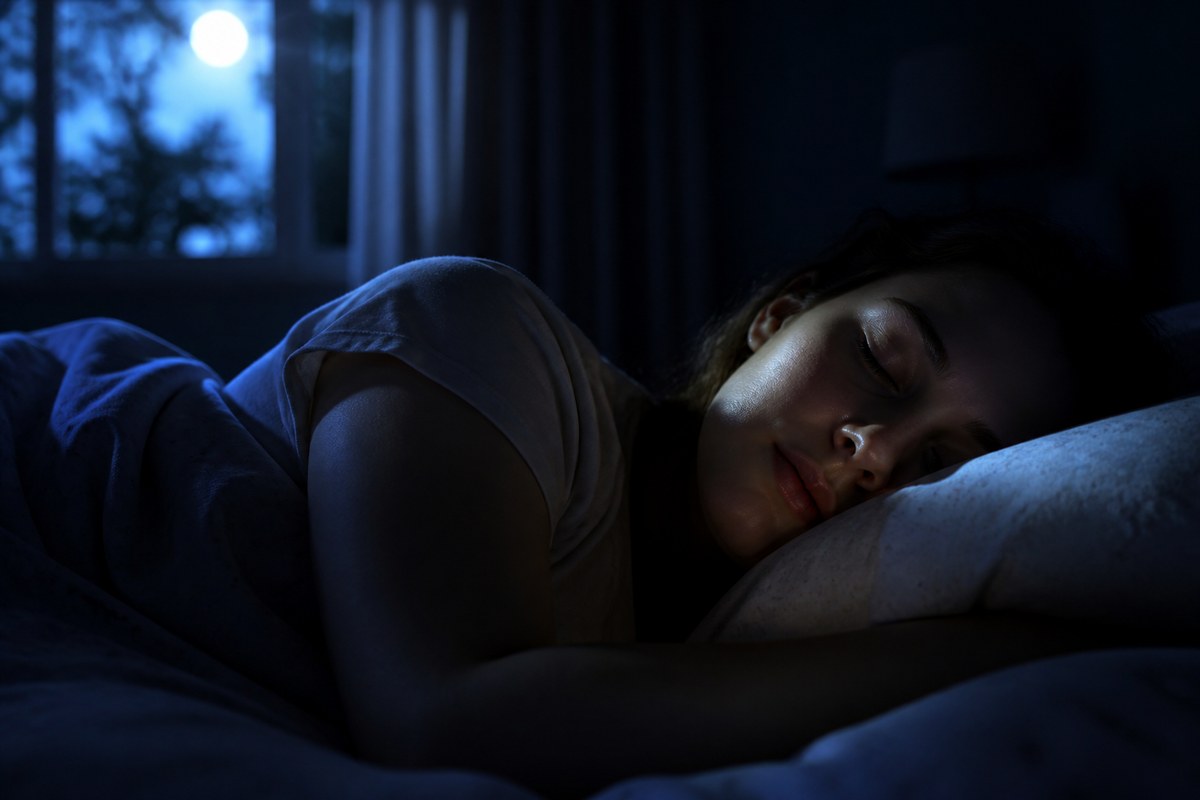
Slow-wave sleep is the deepest stage of non-rapid eye movement sleep, defined by large, synchronized electrical waves rolling across the brain. During this stage, your neocortex alternates between quiet rest and brief bursts of firing while your hippocampus replays recent facts and spatial locations to file them into long-term memory. It dominates the early hours of the night and protects declarative learning even when total sleep time is cut short.
By the edgi team We find the most surprising true thing about an idea and build a 60-second lesson around it.
Slow-wave sleep is the heavy part of the night. On a brain recording it shows up as large, slow waves rolling across the cortex, which is where the name comes from. It is loaded into the first third or so of the night. Later cycles carry less of it, and by the small hours there may be almost none left.
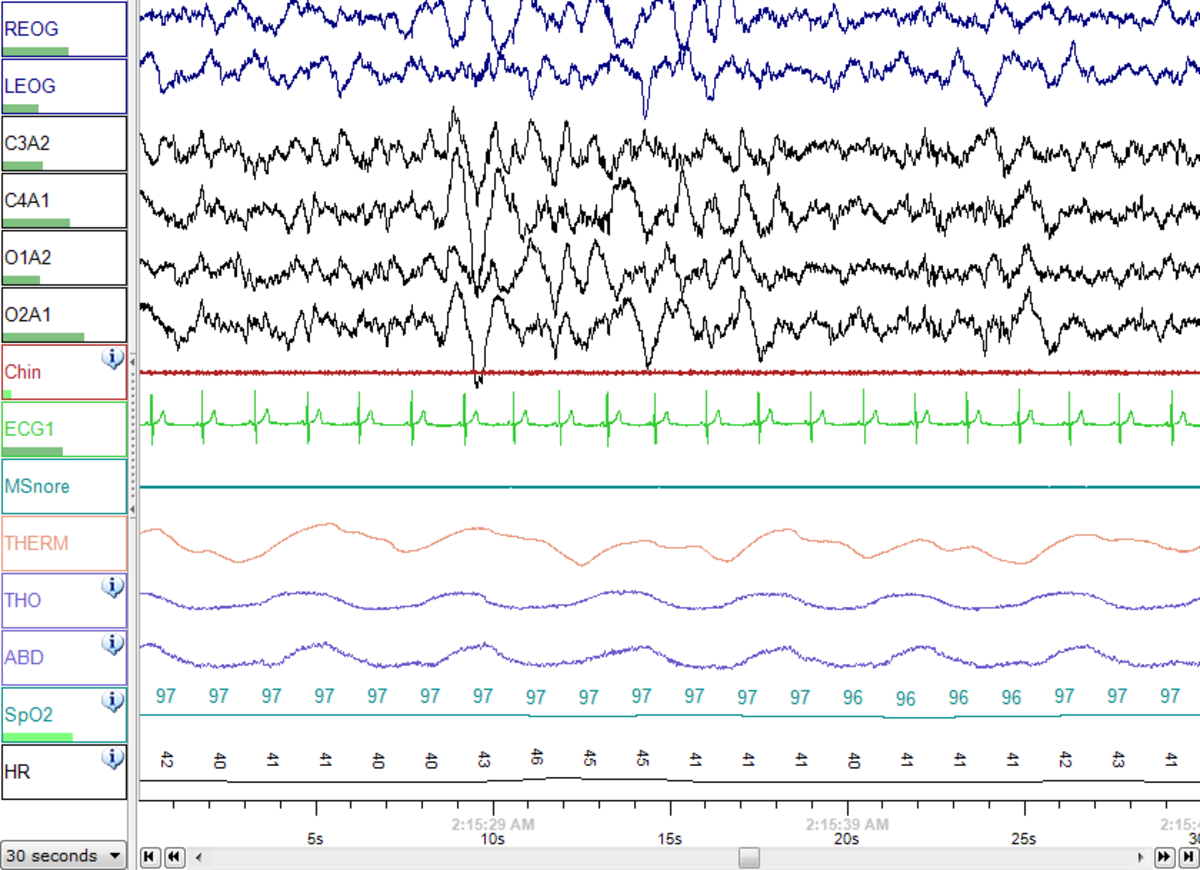
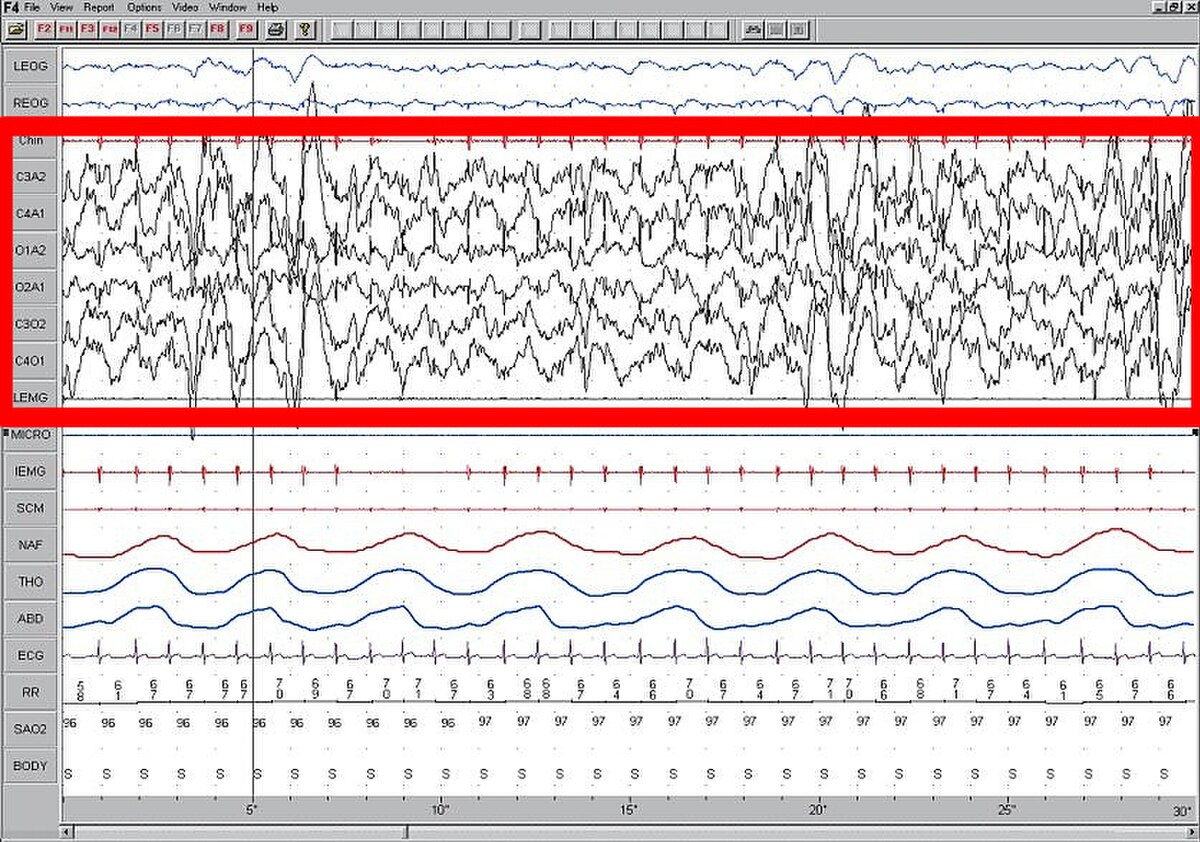
A polysomnography (PSG) recording displays multiple physiological signals over a 30-second period, indicating Sleep Stage N3. NascarEd, CC BY-SA 3.0, via Wikimedia Commons
It is also the sleep that is hardest to be pulled out of. Woken from it you get a few minutes of thick, useless confusion, which has its own name: sleep inertia.
The rose experiment
In 2007 a group in Lübeck had volunteers learn the positions of pairs of cards on a screen while a smell of roses was in the room. That night, once the sleepers were in slow-wave sleep, the same smell was released again. Nobody woke, and nobody knew afterwards that it had happened.
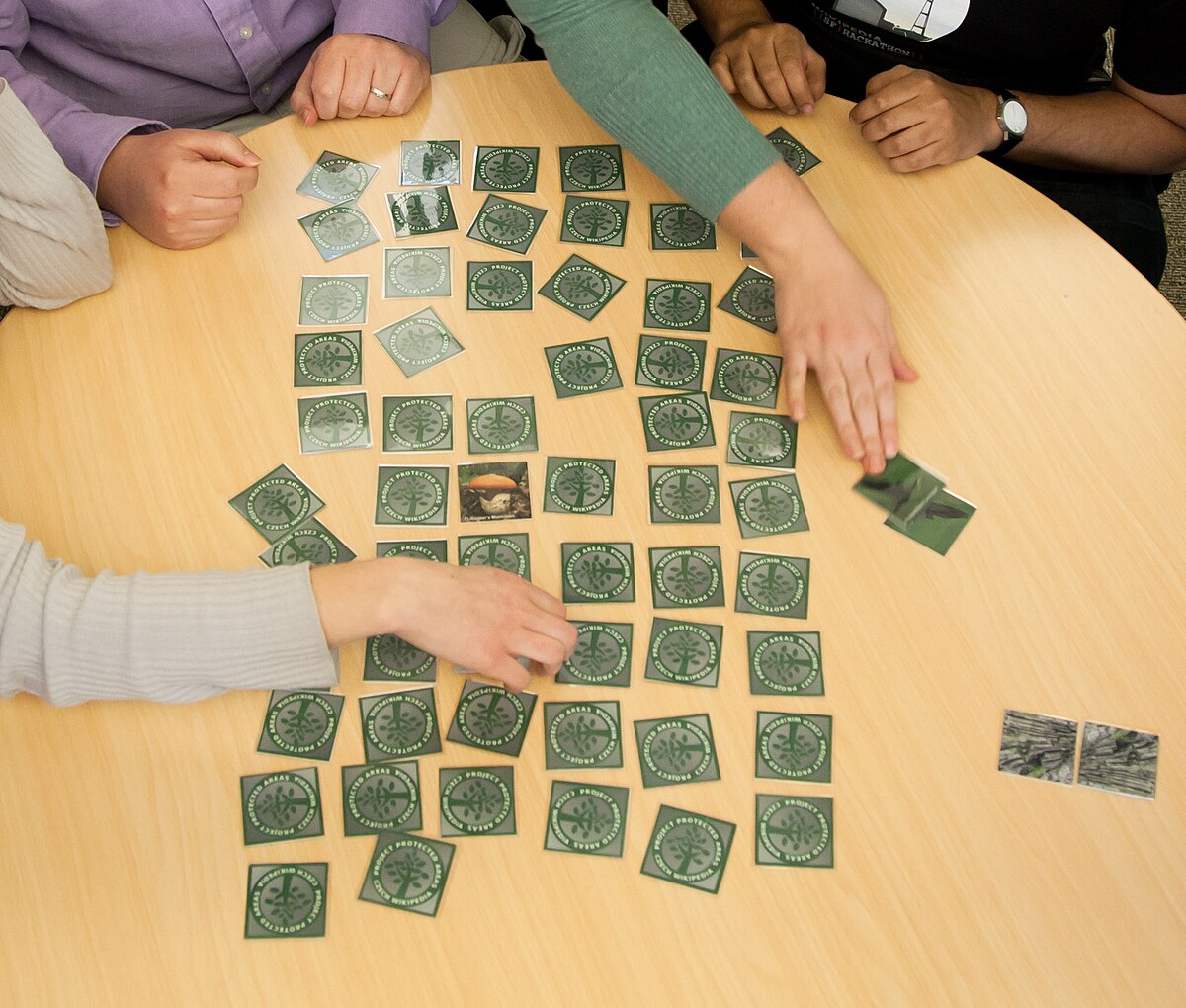
Several people play a card game of Concentration, with numerous green square cards spread across a round wooden table. Matthew (WMF), CC BY-SA 3.0, via Wikimedia Commons
In the morning they placed about 97 percent of the card pairs correctly. Without the smell during sleep, the figure was about 85 percent.
The controls are the point
The same puff given during REM sleep did nothing, and neither did one given while the person was awake. People who had learned the cards without the smell got nothing from it either. A hand skill learned the same evening did not improve either. That kind of procedural memory does not run through the hippocampus.
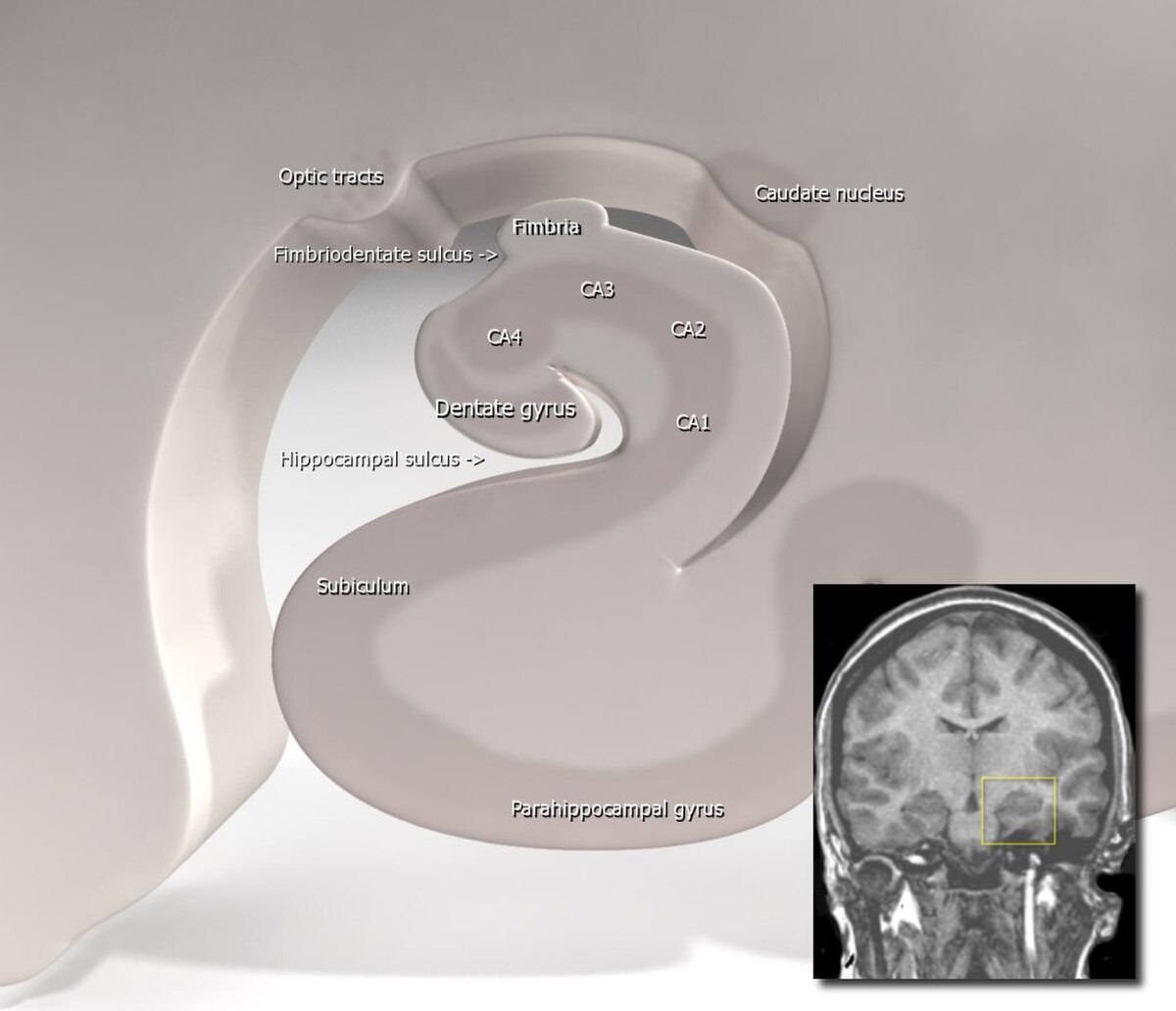
A 3D anatomical diagram of the hippocampus in the human brain, with various structures labeled including Optic tract, Fimbria, Fimbriodentate sulcus, Dentate gyrus, Hippocampal sulcus, Subiculum,… Fg, contact:[email protected], CC BY-SA 3.0, via Wikimedia Commons
In a scanner, the smell during slow-wave sleep set the hippocampus going. The cue was reaching the system that files facts and places, while it worked. That is memory consolidation caught in the act.
Why the first half matters
An earlier experiment split the night in two. Word pairs learned before an early, slow-wave-heavy stretch of sleep were held better; a hand skill improved more across the later, REM-heavy stretch. When sleep gets cut short, this is the stage the body protects: it comes first, and after a bad night it comes back first. What you lose off the end of a short night is mostly REM sleep.
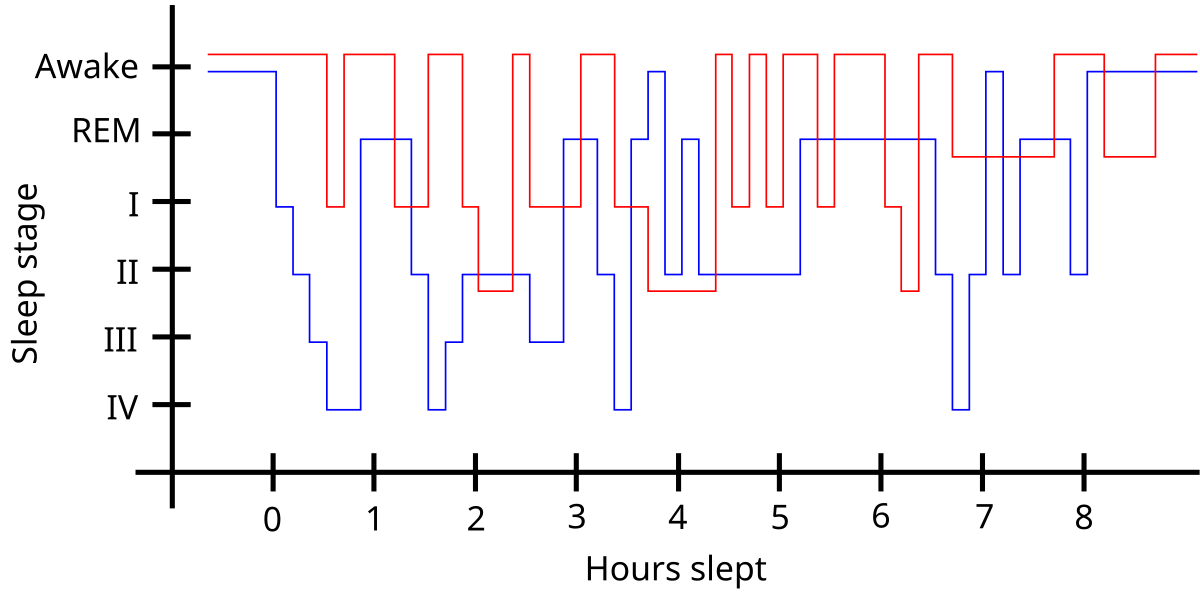
Graph comparing sleep patterns, with Sleep stage on the Y-axis (Awake, REM, I, II, III, IV) and Hours slept on the X-axis (0 to 8.5 hours). RLS-Schlafmuster.png: Markus Mueller derivative work: -- Editor at Large • talk, CC BY-SA 3.0, via Wikimedia Commons
What does not survive is skipping the night altogether. The replay runs during sleep, so an all-nighter after a day of learning gives it nowhere to happen.
What happens in the brain during slow-wave sleep?
A brain in slow-wave sleep produces synchronized electrical waves that range between 0.5 and 4.5 hertz with amplitudes topping 75 microvolts. Each slow oscillation has two phases: a hyperpolarizing down state where neocortical neurons fall silent to rest, followed by a depolarizing up state where neurons fire rapidly.
Red tracing highlights the high-amplitude, slow delta waves that define deep non-REM sleep on a brain recording. Public domain, via Wikimedia Commons
This rhythm relies on the suppression of acetylcholine, a chemical messenger that directs signals between brain areas. Keeping acetylcholine levels low lets the hippocampus transmit stored facts, routes, and emotional memories to the neocortex without disruption. Raising cholinergic activity during this stage disrupts that memory consolidation process entirely.
How does the body change during deep sleep?
Slow-wave sleep, also called stage N3 sleep, brings a distinct shift across your entire physiology. Muscle tone remains moderate, eye movements become slow or vanish entirely, and genital activity stops. Inside the nervous system, sympathetic activity drops while parasympathetic activity rises, slowing the body down.
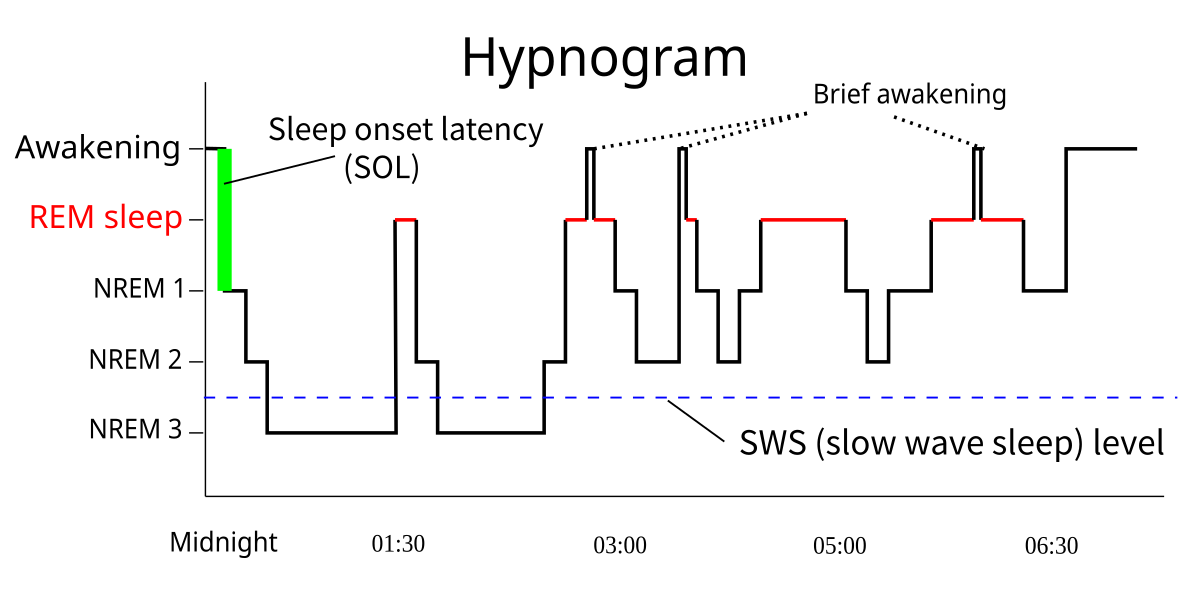
The hypnogram shows slow-wave sleep concentrated heavily in the first few hours of a typical night. RazerM, CC BY-SA 3.0, via Wikimedia Commons
This stage triggers the highest surge of growth hormone secretion found anywhere in the sleep cycle. It also offers the brain a chance to recover from daily mental demands that burn through glucose. Most of this deep stage happens across the first two sleep cycles, lasting between 70 and 90 minutes early in the night before tapering off.
Test yourself
Does slow-wave sleep dominate the first third or final hours of the night?
First third of the night. Slow-wave sleep is heavily front-loaded into the beginning of the night, while later cycles shift toward REM sleep.
Why does memory consolidation benefit from targeted cues during slow-wave sleep?
It reactivates hippocampal filing. Cues presented during slow-wave sleep stimulate the hippocampus, actively replaying and securing factual memories while you rest.
In a study, a rose scent was paired with a learning task, then replayed during sleep. When did it improve people's memory?
When it came back during slow-wave sleep. The cue worked in slow-wave sleep and did nothing in REM sleep or in waking, which is what ties the filing of facts to the deep part of the night.
Play the lesson in edgi and the card is yours. It lands on your Map next to the ideas it connects to, and turns from matte to foil to gold as you learn more around it.
Children and young adults experience the highest amounts of slow-wave sleep. As people age, the total time spent in this stage declines, and older adults may go through entire nights without entering slow-wave sleep at all.
What is the difference between stage 3 and stage 4 sleep?
Before 2007, clinical guidelines split slow-wave sleep into stage 3 and stage 4 based on the proportion of delta waves present. The American Academy of Sleep Medicine combined both stages into a single category known as Stage Three or N3 sleep, which requires at least 20 percent slow-wave activity in a 30-second epoch.