Circadian RhythmWhy your clock runs longer than a day
A circadian rhythm is a natural biological cycle that repeats roughly every 24 hours from inside an organism rather than simply reacting to the sun. It coordinates internal biological processes so they happen at the right time to keep an organism alive and functioning well. Without external cues to correct it, the human internal clock runs slightly longer than a day, averaging about 24 hours and 11 minutes.
By the edgi team We find the most surprising true thing about an idea and build a 60-second lesson around it.
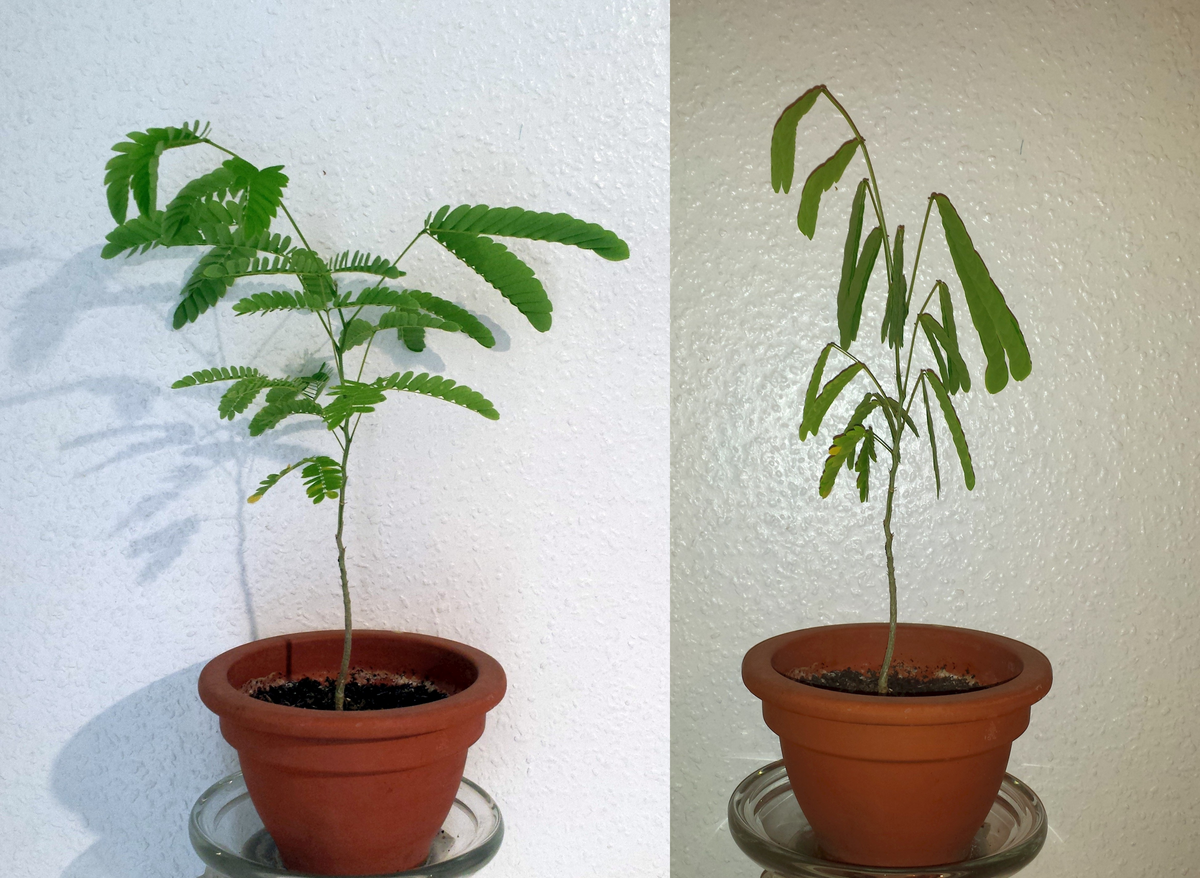
In 1729 a French astronomer, Jean-Jacques d'Ortous de Mairan, was watching a Mimosa pudica on his windowsill open its leaves in the morning and fold them at night. He shut the plant in a dark cupboard and kept checking on it. The leaves went on opening in the morning and closing at night with no daylight reaching them at all.
A Mimosa pudica plant, also known as the "touch-me-not" plant, is shown with its leaves fully open. User:Bluemoose, CC BY-SA 3.0, via Wikimedia Commons
De Mairan did not conclude that the plant had a clock. He thought it was still picking up the sun some other way, through heat or something else that got into the cupboard.
The period gives it away
The measurement that settles it came a century later. Kept in constant light, the leaf cycle ran at about 22 to 23 hours instead of 24. A plant following the sun cannot run fast. Something inside was keeping time on its own, slightly wrong, which is what a circadian rhythm is: a roughly daily cycle generated inside the organism.
Where yours is
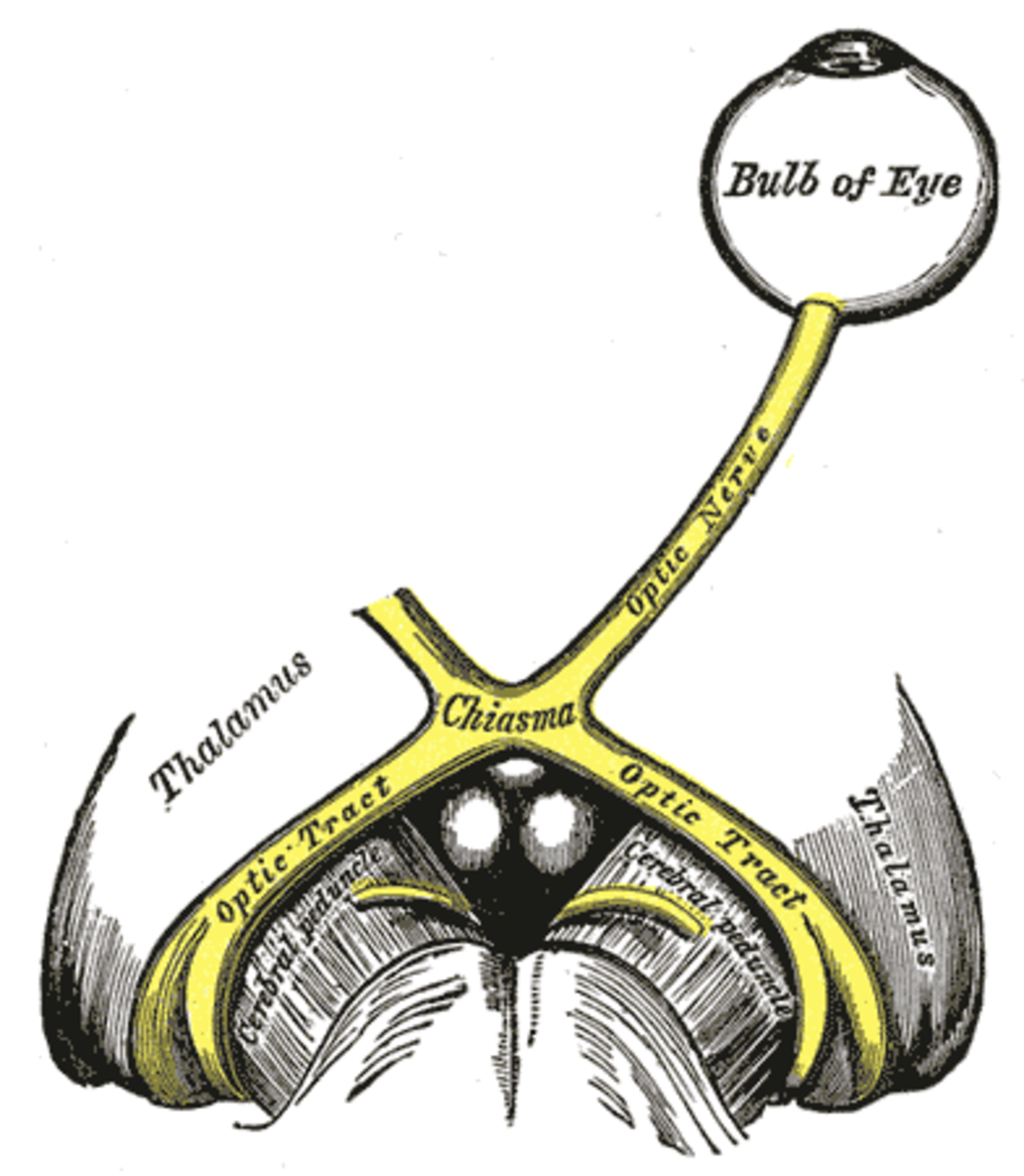
Your own clock is a pair of cell clusters in the hypothalamus called the suprachiasmatic nuclei. They sit just above the point where the optic nerves cross. Destroy them in an animal and the daily rhythm of activity goes. Transplant a working pair into an animal whose own has been destroyed, and it runs on the donor's period, not its own.
A diagram illustrating the optic chiasm and its connections to the eye and brain, with the optic chiasm, optic nerve, and optic tract highlighted in yellow. Henry Vandyke Carter, Public domain, via Wikimedia Commons
Yours does not keep exact time either. Measured on volunteers who had no way of knowing the hour, the human clock averaged about 24 hours and 11 minutes.
Light is what sets it
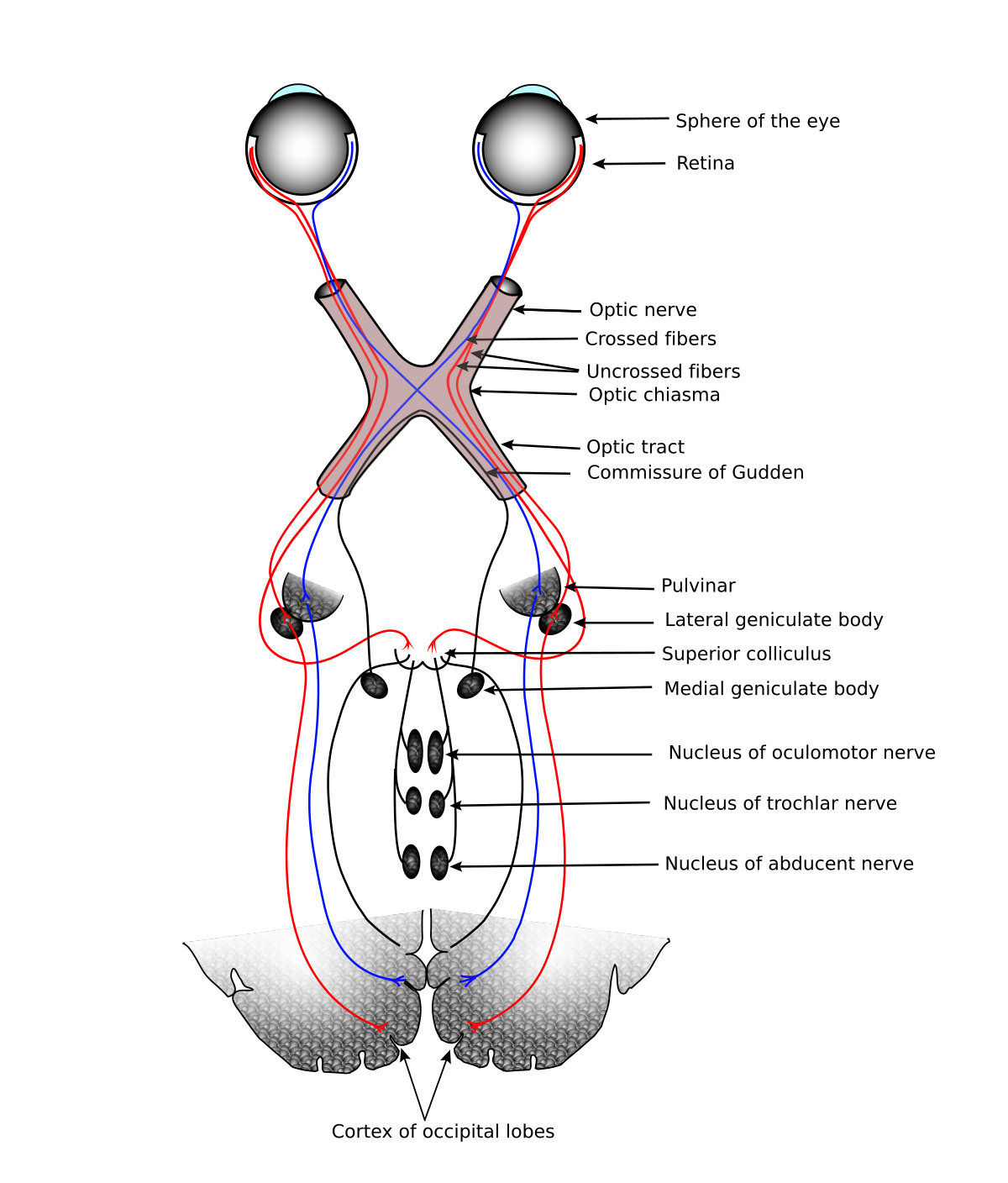
Light is what holds that clock on local time. A signal runs from the eye straight to the suprachiasmatic nuclei along its own pathway, separate from the one that builds what you see. Because the internal day runs long, it has to be pulled back daily. Morning light pulls the clock earlier; light late in the evening pushes it later.
Diagram illustrating the human visual pathway, showing the optic nerves from both "Sphere of the eye" and "Retina" crossing at the "Optic chiasma". KDS444, Public domain, via Wikimedia Commons
That is why a fixed wake time and getting outside early are the two standard levers. They are the daily correction on a clock that does not run at 24 hours.
How your internal clock works
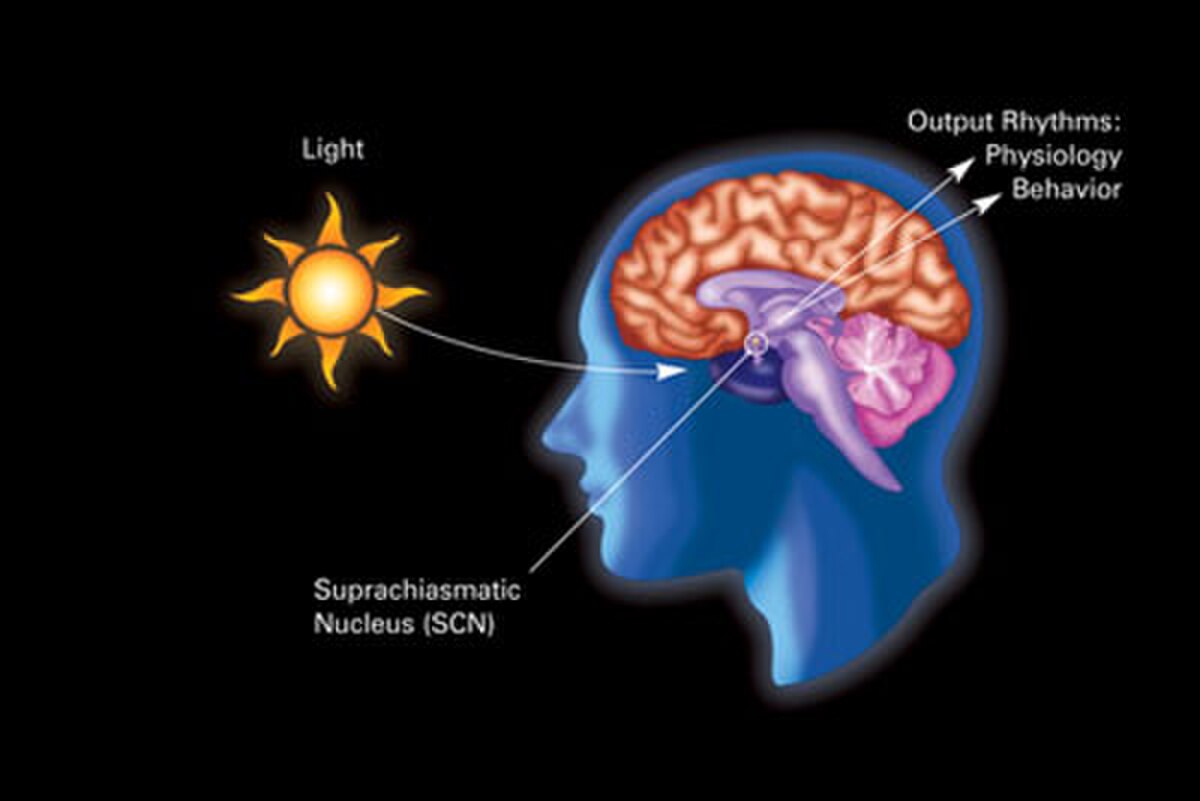
In humans, the master clock is a pair of cell clusters in the hypothalamus called the suprachiasmatic nuclei, located right above where the optic nerves cross. Destroying these clusters in an animal erases its daily activity rhythm, while transplanting working donor tissue makes the animal adopt the donor's cycle length instead.
Light enters the eye and travels to the suprachiasmatic nucleus, which coordinates circadian rhythms across the body. National Institute of General Medical Sciences, Public domain, via Wikimedia Commons
Internal biological cycles must meet specific criteria to count as circadian rhythms: they must be endogenous, meaning they originate inside the organism and persist even in total darkness, and they must run on a period of roughly 24 hours. Because they are driven by internal genes and proteins rather than immediate reactions to the environment, general 24-hour patterns are termed diurnal rhythms only until an internal origin is confirmed.
How light resets the clock
External cues that calibrate the internal clock to the outside world are called zeitgebers, a German term meaning time givers. Light is the primary zeitgeber, though temperature and redox cycles also serve as environmental cues.
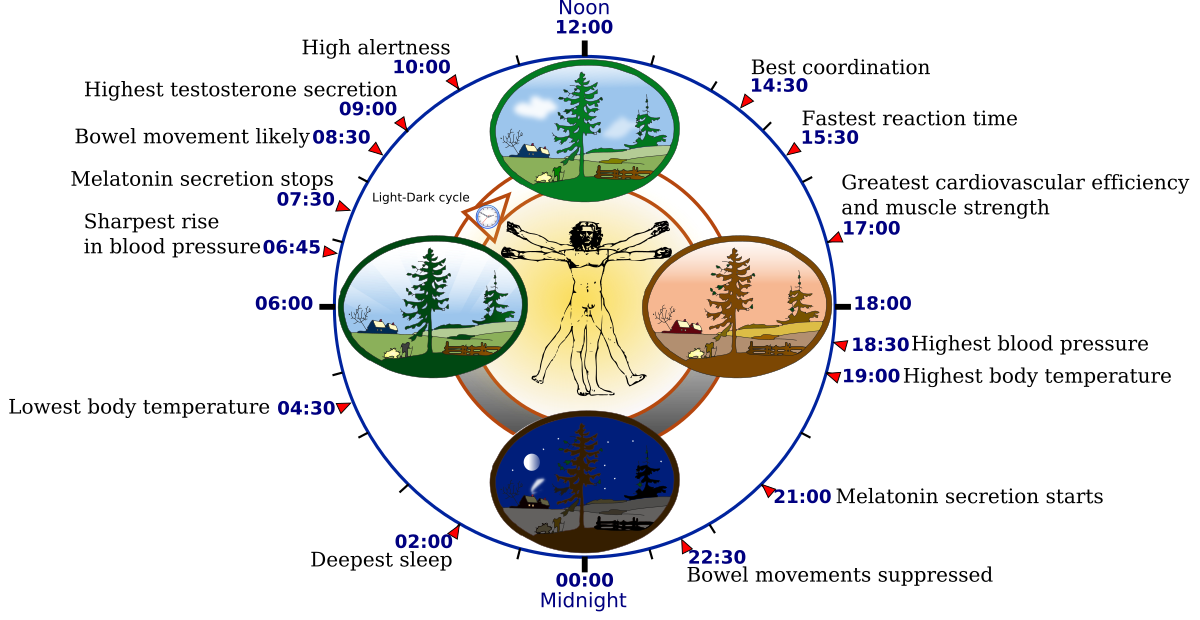
A 24-hour cycle map showing how the human biological clock coordinates hormone releases and daily physiological rhythms. NoNameGYassineMrabetTalk✉ fixed by Addicted04, CC BY-SA 3.0, via Wikimedia Commons
A dedicated nerve pathway carries signals from the eye directly to the suprachiasmatic nuclei, operating entirely separately from normal vision. Because human clocks naturally run about 11 minutes long every day, light acts as an essential reset: morning light pulls the cycle earlier, while light late in the evening shifts it later.
The genetic discovery of internal time
Internal clocks are not exclusive to humans; they evolved independently across animals, plants, fungi, and cyanobacteria. Early observations include 4th century BC records of tamarind leaves opening and closing, as well as 13th-century Chinese medical manuals documenting daily cycles.
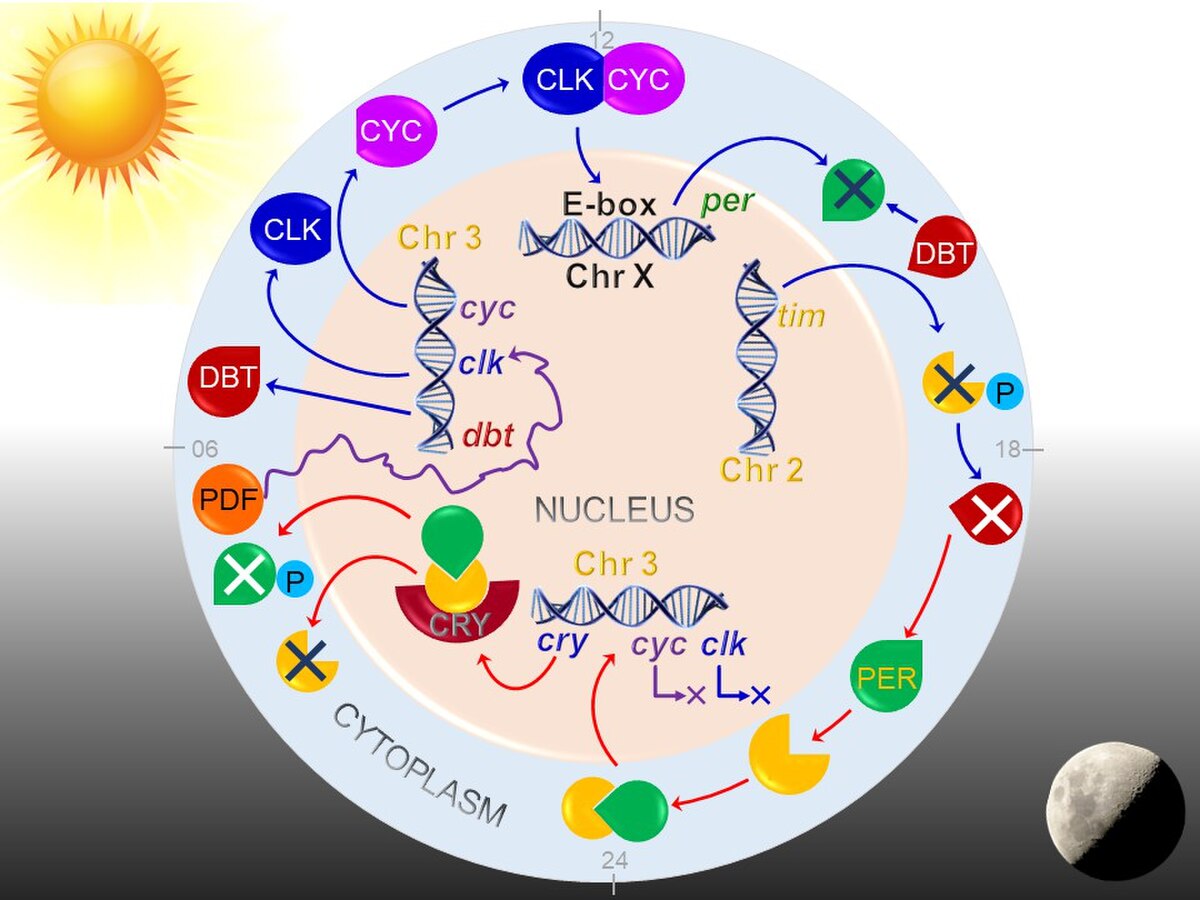
The molecular cycle of clock genes and their proteins, which generate the internal daily timing mechanism. Chhandama, CC BY-SA 4.0, via Wikimedia Commons
The first clock mutation was discovered in fruit flies in 1971 and named the period (per) gene, proving that internal timing has a genetic basis. In humans, mutations can dramatically alter schedules: a single amino acid change in the human PER2 protein causes familial advanced sleep phase syndrome, turning affected individuals into extreme morning larks whose sleep cycles run four hours early.
Test yourself
For a circadian rhythm running longer than 24 hours, what does morning light do?
It pulls the clock earlier. Morning light pulls the internal clock earlier, helping correct its daily drift. Evening light tends to push it later.
What generates a circadian rhythm without external cues?
An internal biological timekeeping process. A circadian rhythm is generated internally; light can reset the clock, but it does not have to trigger each cycle.
Why are you much easier to wake at 3 AM than at midnight?
Sleep is lighter and cortisol is rising. By the second half of the night, deep sleep debt is cleared and the circadian rhythm begins releasing cortisol, making light awakenings much more likely.
Play the lesson in edgi and the card is yours. It lands on your Map next to the ideas it connects to, and turns from matte to foil to gold as you learn more around it.
What is the difference between a diurnal rhythm and a circadian rhythm?
A diurnal rhythm is any biological process that follows a 24-hour cycle. It is only classified as a circadian rhythm if scientists confirm it is generated internally by the organism rather than purely driven by external environmental triggers.
What is a zeitgeber?
A zeitgeber is an external environmental cue that resets and synchronizes an internal clock to local time. Light is the most common zeitgeber, alongside temperature and redox cycles.
What happens when circadian rhythms become abnormal in humans?
When an individual's internal timing becomes desynchronized or altered in a clinical setting, it is diagnosed as a circadian rhythm sleep disorder. An example is familial advanced sleep phase syndrome, where a genetic mutation shifts sleep cycles four hours earlier than normal.