A dream is a series of images, events, and emotions that your mind generates involuntarily while you sleep. Humans typically spend over two hours dreaming each night, broken into sessions lasting 5 to 20 minutes. Rather than delivering hidden messages, dreaming happens as the brain synthesizes internal signals while its logic centers remain mostly inactive.
By the edgi team We find the most surprising true thing about an idea and build a 60-second lesson around it.
During REM sleep, your brain stem sends random electrical bursts to your visual and emotional centers. Your higher brain doesn't like chaos. It desperately tries to stitch those random pulses into a coherent story.
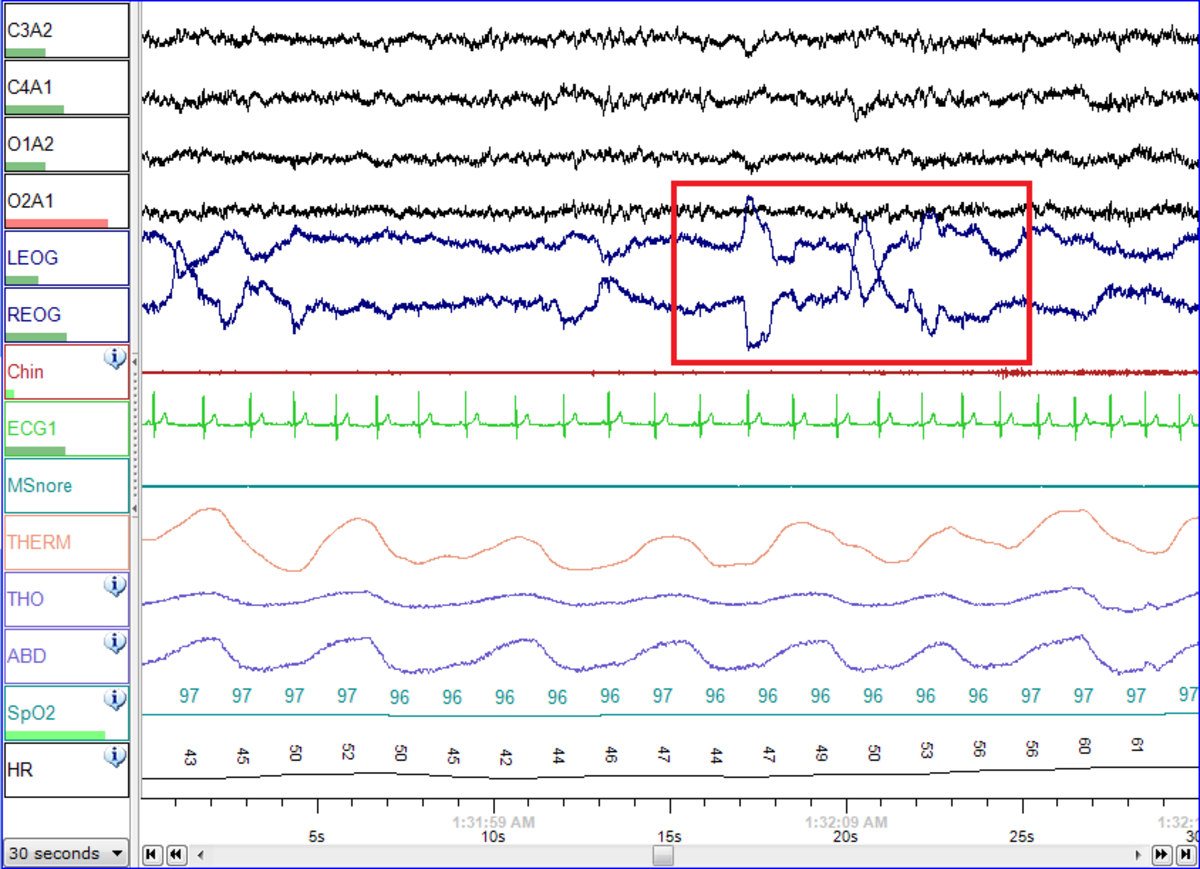
A polysomnography (PSG) recording displaying multiple physiological signals during REM sleep, including EEG (C3A2, C4A1, O1A2, O2A1), EOG (LEOG, REOG), EMG (Chin), ECG (EOG1), and respiratory… NascarEd, CC BY-SA 3.0, via Wikimedia Commons
Think of it like an improvisational actor handed a random prop on stage: they must build a scene around it, no matter how weird the object is.
The logic gap
While this happens, the prefrontal cortex, the part of your brain responsible for logic and self-awareness, is mostly offline. That is why you can be chased by a giant floating toaster and think, 'This makes perfect sense.'
Your internal 'weirdness detector' is disabled, so you accept the narrative without question.
The purpose
In 1977, researchers Allan Hobson and Robert McCarley formalized this as the activation-synthesis hypothesis. It suggests dreams aren't hidden messages from your soul, but a biological byproduct of the brain organizing itself.
An animation shows a stylized human brain with various regions lighting up, representing neural activity. Fastfission on en.wikipedia (or de.wikipedia), CC BY-SA 3.0, via Wikimedia Commons
Rival theories go further: this nightly chaos helps you consolidate memories and rehearse threats in a safe simulation.
How the brain creates dream narratives
In 1977, researchers Allan Hobson and Robert McCarley introduced the activation-synthesis hypothesis. During rapid-eye movement (REM) sleep, the brain stem fires bursts of electrical activity into visual and emotional areas. The higher brain reacts by weaving these random pulses into a narrative, much like an actor improvising a scene around unexpected props.
This storytelling happens while the prefrontal cortex, which handles logic and self-awareness, remains largely offline. Without this internal monitor, strange shifts feel entirely natural during the dream. Locations and objects blend into each other, and you accept bizarre scenes without question.
What people actually dream about
Calvin S. Hall analyzed over 50,000 dream reports and found that negative emotions dominate human dreaming. Anxiety is the most common emotion, followed by anger, fear, and feelings of abandonment. Positive emotions like joy appear far less frequently, while sexual content accounts for only 8 to 10 percent of dreams.
Dream content also reflects sensory inputs and external stress. People who are blind from birth do not experience visual imagery in dreams; instead, their dreams consist of hearing, touch, taste, and smell. During the COVID-19 pandemic, a study of over 15,000 dream reports showed that themes of fear, illness, and death multiplied two to four times.
Test yourself
Why are loved ones such common dream characters?
They fill a large part of your memory. People you love are tied to the most memories and feelings, so the sleeping brain reaches for them most easily. A dream appearance says little about what will happen to them.
You dream your sister is in danger, but she is fine. What best explains the dream?
A worry used a familiar face to play out. Emotion-processing areas stay active in REM sleep while the checking part of the brain is quieter. A worry can borrow a well-remembered person to act it out.
Why are most dreams forgotten seconds after waking?
The brain paused long-term storage. During dream sleep, brain chemicals required to store long-term memories drop sharply. You only remember scenes caught by an abrupt awakening.
Play the lesson in edgi and the card is yours. It lands on your Map next to the ideas it connects to, and turns from matte to foil to gold as you learn more around it.
No, dreams also occur during non-REM sleep stages. However, they are most frequent during REM sleep, when brain activity rises to levels similar to being awake.
How did ancient people view their dreams?
Ancient Mesopotamians and Egyptians often experienced visitation dreams, where gods or ancestors commanded them to act or predicted the future. In these early accounts, dreamers were mostly passive listeners rather than active participants in a story.
Do animals experience dreams?
Scientists cannot prove whether animals dream because studying dreams requires a verbal report from the sleeper. All mammals show REM sleep patterns, which leads researchers to suspect they might dream, but it remains unconfirmed.