PsychoanalysisWhy the ego is not master in its home
Psychoanalysis is a theory of mind and a talk therapy method founded by Sigmund Freud to treat mental disorders by uncovering unconscious mental processes. It treats everyday thoughts, slips, and dreams as clues to hidden drives that the conscious mind represses. The approach shows that conscious awareness is only a small part of mental life, leaving the conscious self to manage ongoing conflicts with buried impulses.
By the edgi team We find the most surprising true thing about an idea and build a 60-second lesson around it.
Psychoanalysis is a theory of mind, a treatment method, and a school that grew from Freud's work. In classical analysis, a patient uses free association and says what comes to mind without first making it neat, relevant, or persuasive.
The analyst listens not only to the story but to its patterns: where the person hesitates, repeats themselves, changes the subject, or reacts strongly to the analyst.
The relationship joins the work
A patient may begin to change the subject whenever a family memory appears. In psychoanalysis, that shift can be treated as resistance, something to explore rather than a failure to cooperate. Feelings toward the analyst, including transference, are material too. The relationship is not merely the place where treatment happens; it is one of the places the pattern may appear.
The aim is not to catch someone hiding a secret. It is to pay attention to recurring ways of feeling, speaking, and relating so they can be understood.
A family of later therapies
Later psychodynamic therapies grew from psychoanalysis, but they do not all keep classical analysis unchanged. A later therapy may be shorter, more focused, or less centered on Freud's original drive theory while still working with relationships, patterns, and meanings outside immediate awareness.
That family resemblance matters. Psychoanalysis is one distinct method, not another name for every therapy that uses conversation.
How does psychoanalysis work?
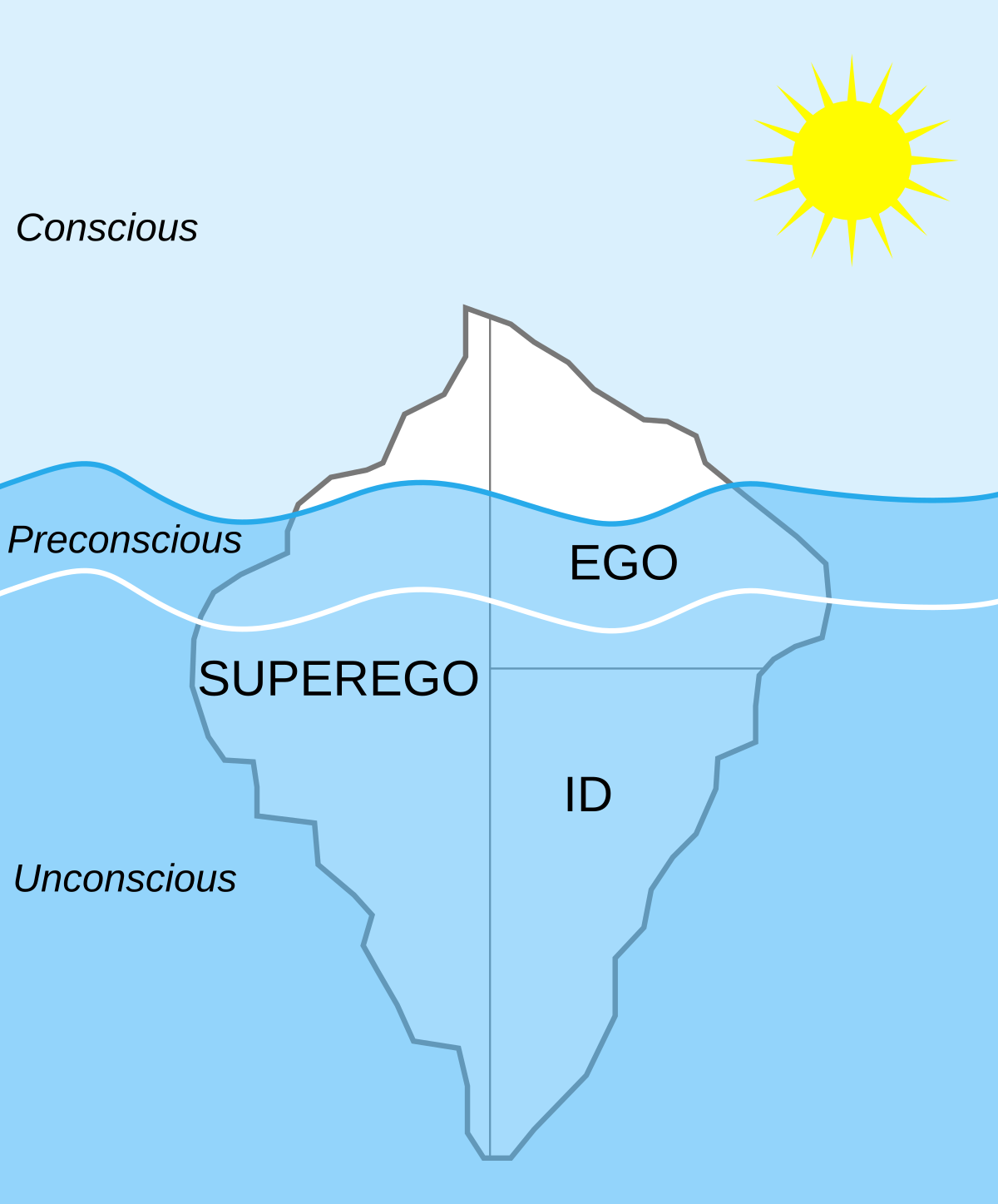
Freud described his finding that unconscious contents largely shape cognition and behavior as the third great insult to human pride, following Copernicus showing the Earth revolves around the Sun and Darwin showing humans evolved from apes. In the mind, an inner conflict occurs between three agencies: the id, the ego, and the superego. Drives in the id are repressed because of childhood trauma, and the individual maintains this repression through defense mechanisms such as censorship and fear of punishment.
This iceberg diagram shows the structural model, where the conscious ego sits at the surface while the deeper drives of the id and superego operate mostly underwater. historicair, Public domain, via Wikimedia Commons
In treatment, the patient uses free association by speaking without filtering thoughts for neatness or relevance. The analyst watches for resistance, which appears when the patient changes the subject or hesitates, as well as transference, where feelings are redirected onto the analyst. The goal of therapy is summarized by Freud as "Where id was, there ego shall be," helping the ego recognize hidden needs and find realistic, self-controlled ways to satisfy them.
What are the core ideas of psychoanalytic theory?
Freud identified four foundational beliefs for his discipline: unconscious mental processes, repression and resistance, the importance of sexuality, and the Oedipus complex. He argued that instinctive impulses break through in the symbols of dreams, neurotic symptoms, and everyday verbal slips. He also structured healthy emotional development into sequential stages: the oral, anal, and genital stages.
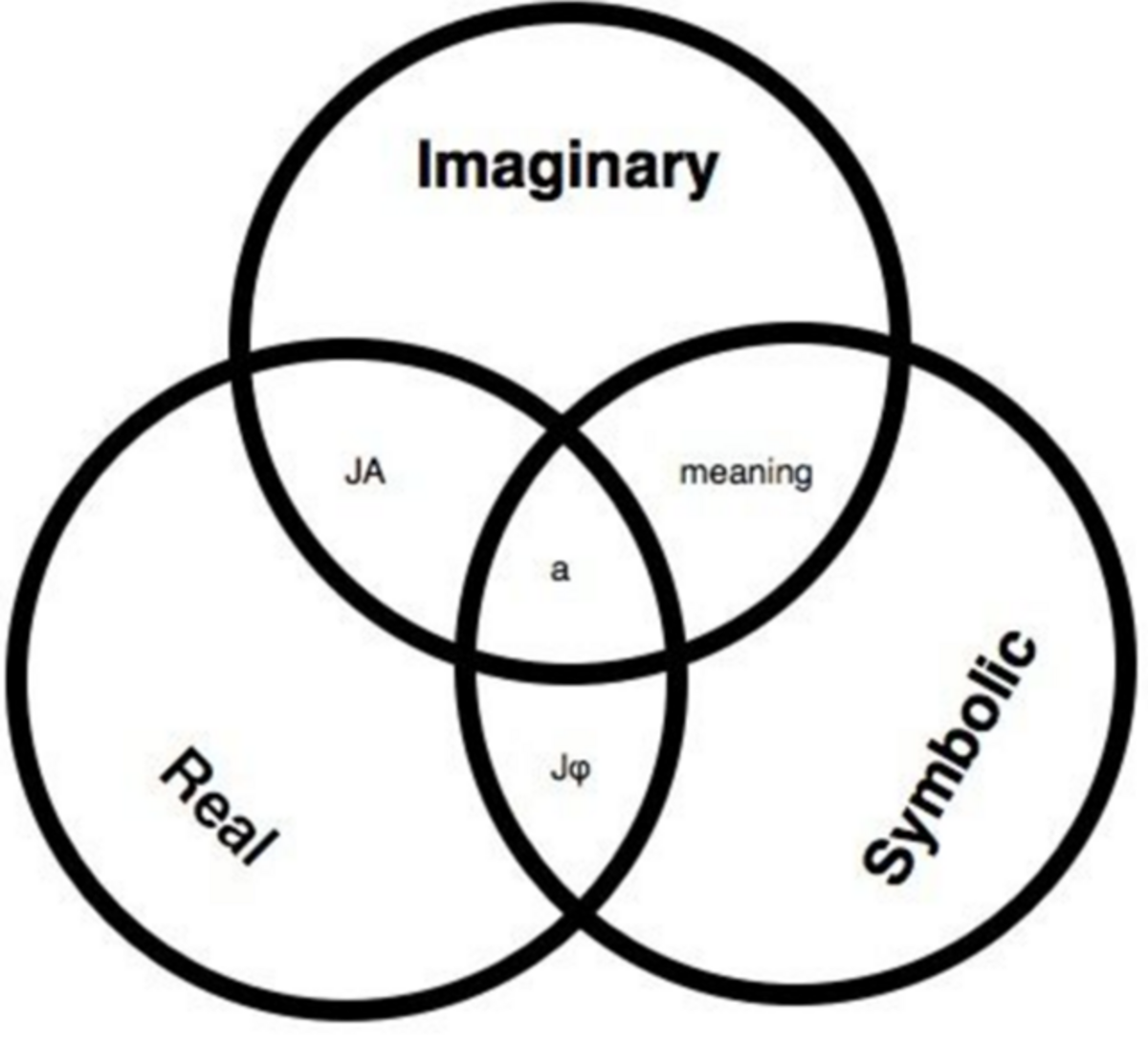
This diagram outlines Jacques Lacan's elaboration of psychoanalytic theory into the three registers of the Real, the Imaginary, and the Symbolic. SpyrosZenios, CC BY-SA 4.0, via Wikimedia Commons
Beyond the clinic, psychoanalytic ideas influenced literary criticism, myths, fairy tales, and philosophies like Freudo-Marxism. Later thinkers expanded the tradition: neo-Freudians like Karen Horney and Erich Fromm created subfields, while Jacques Lacan introduced a return to Freud by examining the language-like structure of the unconscious.
Test yourself
Someone abruptly changes the subject when a topic arises. What does a skilled observer look at?
The pattern behind the shift itself. A sudden shift in topic is rarely just a coincidence; the hesitation itself often reveals the underlying pattern more clearly than the words ever could.
An interpersonal dynamic repeats inside a professional relationship. How is it best treated?
As active material to explore. Relationships are rarely just the backdrop of work; they often mirror the exact patterns and dynamics being examined, making them valuable data.
A therapy uses analytic ideas but changes classical technique. What fits?
A psychodynamic approach. Psychodynamic therapies grew from psychoanalysis but can revise its theory, format, and technique.
Play the lesson in edgi and the card is yours. It lands on your Map next to the ideas it connects to, and turns from matte to foil to gold as you learn more around it.
Did all of Freud's colleagues stick to psychoanalysis?
No. Early colleagues Alfred Adler and Carl Jung broke away to develop their own separate approaches, known respectively as individual psychology and analytical psychology. Freud explicitly stated that these rival methods were not forms of psychoanalysis.
What is the Oedipus complex?
Named after the tragedy Oedipus Rex, it is Freud's theory of a child's developmental conflict with the father over the mother. Freud linked this psychological pattern to human cultural origins in works like Totem and Taboo, arguing it established early social prohibitions against murder and incest.
Is psychoanalysis proven to be effective?
Its overall efficacy remains contested, though evidence suggests that psychoanalysis, especially long-term psychoanalytic psychotherapy, can be effective for certain disorders. Research indicates it may offer long-term benefits compared to other psychotherapies.