Radicalization is the process where a person or group adopts increasingly extreme views in opposition to the social, political, or religious status quo. It is typically a gradual drift driven by grievances, search for identity, or online echo chambers rather than sudden mind control. The process can lead to nonviolent action or violent extremism, functioning as a social trap that cuts people off from mainstream life.
By the edgi team We find the most surprising true thing about an idea and build a 60-second lesson around it.
Radicalization is the gradual process of adopting extreme views in opposition to a social or political status quo. It rarely happens overnight through sudden mind control or dramatic conversion.
Instead, it is usually a step-by-step descent where an individual's worldview shifts over months or years.
The mechanism
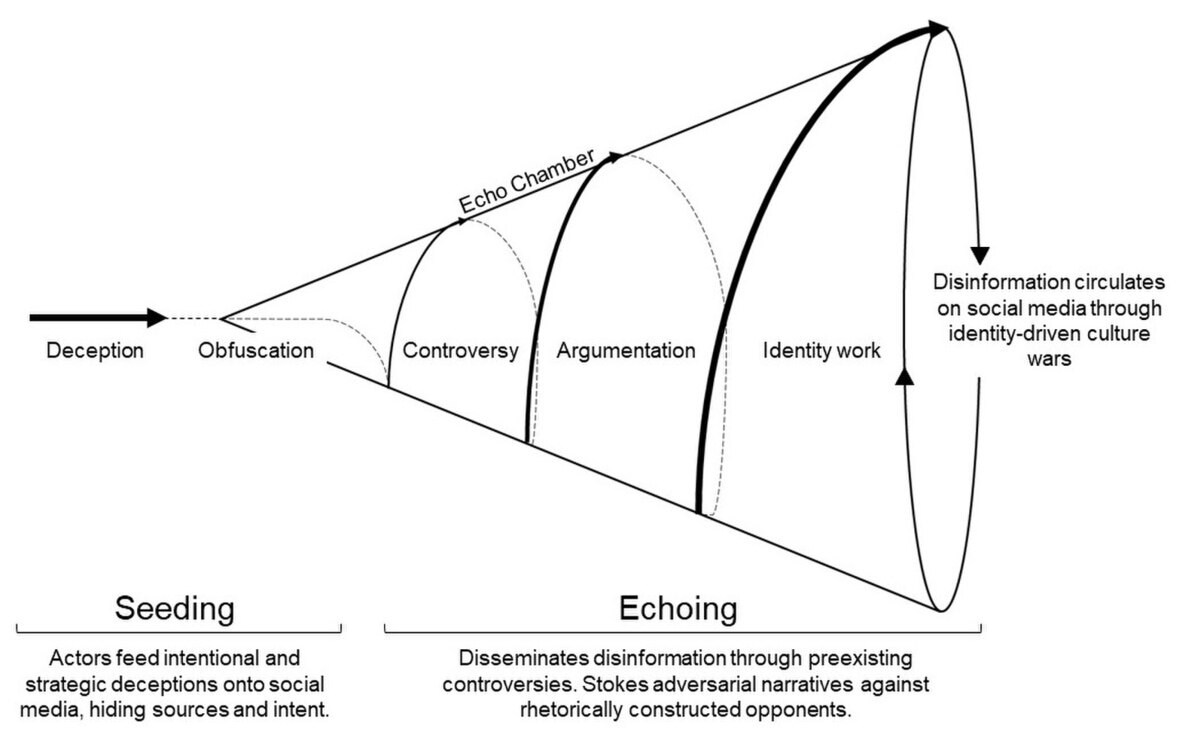
The process often begins with a sense of grievance, alienation, or a search for identity and community. Subcultures and online echo chambers accelerate the shift by rewarding increasingly extreme rhetoric.
A diagram illustrates how disinformation spreads through "controversies" and "echo chambers," starting with "Seeding" (Deception, Obfuscation) by actors feeding intentional deceptions into social… Diaz Ruiz, C. and Nilsson, T.; MexFin, CC BY-SA 4.0, via Wikimedia Commons
Over time, moderate voices are rejected as compromised, leaving only the most radical interpretation as the absolute truth.
Action and extremism
Not every radicalized person commits violence, but the process is a core focus of counterterrorism research. When it does cross the line, it can manifest as organized extremist groups or isolated individuals known as lone wolves.
A lone wolf stands in a snowy forest, looking towards the viewer. Oregon Department of Fish & Wildlife, CC BY-SA 2.0, via Wikimedia Commons
Understanding the pipeline is the first step in interrupting it before beliefs turn into destructive acts.
How does radicalization work?
Radicalization operates across multiple separate pathways that reinforce one another. It translates real or perceived grievances, feelings of alienation, or identity seeking into extreme ideological stances. Echo chambers and extremist subcultures accelerate this shift by rewarding radical statements and dismissing moderate viewpoints as compromised.
When radicalization occurs across multiple reinforcing pathways, it increases a group's lethality and resilience. The process compromises an individual's ability to participate in mainstream society or the modern economy. It becomes a sociological trap, leaving individuals with no other avenues to satisfy their material and social needs.
How do governments define the shift?
There is no single universally accepted definition of radicalization across governments and researchers. Context and political perspectives often determine what is perceived as radical, making the exact threshold difficult to pinpoint unless it involves illegal acts or violence.
The UK Home Office defines it as the process by which individuals come to support terrorism and violent extremism, emphasizing solutions like youth employment, immigrant integration, and ex-prisoner support. Canada focuses on the movement from moderate beliefs toward extreme views, noting that radical thought itself is not illegal until it threatens national security through violence. Denmark centers on the increasing acceptance of undemocratic or violent means to reach political goals.
Play the lesson in edgi and the card is yours. It lands on your Map next to the ideas it connects to, and turns from matte to foil to gold as you learn more around it.
No, radicalization can result in both violent and nonviolent action. While academic literature and security agencies focus heavily on violent extremism and terrorism, individuals can hold radical views without breaking laws or committing violent acts.
How does UNESCO define radicalization?
UNESCO outlines radicalization through three core elements: an individual's search for fundamental meaning or root ideology, the adoption of violent expansion of those ideas within a group, and the polarization of society into an 'us' versus 'them' dynamic where outsiders are dehumanized through scapegoating.