Action PotentialThe voltage spike that runs your nerves
An action potential is a rapid, temporary spike in electrical voltage across a cell membrane that carries a signal from one place to another. Unlike a steady current in a metal wire, it is an all-or-nothing pulse triggered only when a cell reaches a specific threshold. These electrical pulses allow your nervous system to communicate, muscles to contract, and certain glands to release hormones.
By the edgi team We find the most surprising true thing about an idea and build a 60-second lesson around it.
An action potential is not a continuous current. It is a discrete, all-or-nothing spike of energy. When a neuron hits a specific voltage threshold, millions of microscopic gates swing open in its membrane.
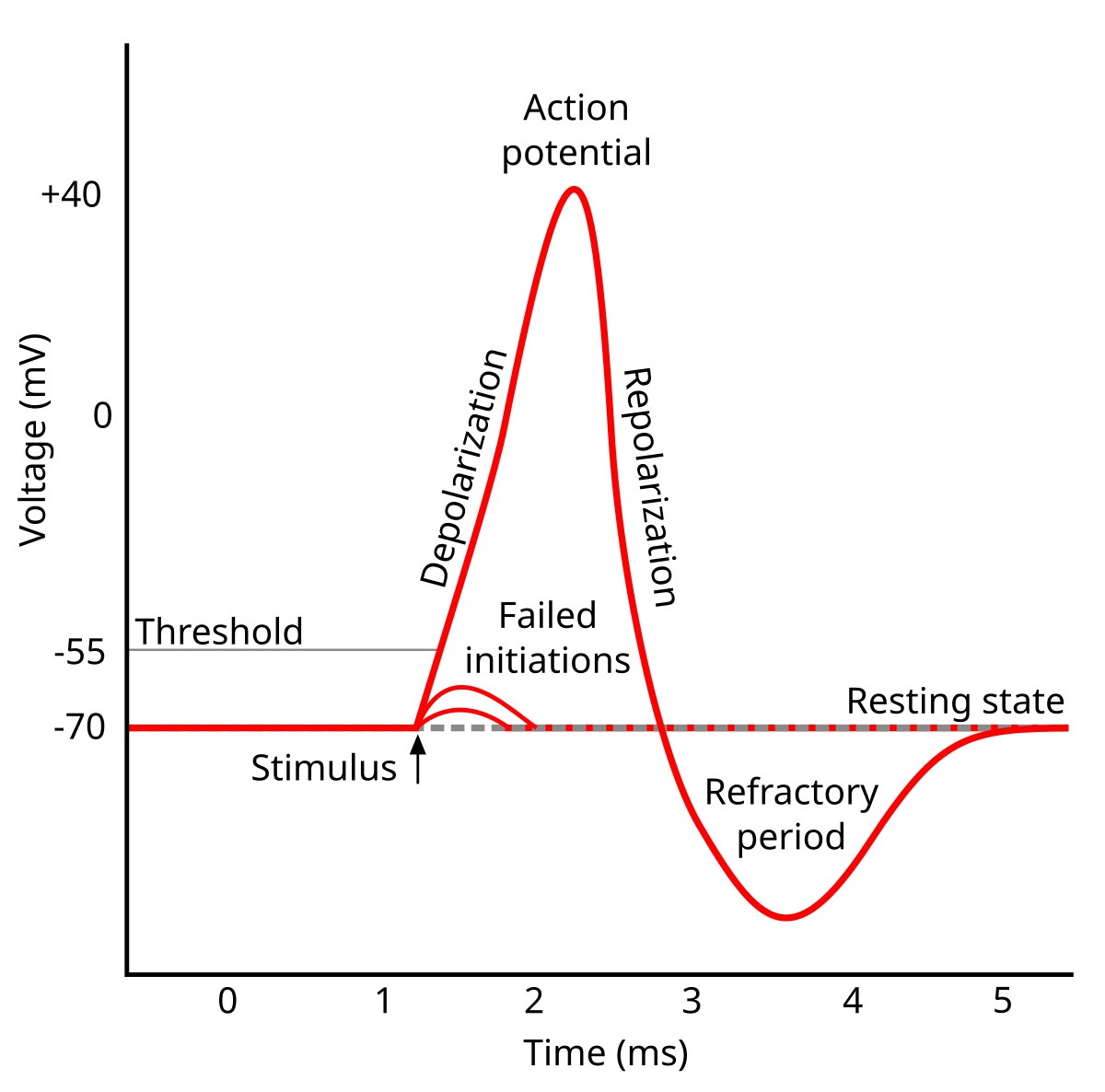
Graph plotting voltage (mV) on the Y-axis against time (ms) on the X-axis, showing a typical action potential. Original by en:User:Chris 73, updated by en:User:Diberri, converted to SVG by tiZom, CC BY-SA 3.0, via Wikimedia Commons
Charged atoms, mostly sodium, rush inside, creating a temporary reversal of the cell's electrical charge. That, right there, is the signal.
The squid discovery
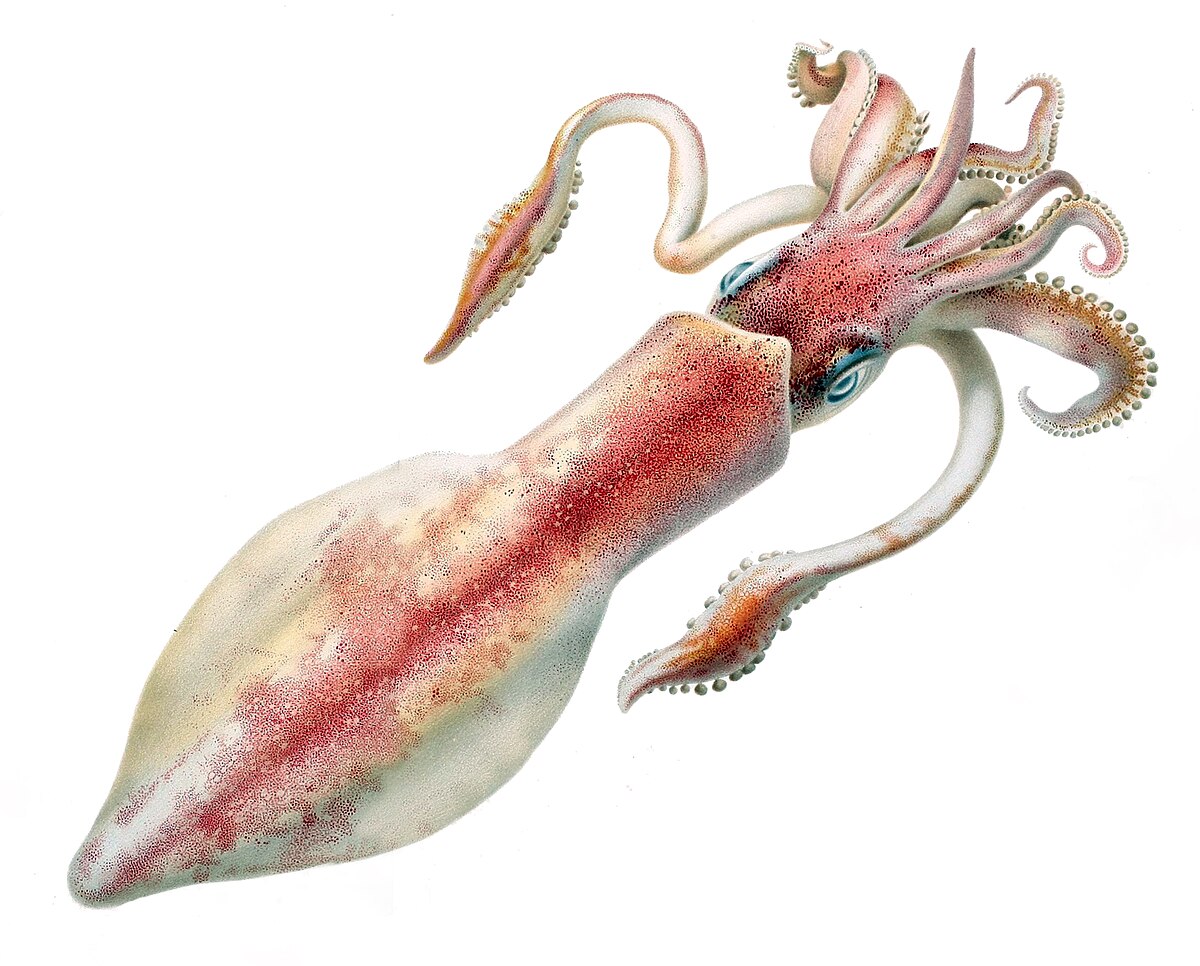
We cracked this code in the 1930s using the Atlantic squid. Human nerves are microscopic, but squid have a giant axon nearly a millimeter thick, large enough to see with the naked eye.
An illustration of a longfin inshore squid (Doryteuthis pealeii) with a reddish-pink mantle and white body, featuring prominent eyes and tentacles. Comingio Merculiano (1845–1915), Public domain, via Wikimedia Commons
By sticking a wire into that massive nerve, researchers Alan Hodgkin and Andrew Huxley recorded the very first electrical pulse of a living thought.
The recharge
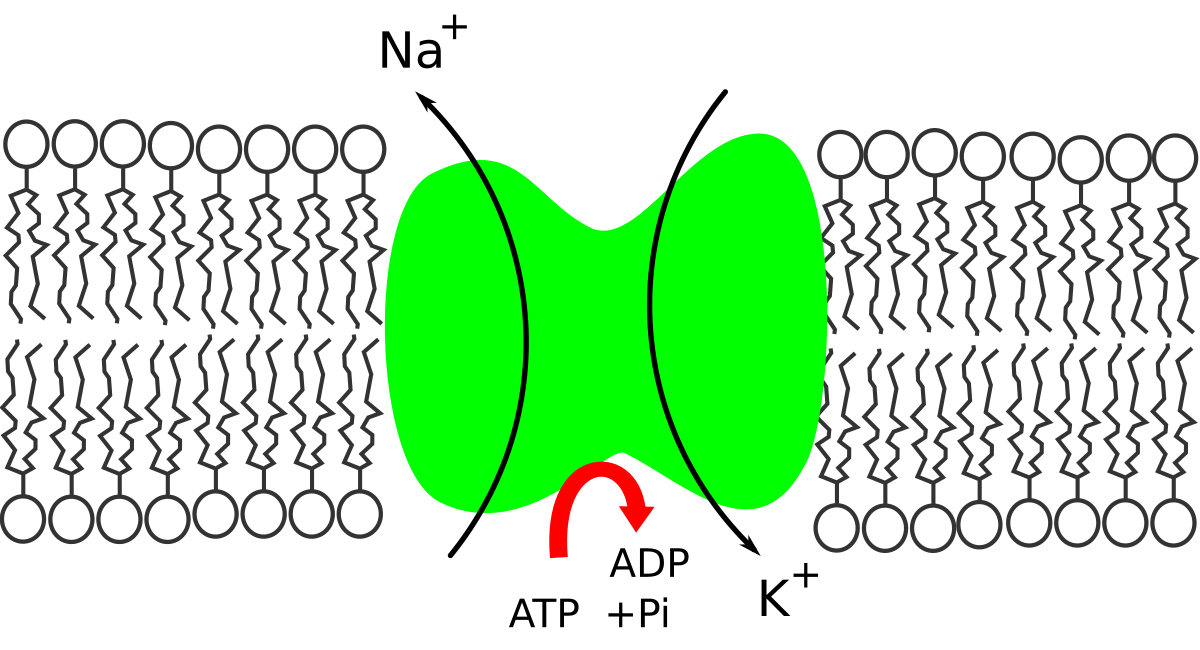
After firing, the cell must reset. It pumps the sodium back out, a phase called the refractory period. This reset is why you cannot feel two rapid touches as distinct events; your nerves are physically busy recharging.
Diagram illustrating the flow of ions through a sodium-potassium pump embedded in a cell membrane. NaKpompe2.jpg: Original uploader was Phi-Gastrein at fr.wikipedia derivative work: sonia, CC BY-SA 3.0, via Wikimedia Commons
To bypass this delay, your body wraps axons in myelin, letting the signal skip across gaps like a stone on water.
How does an action potential fire?
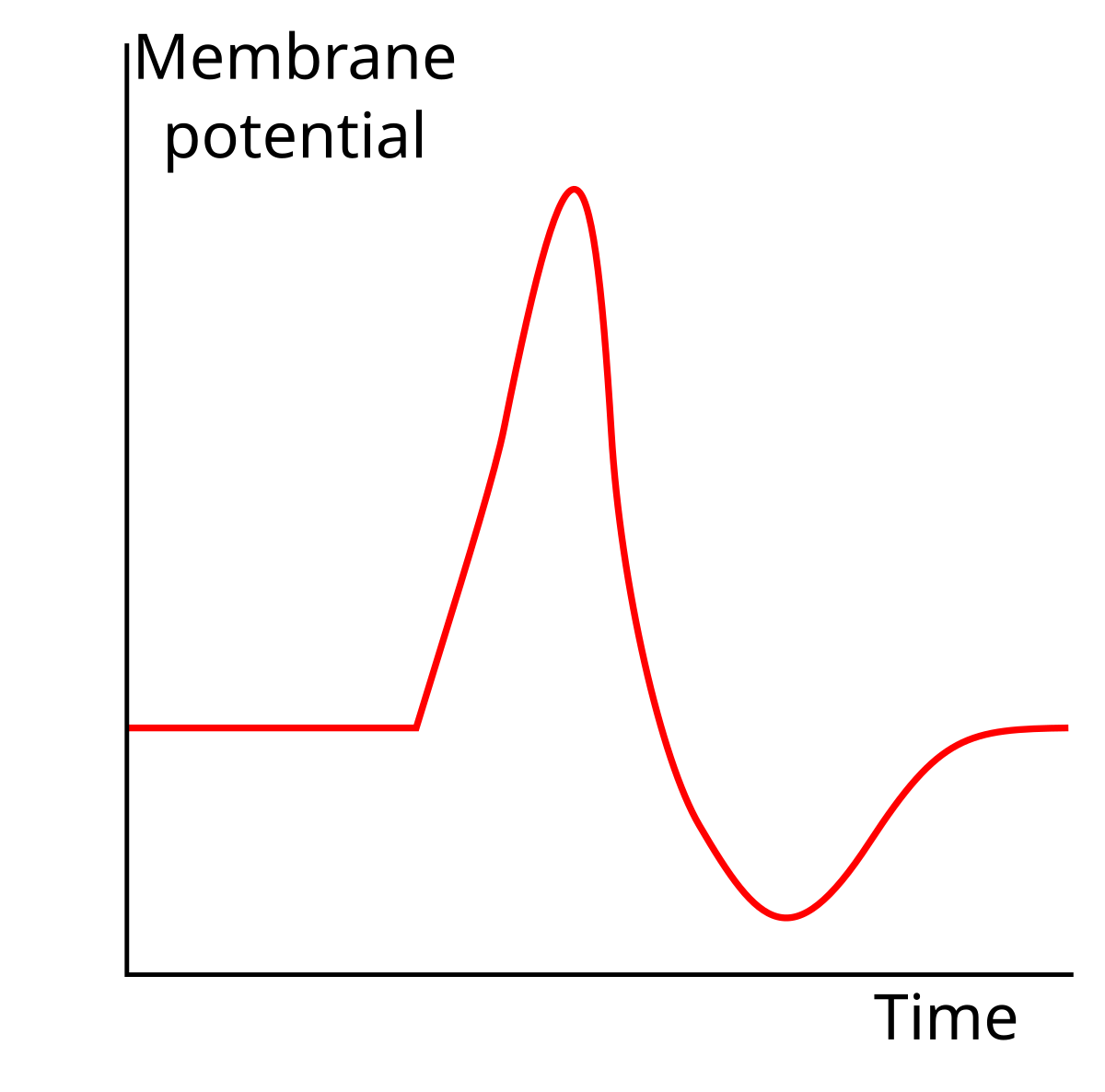
A resting animal cell membrane sits at a negative voltage of about -70 mV. Action potentials occur because voltage-gated ion channels, which are specialized proteins embedded in the fatty cell membrane, open and close in response to electrical changes.
The voltage graph shows the rapid spike and subsequent drop of a membrane potential during an action potential. Original by en:User:Chris 73, updated by en:User:Diberri, converted to SVG by tiZom, CC BY-SA 3.0, via Wikimedia Commons
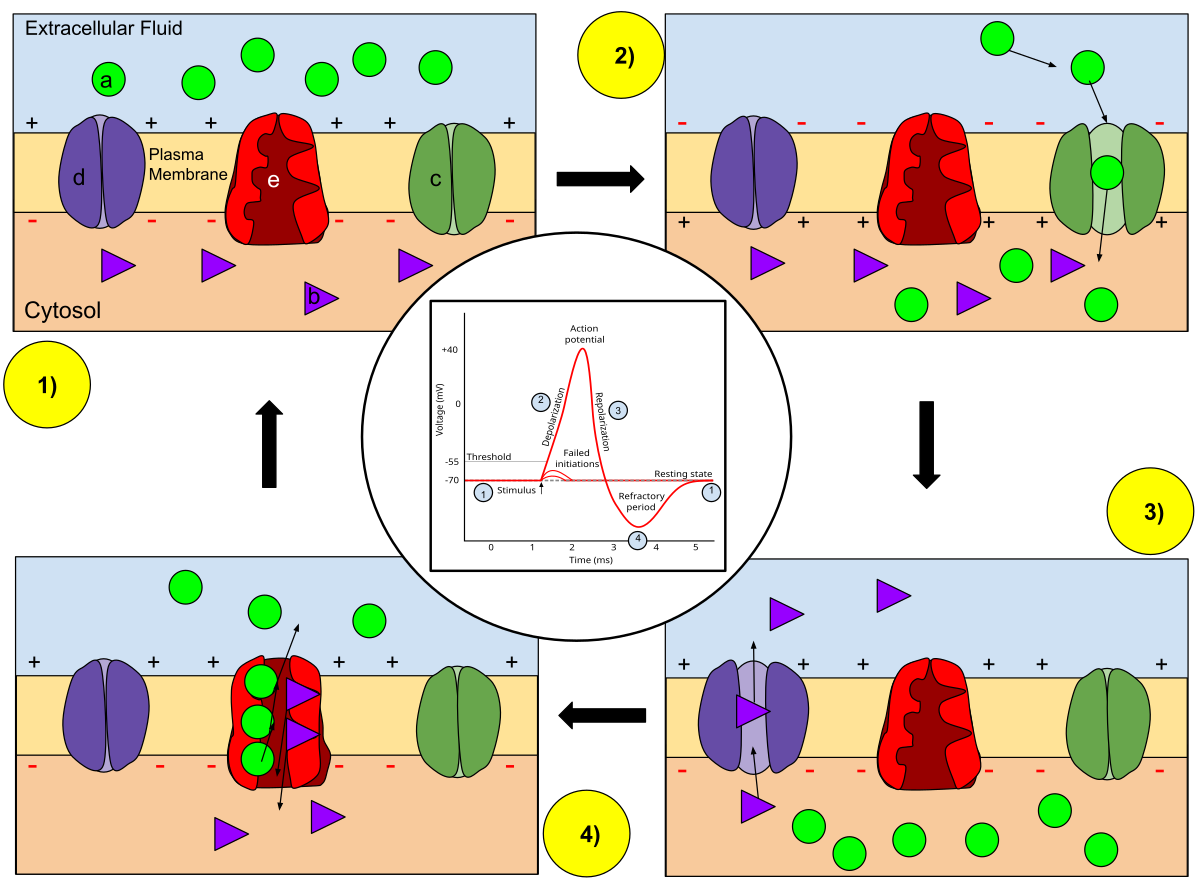
When the cell membrane reaches a precise threshold voltage, voltage-gated sodium channels rapidly open. Sodium ions rush into the cell interior, reversing the electrical charge across the membrane in an explosive chain reaction. Once the spike peaks, sodium channels quickly shut, and potassium channels open to let potassium ions flow out, restoring the resting negative balance.
What happens after the spike?
Following the sudden electrical peak, the membrane enters a brief dip below its resting voltage, known as afterhyperpolarization. The cell actively transports sodium back out to reset its electrochemical balance during this refractory period.
Sodium and potassium channels regulate the directional flow of charged ions across the cell membrane at each stage. CThompson02, CC BY-SA 4.0, via Wikimedia Commons
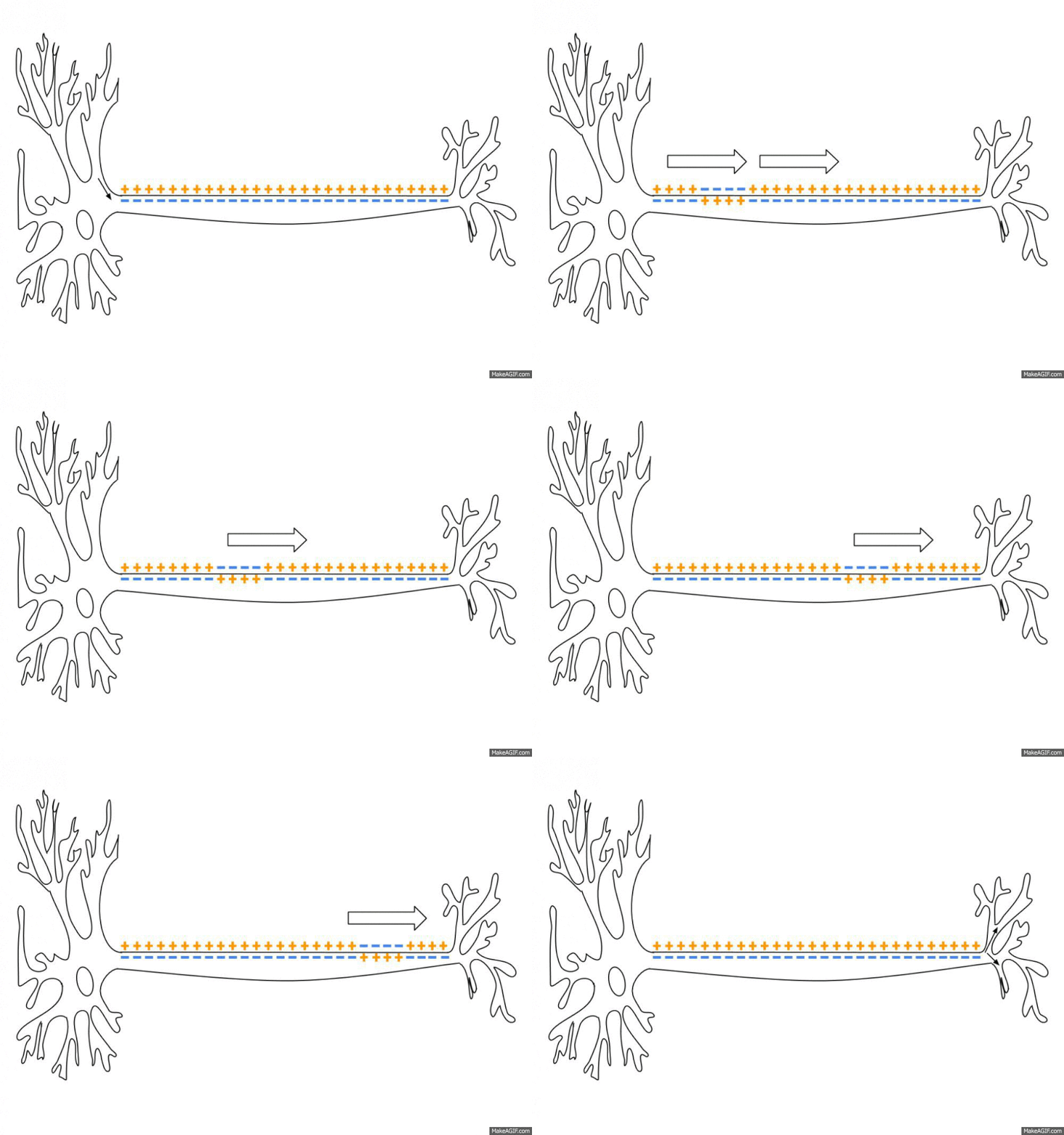
Because of this reset phase, individual spikes remain separate rather than blurring together into a single signal. In neurons, the resulting wave of depolarization travels along the axon until it reaches synaptic terminals at the end, triggering signals to adjacent nerves, muscle cells, or glands.
Where do action potentials occur?
Action potentials are not unique to neurons. They occur in many excitable cells, including skeletal and cardiac muscle cells, pancreatic beta cells that release insulin, certain cells in the anterior pituitary gland, and even some plant cells.
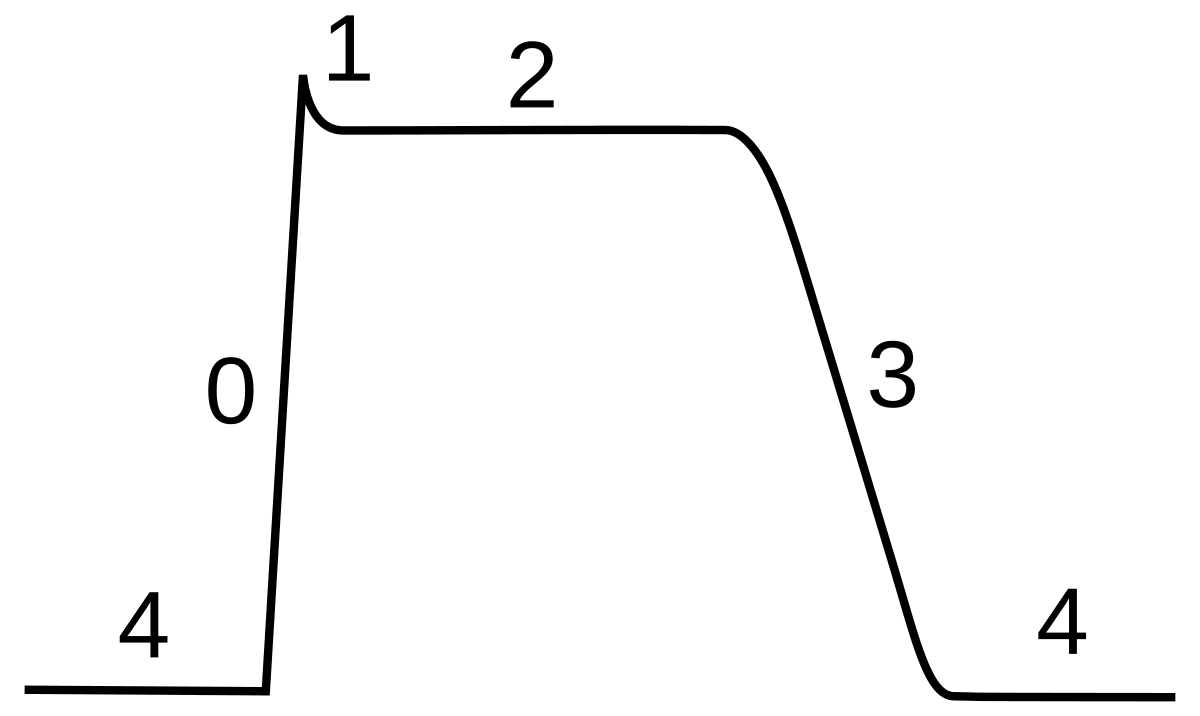
Cardiac muscle action potentials combine fast sodium spikes with longer calcium phases to control heart contractions. PNG: Quasar SVG: Mnokel (talk), CC BY-SA 3.0, via Wikimedia Commons
Different cells rely on different ions and timeframes. While a sodium-based nerve impulse in a mammalian neuron lasts only a fraction of a millisecond, calcium-based action potentials can last 100 milliseconds or longer. In heart muscle cells, a fast sodium spike acts as a primer for a longer calcium spike that drives contraction.
Test yourself
When an action potential reaches threshold, what starts the voltage spike?
Sodium rushes into the cell. Threshold opens membrane gates, letting sodium enter and briefly reverse the cell’s charge. The spike is triggered rather than a gradual voltage increase.
Why might two rapid touches feel like one during an action potential?
The nerve may still be resetting after firing. After firing, a nerve enters a refractory period while it resets, limiting how quickly it can fire again.
How does an action potential travel along a neuron compared to household electricity?
As a wave of chemical gate openings. Action potentials rely on charged atoms rushing through membrane gates rather than free-flowing electrons, making them discrete biological pulses instead of standard currents.
Play the lesson in edgi and the card is yours. It lands on your Map next to the ideas it connects to, and turns from matte to foil to gold as you learn more around it.
Duration depends on the cell type. In mammalian neurons, a typical sodium-driven action potential lasts under one millisecond, whereas calcium-driven action potentials in other cells can last 100 milliseconds or more, and plant action potentials can last several seconds.
What starts an action potential in a neuron?
An action potential starts when the electrical charge at an excitable section of the membrane, such as the axonal initial segment near the axon hillock, reaches a specific threshold voltage. This shift forces voltage-gated sodium channels to swing open.
Do action potentials change the overall concentration of ions inside the cell?
No, the overall concentrations on either side of the membrane remain relatively unchanged. Only a tiny fraction of ions needs to cross the membrane during a spike to completely flip the electrical potential.