Authority bias is the tendency to assume an opinion or order is accurate simply because it comes from an authority figure. People defer to titles, uniforms, or institutional rank rather than evaluating the actual content of the claim. This mental shortcut helps society function smoothly, but it also causes people to obey harmful or fraudulent commands without checking the facts.
By the edgi team We find the most surprising true thing about an idea and build a 60-second lesson around it.
Authority bias is treating the sign of expertise as the expertise. A badge, a title, a white coat: you check who is talking instead of what they are saying. In 1966 a psychiatrist named Charles Hofling ran a test on 22 hospital wards. A nurse alone on a night shift took a phone call from a Doctor Smith she had never met.
He told her to give a patient 20 milligrams of a drug called Astroten. The bottle said the maximum daily dose was 10, no doctor had signed anything, and phone orders were against the rules. 21 of the 22 nurses took the drug to the bedside. Researchers stopped them there. The capsules were glucose and no patient was ever at risk.
When the title overrides the rules
In a separate hypothetical survey, almost every nurse said they would refuse that order. In the ward study, 21 of 22 carried it to the bedside. The gap suggests that the title can make obedience feel expected, even when an order breaks stated rules.
The shortcut is usually reasonable, because nobody can check a stranger's medical reasoning at 2am. It fails when someone has the costume without the training. An accepted title can leave the claim unchecked.
The airport that was never there
In 1995 a man called Emmanuel Nwude phoned a director at a large Brazilian bank and introduced himself as the governor of Nigeria's central bank. He said Nigeria was building a new airport in Abuja and the bank could fund it. Over the next three years the bank sent about 242 million dollars.
There was no airport. The bank sent money for a project that did not exist, an advance-fee fraud that did not require Nwude to produce a real airport plan. The bank, Banco Noroeste, collapsed in 2001, and Nwude was sentenced to twenty-five years for the fraud.
Why people defer to authority figures
Human societies structure themselves into hierarchies, and people routinely give up a degree of personal choice to maintain social order. From childhood, people learn to defer to figures like teachers, police officers, and doctors. This instinct connects to system justification theory, which describes the psychological drive to view the existing social system as stable, fair, and legitimate.
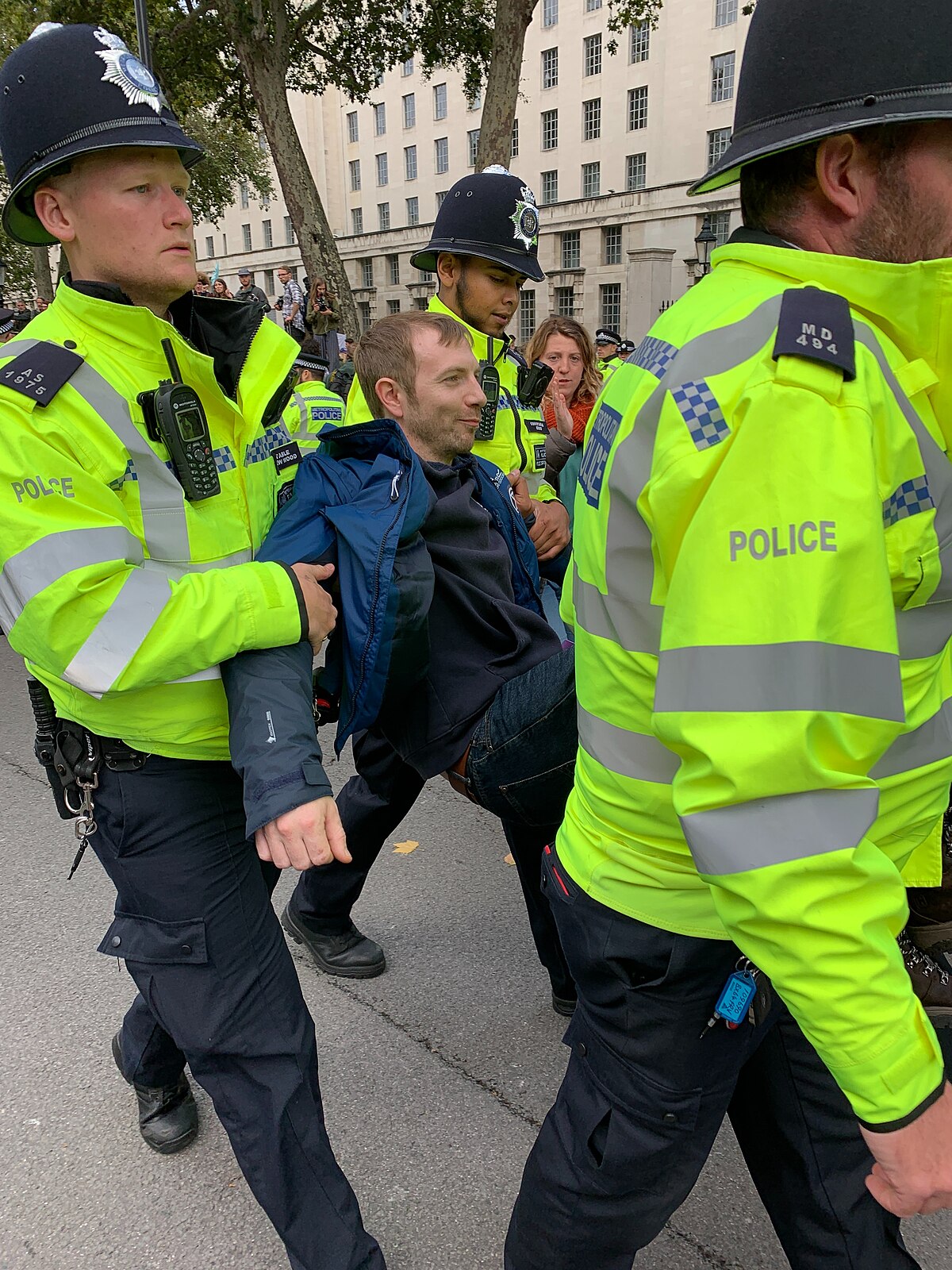
A police officer arresting a protester demonstrates how society grants uniform-wearing figures the power to enforce rules. Flyingfish101, CC BY-SA 4.0, via Wikimedia Commons
When an authority figure is accepted as legitimate, people grant them the right to demand compliance. Respect for authority directly correlates with the strength of the bias: the higher a person's respect for an institution, the more likely they are to accept its representatives' decisions without questioning them.
How uniforms and symbols trigger obedience
A simple change of clothes can dramatically alter how people respond to an order. In research conducted by Leonard Bickman, passersby were twice as likely to obey requests to pick up litter or provide parking meter money from an actor dressed as a security guard compared to one dressed as a milkman.
Stanley Milgram observed a similar effect in his obedience experiments. When instructions to administer electric shocks came from an experimenter wearing a white lab coat, obedience was 65 percent, but compliance dropped to 20 percent when the orders came from someone in plain clothes.
Because visual symbols like uniforms and titles command automatic deference, bad actors can exploit the shortcut. Anyone who adopts the outward appearance of an expert can trigger compliance, leaving their actual knowledge and instructions completely unverified.
Test yourself
What triggers authority bias?
Treating a symbol of expertise as proof. Authority bias happens when people substitute visible cues like titles or lab coats for actual verification of a claim.
Why do people rely on authority cues?
Evaluating every complex claim is too slow. Checking specialized reasoning directly is often impractical, so the brain uses credentials as a fast shortcut despite the risks.
A survey says nurses would refuse, but the ward study finds compliance. What does that gap show?
Authority cues can outweigh stated rules. The survey and ward study used different nurses, so the gap cannot reveal any one nurse's reasoning. It suggests that the doctor's title made obedience feel expected even though the order broke stated rules.
Play the lesson in edgi and the card is yours. It lands on your Map next to the ideas it connects to, and turns from matte to foil to gold as you learn more around it.
The opposite is blanket anti-authoritarianism, which is the immediate rejection of an authority figure's knowledge. People with this view assume claims made by authorities are inherently false regardless of the evidence.
Who popularized the concept of authority bias?
American psychologist Stanley Milgram popularized the term through his research on social obedience and deference to perceived experts.