Social engineering: why hackers ask instead of hacking
Social engineering is the use of psychological pressure and manipulation to trick people into performing actions or handing over confidential information. Instead of breaking through computer security with code, attackers target human decision-making and cognitive biases to get authorized users to grant access voluntarily. It turns normal trust, curiosity, or helpfulness into an entry point for fraud and system intrusion.
By the edgi team We find the most surprising true thing about an idea and build a 60-second lesson around it.
Social engineering is getting a person to hand over access instead of taking it. No exploit and no code. A request, delivered by someone the target has a reason to help. In 1992 Kevin Mitnick went after the source code for a Motorola phone. By his own account he rang the company, got passed along, and came away with the project manager's name. She was on vacation.
So he rang her assistant, said he was Rick from research and development in Arlington Heights, and that Pam had been meant to send him the source code before she left. The assistant sent it. Inventing a role that makes a request routine is called pretexting. What Mitnick brought to that call was a name, a department, and a reason to be phoning that made sense to whoever picked up.
Four old levers on a new wire
Read a phishing email closely and there is nothing technical in it. It is four familiar moves stacked in one paragraph. It is from your bank (authority bias), your account locks in 24 hours (scarcity), you need only confirm your address first (foot-in-the-door technique), and your whole team has already done it (social proof).
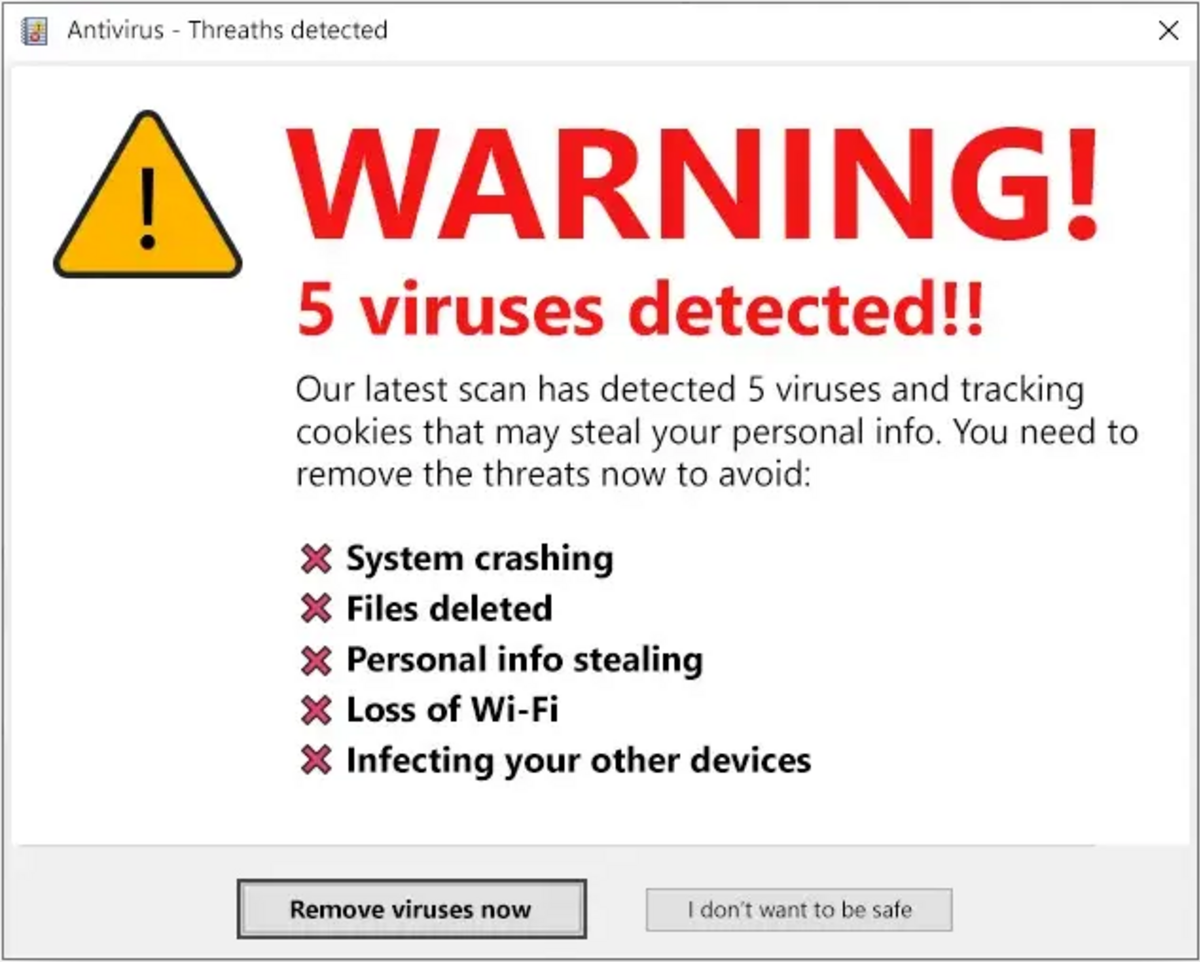
A computer screen displays a fake 'Antivirus, Threats detected!' warning popup, a common example of scareware. Avast Software, Public domain, via Wikimedia Commons
None of that is new and none of it needed a computer. What email changed is the price of an attempt: a con that works one time in ten thousand is a good business at ten million sends.
The part no software sees
Tailgating is the same trick with no computer in it. Stand at a locked door holding a full box and wait. Somebody polite will badge you through, and the badge reader will log a valid entry. "I'm here for the Thursday audit" can be entirely true and still put you in the server room. Misleading with nothing but true statements is called paltering, and it survives a challenge that a lie doesn't.
The defense is not a sharper instinct, it is a second channel. Hang up and call the number you already had, or walk to the desk and ask. Every action in the chain is one the person was authorized to take, performed by the person authorized to take it. The logs show a normal Tuesday.
How attackers manipulate trust and curiosity
In a 2016 study at the University of Illinois, researchers dropped 297 USB flash drives around campus. Passersby picked up 290 of them (98 percent), and 135 drives (45 percent) were plugged into computers that opened files and connected back to the researchers. This tactic, called baiting or leaving a 'road apple', relies entirely on curiosity or greed rather than software exploits.
Attackers also exploit everyday trust through pretexting, creating an invented role using real details like dates of birth or Social Security numbers to make strange requests sound legitimate. Other physical attacks include tailgating, where an intruder poses as a courier carrying boxes so an employee holds open a secure door. Even trusted websites can become traps through water holing, where attackers compromise a site their targets regularly visit because victims let their guard down on familiar territory.
Common tactics in digital deception
Digital social engineering takes many forms beyond basic email phishing. Scareware bombards a target with fake security alerts, tricking them into installing remote access tools or paying ransoms under the belief that their computer is infected. In ad phishing, attackers buy online advertisements that mimic real banks or customer support pages to capture passwords and credit card numbers.
Other schemes rely on direct exchanges. Quid pro quo attacks offer a fake benefit, such as free IT help or money, in exchange for sensitive credentials. Attackers also build long-term relationships on social networks, chatting with targets over time to establish personal trust before requesting confidential details.
Test yourself
What is the primary mechanism that makes social engineering successful against secure systems?
Exploiting human trust and routines. Social engineering bypasses technical controls by convincing authorized users to voluntarily hand over access, requiring zero software exploits.
How does tailgating differ from traditional digital hacking methods in system logs?
It generates completely normal activity logs. Because an authorized person lets the intruder through, the badge reader records a valid entry, making the malicious act look like routine business.
Mass phishing emails are full of obvious tells. Why doesn't the sender clean them up?
One reply in ten thousand still pays. Sending ten million costs close to nothing, so a message that works one time in ten thousand is already a business. The tells only lose the people who were never going to reply, and losing them is free.
Play the lesson in edgi and the card is yours. It lands on your Map next to the ideas it connects to, and turns from matte to foil to gold as you learn more around it.
What is the difference between social engineering and a traditional con?
A traditional con is usually a complete fraud scheme on its own. In security contexts, social engineering is often just one preliminary step used to gather information or gain system access for a larger attack.
Is pretexting illegal?
In the United States, specific laws target this behavior. The 1999 Gramm-Leach-Bliley Act explicitly makes pretexting to obtain banking records an illegal act punishable under federal statutes, with oversight from the Federal Trade Commission.
What is water holing?
Water holing is a targeted attack where hackers set traps on legitimate websites that a specific group visits regularly. Because victims trust the site, they are willing to click links they would normally avoid in an unsolicited email.