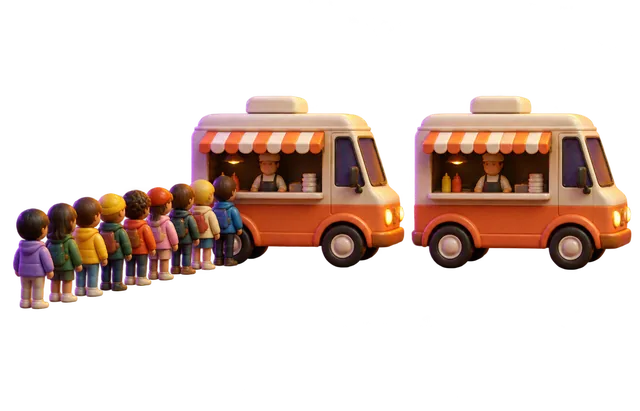
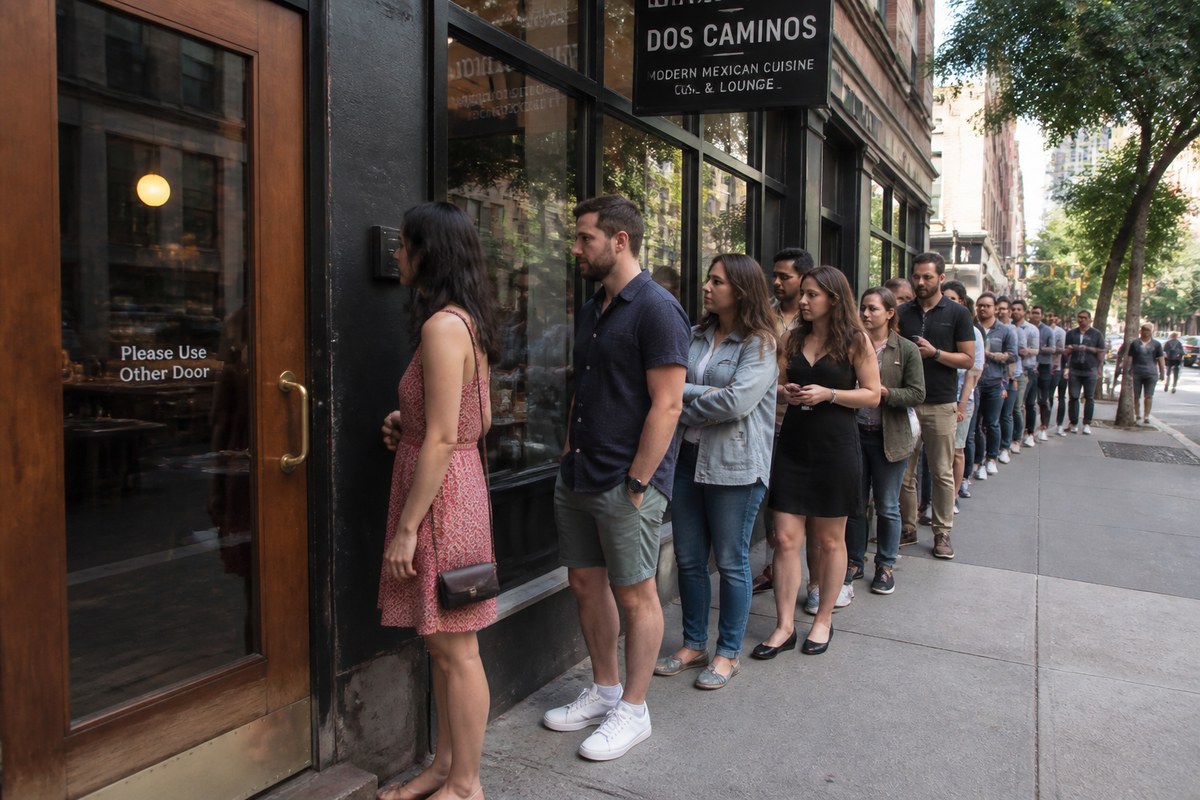
Social proof is a psychological phenomenon where people copy the actions of others to figure out how to behave in an ambiguous situation. It is driven by the assumption that the surrounding crowd knows more about what is happening than any individual does. This reliance can lead people to adopt others' choices as their own genuine beliefs, even when the crowd's decision is based on very little real information.
By the edgi team We find the most surprising true thing about an idea and build a 60-second lesson around it.
Social proof is what you fall back on when you don't know what to do: look at what everyone else is doing, and do that. In 1968 researchers put one man on a busy New York sidewalk and had him stare up at a sixth-floor window for a minute. About 4 percent of the people walking past stopped to look too.
With fifteen men at the same window, 40 percent of passersby stopped outright, and 86 percent at least tilted their heads back without breaking stride. The window was empty both times. The crowd was not information about the window, but it was the only information anyone had, so it got used. A full restaurant gets used the same way.
The laughter is fake and it still works
A sitcom laugh track is recorded laughter dropped in by an engineer. Everybody knows this. It works anyway. In 2019 a team at University College London read 40 deliberately terrible dad jokes to 72 people, with a burst of laughter added that nobody could have mistaken for real.
It should have moved nothing at all. The jokes came out about 10 percent funnier. Knowing it is fake does not switch it off, because funny is not a property you measure off the joke. It is a judgment, and other people laughing is evidence about a judgment.
What the carriage decided
Somebody on a crowded train starts shouting. You look up. So does everybody else, and then everybody goes back to their phone. In that half-second every passenger looked at the others to find out how alarmed to be. They all found the same thing: everybody else looking calm, because everybody else was doing exactly this.
That is the bystander effect. The carriage has settled on an answer, and every passenger in it read the answer off the others.
Why uncertainty triggers social proof
Uncertainty is the main engine behind social proof. When an experience is ambiguous, such as testing an unfamiliar product, people look to the opinions of others to reach a conclusion. They assume the surrounding crowd has better knowledge about the environment.
This effect grows stronger when being accurate matters most. In an eyewitness identification experiment, subjects viewed slides shown too quickly to see clearly. Three actors working with the researchers deliberately gave the same incorrect answer first. When subjects were told their scores would establish official police norms, making accuracy feel critical, they conformed to the wrong answer 51 percent of the time, compared to 35 percent in a low-importance setup.
How similarity and peers drive compliance
People rely far more on social proof when they see the surrounding group as similar to themselves. Robert Cialdini identified this as peer power: individuals respond more to influence applied horizontally across colleagues than vertically from superiors.
A door-to-door charity campaign demonstrated this dynamic. Solicitors found that as the list of prior donors grew longer, the next person was more likely to give money. The donation rate increased even further when the list contained names of people the prospective donor knew, such as friends and neighbors.
Private acceptance versus public compliance
Social proof does not just change public behavior; it often creates private acceptance, where an individual genuinely believes the group is right. This separates informational social influence from normative social influence, which is conforming purely to be liked or avoid standing out.
In a 1935 experiment by Muzafer Sherif, subjects in a dark room estimated the movement of a stationary dot of light that only appeared to move due to an optical illusion. When grouped together, their conflicting individual estimates converged into a single shared number. When tested alone again later, subjects kept using the group's number, proving they had adopted the collective judgment as their own view of reality.
Test yourself
Why does a canned sitcom laugh track still make bad jokes feel funnier to viewers?
It serves as social evidence of humor. Humor is a social judgment, so hearing others laugh provides immediate behavioral evidence that the joke warrants a positive reaction, overriding conscious knowledge that the sound is fake.
Does social proof rely on people having expert knowledge?
No, it works even when no one knows. Social proof relies on observing behavior, not verifying expertise. People copy others simply because action is visible, even if the crowd is just guessing too.
Canned laughter still works on people who can hear that it's fake. Why?
Funny is a judgment, not a fact. There is no measurement of funny to overrule the laughter with. Where a hard fact is available, other people's behavior loses most of its pull. Where the thing is a judgment, it keeps it.
Play the lesson in edgi and the card is yours. It lands on your Map next to the ideas it connects to, and turns from matte to foil to gold as you learn more around it.
Robert Cialdini coined the term in his 1984 book Influence: Science and Practice. He listed it as one of his six central principles of persuasion.
Do different cultures respond to social proof differently?
Yes. Studies show that people in collectivist cultures conform to the social proof of others more frequently than people in individualist cultures.
What is an information cascade?
An information cascade occurs when people converge too quickly on a single choice by copying each other. Because everyone relies on the crowd rather than direct evidence, large groups can end up making a unified decision based on very little actual information.