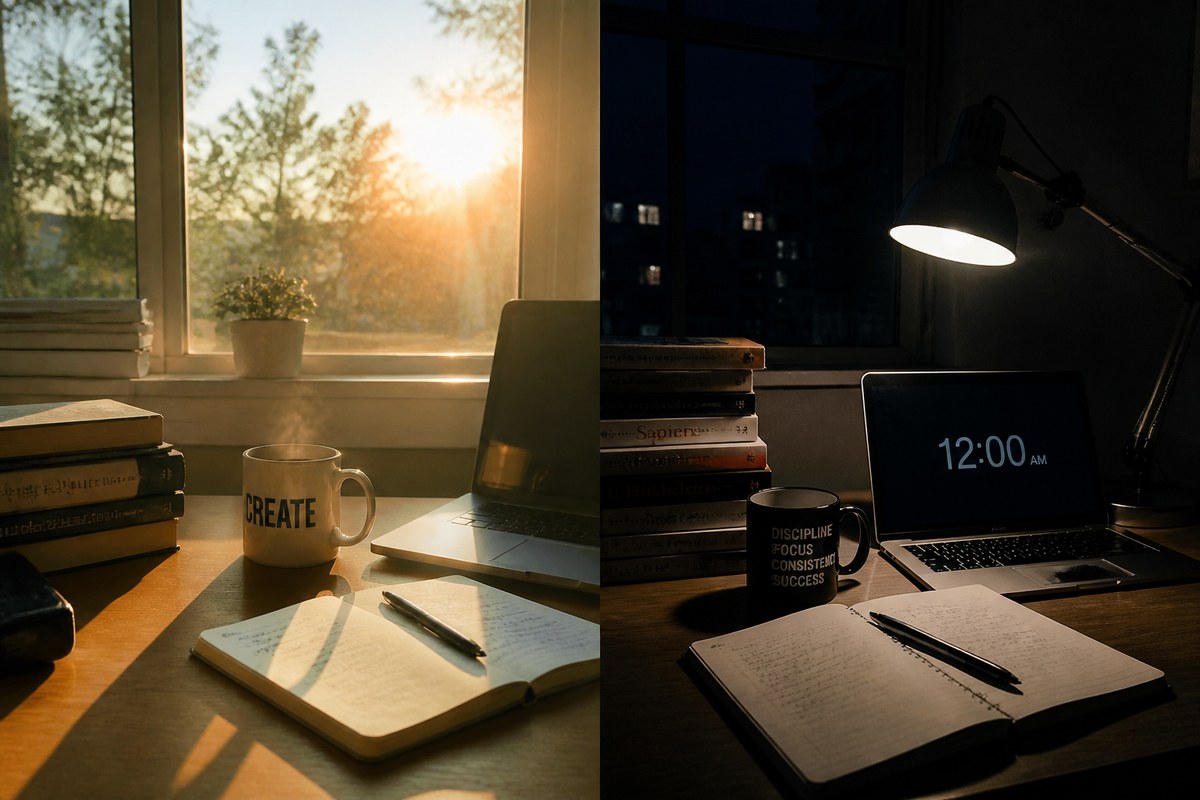
A chronotype is a person's natural biological tendency to sleep and be active at specific times during a 24-hour day. Driven by internal clock genes rather than mere habit, it defines whether someone is naturally an early riser, a night owl, or somewhere in the middle. Your chronotype is not fixed for life; it shifts predictably as you age, peaking at its latest schedule around early adulthood.
By the edgi team We find the most surprising true thing about an idea and build a 60-second lesson around it.
On a work day an alarm ends your sleep. On a free day nothing does, so the middle of your free-day sleep is what researchers use to place you. That midpoint, adjusted for the sleep you were catching up on, is your chronotype. The Munich questionnaire that measures it this way has been filled in by hundreds of thousands of people since 2002.
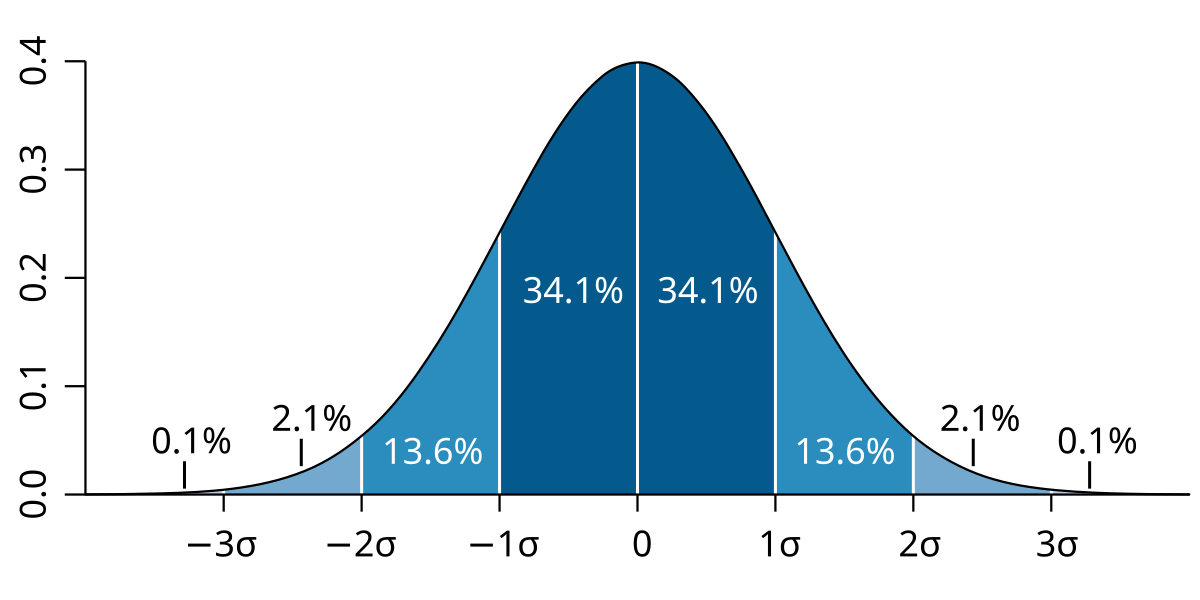
It comes out as a spread rather than two boxes. Most people land somewhere in the middle, with very early risers at one end and very late ones at the other.
Diagram of a normal distribution curve, also known as a bell curve, illustrating the 68–95–99.7 rule for data points within standard deviations from the mean. M. W. Toews, CC BY 2.5, via Wikimedia Commons
It moves across a life
Chronotype changes with age, and in a survey of about 25,000 people aged 10 to 90 the pattern was sharp. Timing runs later right through the teens, peaks, and then turns around. The peak of lateness lands at about 19.5 years in women and about 21 in men. From there it runs earlier, year after year, for the rest of life.
The researchers proposed that turning point as a biological marker of the end of adolescence. A sixteen-year-old who cannot sleep at ten is sitting at the phase their age puts them in.
The offset you live in
Someone with a late chronotype on an early schedule does the same thing five days a week: sleeps at the wrong time for their own clock, then has that sleep cut short by the alarm. The size of that mismatch has a name and a number. Social jetlag is the gap between the middle of your sleep on work days and the middle of it on free days.
Black wind-up alarm clock with a white face, black numbers, and two bells on top. Sun Ladder, CC BY-SA 3.0, via Wikimedia Commons
An hour or two of it is common. That is the same as living one or two time zones away from the place you work, without ever getting on a plane.
What you can actually move
Effort is not the variable here. What moves is the schedule: the time you get up, and how far the weekend is allowed to drift away from it. Holding one wake time across all seven days shrinks the gap, because the gap is the distance between your two schedules. Where the schedule cannot move, the lateness at least stops being a character flaw.
What causes your chronotype
Chronotype is the outward behavior produced by an underlying circadian rhythm, which controls body temperature, hormone levels, appetite, cognitive faculties, and metabolic function. Candidate genes, called CLOCK genes, exist in most cells across the body and brain to regulate these processes. Morning types experience an earlier peak in daytime body temperature than evening types, even though total sleep length between both groups is typically the same.
Except in the most extreme, rigid cases, chronotype stems from interactions between these genes and environmental cues known as zeitgebers. Key cues include natural light, feeding times, social behavior, and work or school routines. Chronotypes also appear in other species, including fruit flies and mice, leading researchers to propose an evolutionary root tied to nighttime vigilance in ancestral human groups.
How chronotypes change with age
A person's chronotype shifts across development rather than staying constant. Pre-pubescent children lean toward early sleep periods, while adolescents drift progressively later. This delay peaks at roughly 19.5 years of age in women and 21 years in men, a turning point researchers propose as a biological marker for the end of adolescence.
After this early-adulthood peak, sleep preferences gradually shift earlier through adulthood and into old age. Because of this trajectory, context matters when defining types: a 23:30 bedtime might indicate a morning type among university students, but an evening type among people aged 40 to 60.
Measuring morningness and eveningness
Normal variation between morning types and evening types spans a sleep-wake difference of two to three hours. Large-scale surveys, such as Till Roenneberg's 2007 study of over 55,000 people, show that chronotypes follow a continuous normal distribution: most people sit in the middle rather than at extreme ends. Research by Paine et al. found that morningness and eveningness preferences remain largely independent of ethnicity, gender, and socioeconomic status.
Researchers measure these differences using quantitative tools. Early work by O. Öquist in 1970 led to the 19-item Morningness-Eveningness Questionnaire (MEQ) by Jim Horne and Olov Östberg in 1976. Other tools include Folkard's Circadian Type Inventory (CTI), which tests sleep rigidity and shift-work adaptability, the Composite Scale of Morningness (CSM), and the Munich Chronotype Questionnaire (MCTQ).
Test yourself
How is a person's chronotype best measured?
By natural sleep midpoint on free days. Work days rely on an alarm that truncates sleep, whereas a free day reveals the body's preferred timing.
What does social jetlag primarily measure for an individual?
The schedule mismatch between work and free days. Social jetlag is the gap between the midpoints of sleep on work days and free days, reflecting internal clock friction.
A 17-year-old cannot sleep before 1am and cannot wake for school. What is that?
The latest phase their age produces. Sleep timing runs latest in the late teens and early twenties, peaking near 19.5 years in women and 21 in men, then moves earlier for the rest of life.
Play the lesson in edgi and the card is yours. It lands on your Map next to the ideas it connects to, and turns from matte to foil to gold as you learn more around it.
What happens when an extreme chronotype clashes with a normal schedule?
When an individual's morning or evening preference is so strong and intractable that it prevents participation in school, work, or social activities, it is classified as a circadian rhythm sleep disorder.
What are the four animal chronotype categories?
In 2016, clinical psychologist Michael J. Breus proposed categorizing people into lions (early larks), bears (middle-of-the-road sleepers), wolves (night owls), and dolphins (people with irregular sleep schedules).
What is the Circadian Type Inventory used for?
Developed by Folkard in 1987, the Circadian Type Inventory measures how rigid or flexible a person's sleep habits are and how well they overcome drowsiness, helping identify individuals who can adapt to shift work.