MelatoninWhy your brain makes a fraction of a milligram
Melatonin is a hormone produced in the brain that tells the body when it is dark outside. Rather than knocking you out like a sedative, it acts as a timing signal to set your internal daily clock. In humans, natural production begins climbing roughly two hours before bedtime and drops sharply by morning.
By the edgi team We find the most surprising true thing about an idea and build a 60-second lesson around it.
Aaron Lerner was a dermatologist hunting a treatment for vitiligo. He knew of a report from 1917: cow pineal gland fed to tadpoles turned them pale within the hour. Lerner built his test around frog skin. Add the right extract and the pigment cells pull their color inward, the skin goes pale, and you can see that the active substance is in there.
A common frog (Rana temporaria) tadpole swims in murky green water, surrounded by aquatic vegetation. Viridiflavus, CC BY-SA 3.0, via Wikimedia Commons
Isolating the substance took roughly a quarter of a million cow pineal glands. In 1958 Lerner named it Melatonin. It never treated vitiligo. He had found a hormone the pineal gland releases in the dark.
The signal and the clock
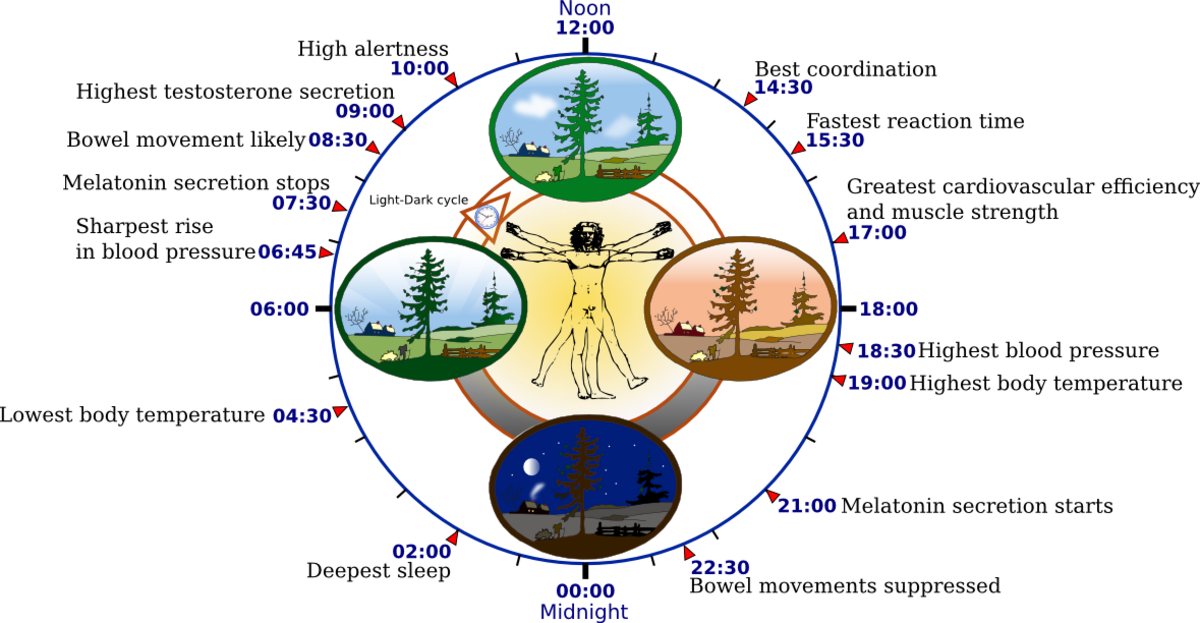
Melatonin climbs in the evening and drops before morning. Light shuts the release down and darkness lets it run, so the level in your blood is a running report on how dark it is. Your circadian rhythm reads that report as a time cue. In most people the rise starts about two hours before their usual bedtime, and labs use it to mark where a person's internal night begins.
Diagram illustrating the human circadian rhythm, or biological clock, with various physiological parameters mapped to a 24-hour cycle. GYassineMrabetTalk✉ This PNG graphic was created with Inkscape ., CC BY-SA 3.0, via Wikimedia Commons
Swallowing melatonin puts that same signal into your blood at an hour you picked. The clock reads it, and when you take it decides how far the clock moves. In the lab, the biggest shift came from a dose taken in the afternoon or early evening, hours ahead of the person's usual bedtime. Three days of that moved their internal clock about an hour and a half earlier.
As a sleeping pill
Melatonin taken at bedtime does get people to sleep faster, and the size of that help is small. Across trials in people with sleep problems it cut about seven minutes off the wait, against placebo. In 2017 the American Academy of Sleep Medicine advised clinicians not to use it for insomnia. The guideline marks that as a weak recommendation, because the evidence on either side is thin.
What is in the bottle
Your own pineal gland puts out a fraction of a milligram across a night, and the shelf sells 5 and 10 milligram tablets. The studies that moved the clock mostly used half a milligram or less. More does not move more. One lab ran 0.5 mg against 3.0 mg through the same protocol and the shifts came out about the same size. The bigger dose had to be taken earlier and made the evening drowsier.
The number on the label is loose. In a test of 31 supplements the melatonin ran from 83 percent below the printed amount to 478 percent above, and a quarter also held unlisted serotonin.
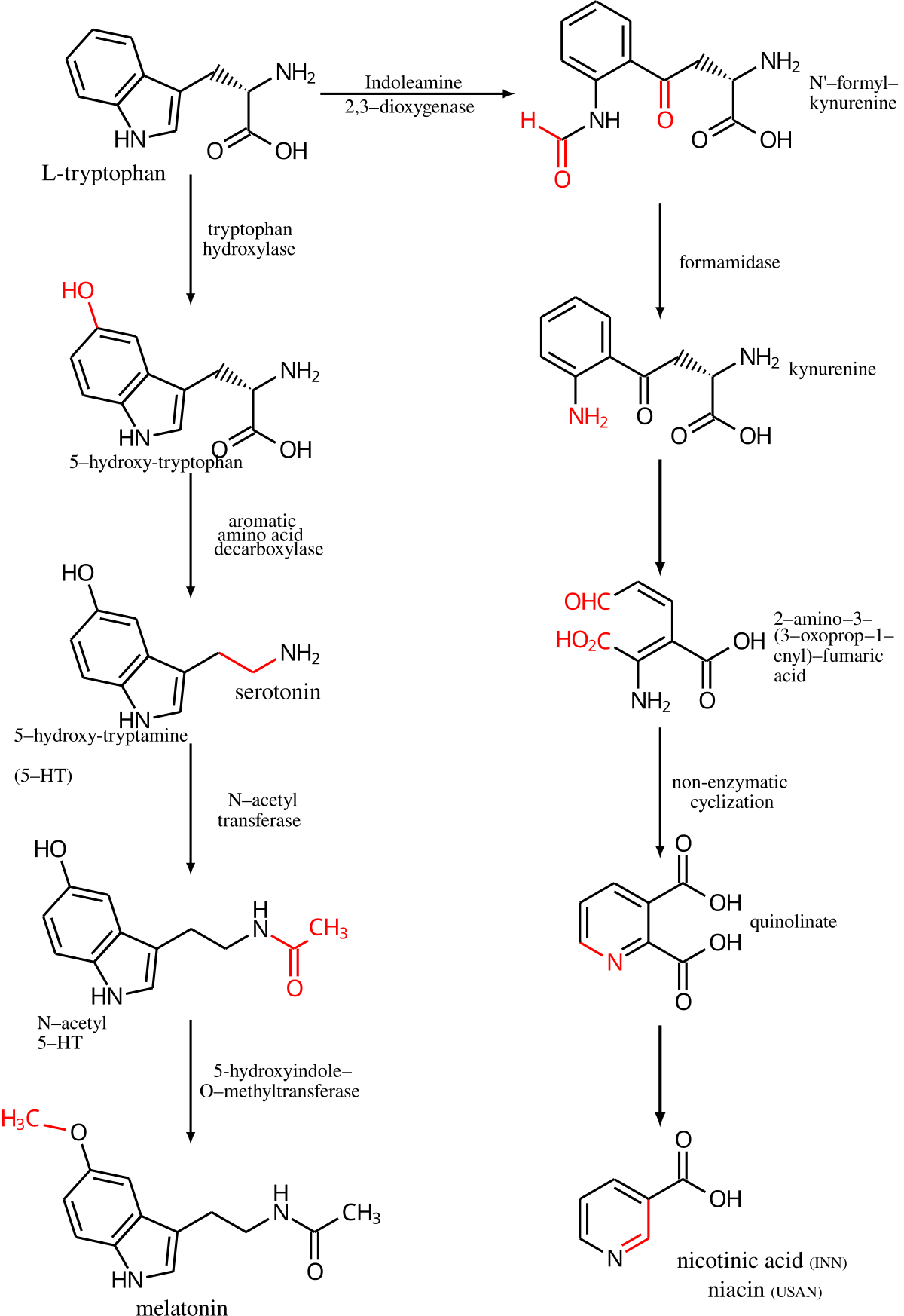
Diagram illustrating the metabolism of L-tryptophan into serotonin and melatonin (left pathway) and niacin (right pathway). Krishnavedala, Public domain, via Wikimedia Commons
How the brain creates a darkness signal
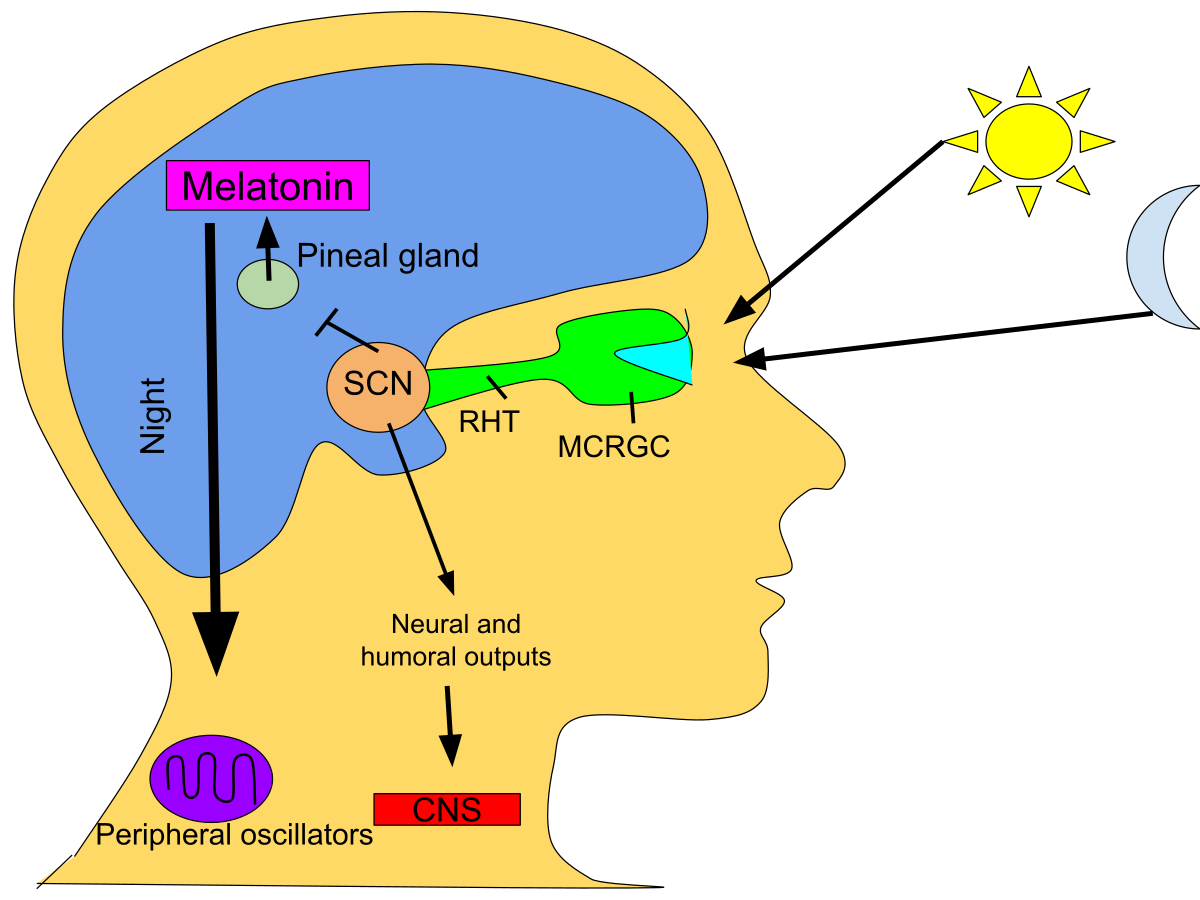
Human adults produce only about 30 micrograms of melatonin per day, with roughly 80 percent of it synthesized at night. The brain's pineal gland releases this compound into the bloodstream in the dark, and exposure to light shuts that production down. Peak levels occur between midnight and 8:00 am.
Light exposure detected by the eyes suppresses melatonin production in the pineal gland, while darkness allows its release. Srruhh, CC BY-SA 4.0, via Wikimedia Commons
Melatonin binds to two main receptors in the body: melatonin receptor 1 and melatonin receptor 2. Both belong to the G-protein coupled receptor family. In addition to setting the timing of sleep and wakefulness, this signaling helps regulate blood pressure and seasonal rhythms such as reproduction, molting, and hibernation in vertebrates.
Ancient origins as a cellular antioxidant
Melatonin existed long before animals used it to time sleep. Organisms ranging from bacteria to plants synthesize the molecule, with mitochondria acting as its primary cellular producers. Within the mitochondrial matrix, its concentration is significantly higher than in blood plasma.
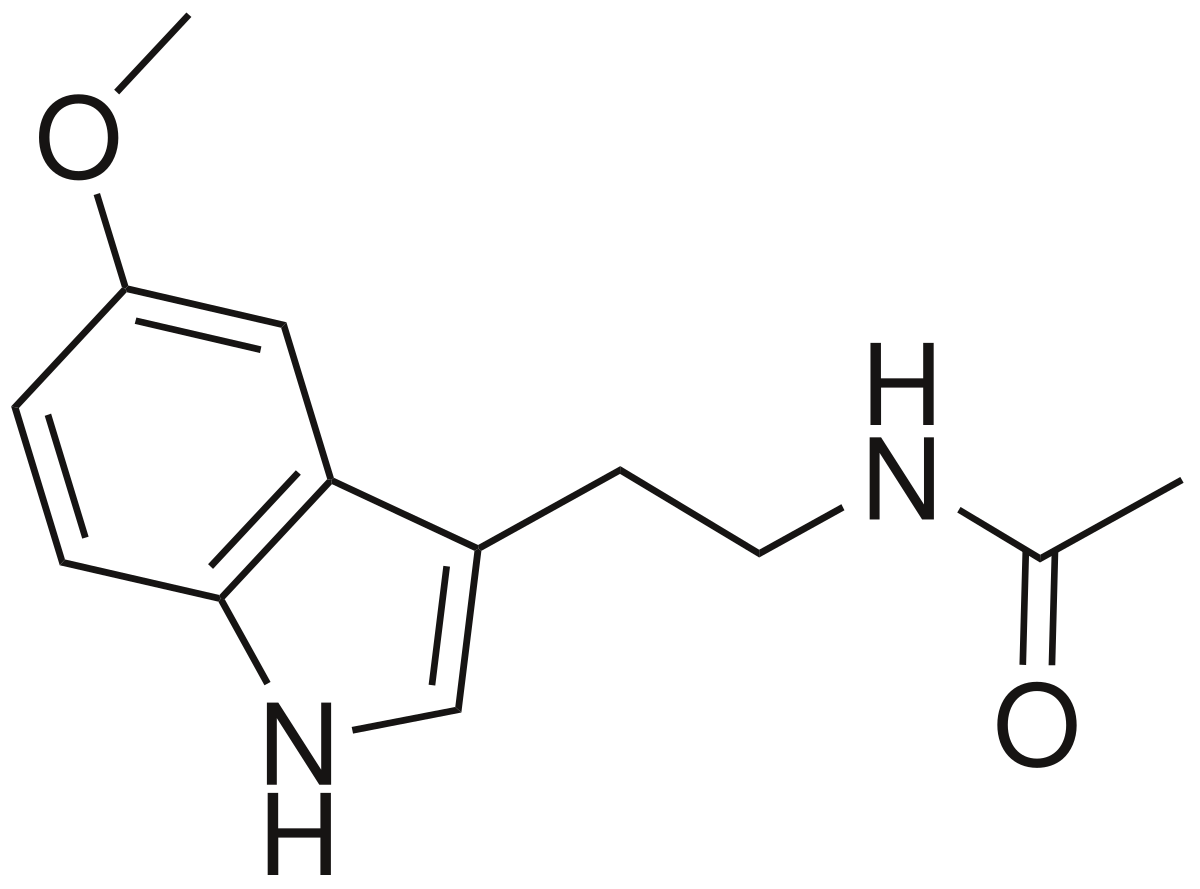
The molecular structure of melatonin, an indoleamine compound synthesized in both single-celled organisms and complex animals. Lukáš Mižoch, Public domain, via Wikimedia Commons
Inside cells, melatonin serves as a powerful antioxidant that neutralizes reactive oxygen species, including hydroxyl and superoxide radicals. It is twice as effective as vitamin E at scavenging peroxyl radicals. It also triggers receptors to boost the expression of protective enzymes, including catalase and superoxide dismutase.
Using melatonin as a sleep supplement
Taking melatonin acts as a synthetic time cue. When swallowed hours before a person's habitual bedtime, it can shift their internal clock earlier by up to an hour and a half over three days. Taking it right at bedtime only reduces the time it takes to fall asleep by about seven minutes on average.
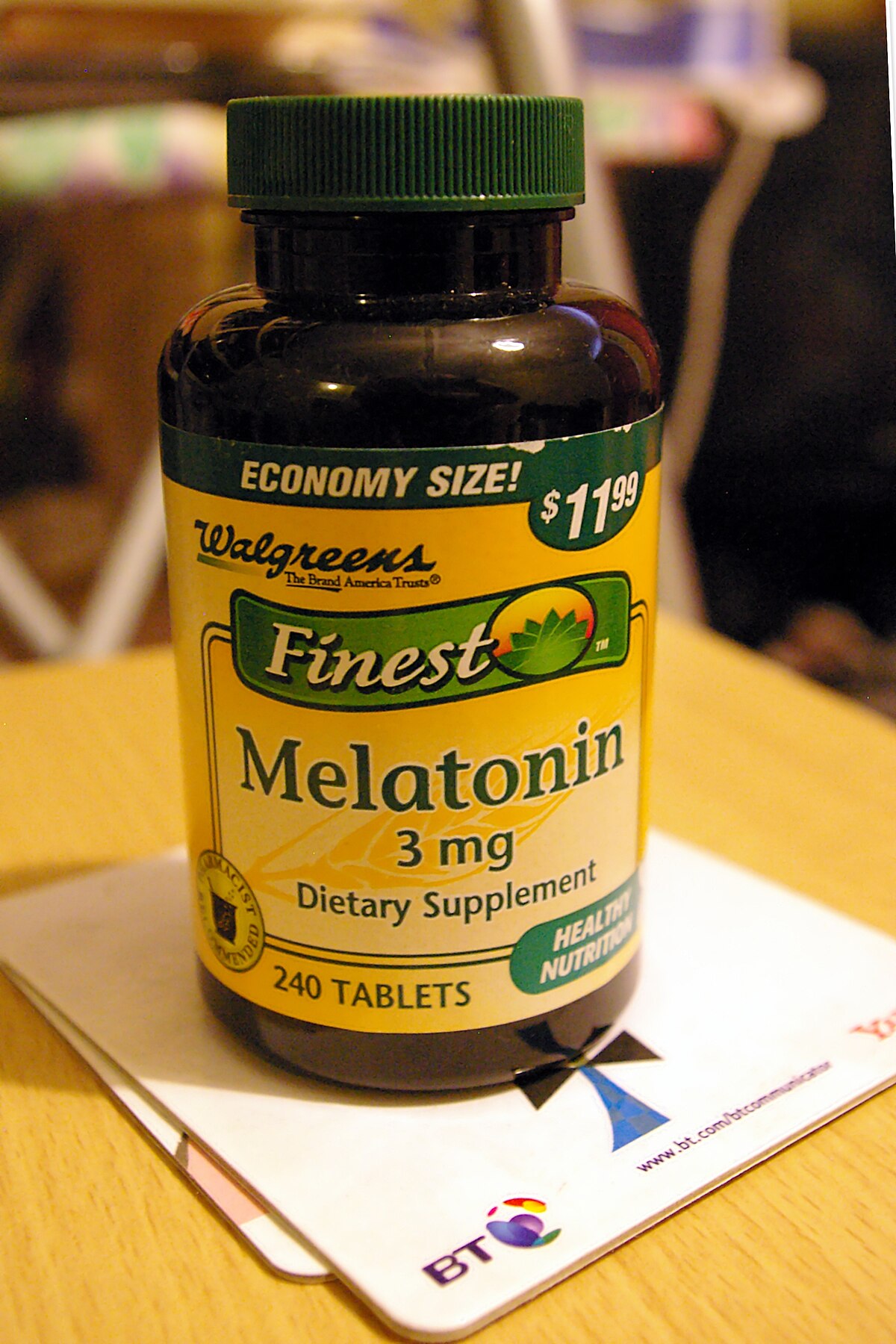
Commercial melatonin tablets frequently contain milligram dosages that far exceed the micrograms naturally secreted by the pineal gland. Walgreens_Melatonin.jpg: Ged Carroll from London mostly, UK derivative work: Zoohouse (talk), CC BY 2.0, via Wikimedia Commons
Because normal physiological output is a tiny fraction of a milligram, commercial tablets of 5 or 10 milligrams deliver massive amounts relative to what the body creates. Doses of 0.5 milligrams achieve clock-shifting effects similar to 3.0 milligrams without causing the same level of evening grogginess. In older adults, a prolonged-release form called Circadin is approved in several countries for short-term insomnia treatment.
Test yourself
When attempting to shift an internal circadian rhythm earlier, when is a dose most effective?
Hours before usual bedtime. The circadian clock reads melatonin as a dusk signal, meaning timing the dose in the late afternoon or early evening shifts the rhythm ahead.
Does melatonin act primarily as a direct sedative or a time cue for the body clock?
A time cue for the body clock. Melatonin signals darkness rather than forcing sleep, which explains why taking it at bedtime yields only a minor reduction in sleep onset.
You want to fall asleep an hour earlier this week. When does melatonin help most?
A small dose swallowed in early evening. The shift earlier is largest when a dose lands hours before your usual bedtime, and 0.5 mg moves the clock about as far as 3 mg does.
Play the lesson in edgi and the card is yours. It lands on your Map next to the ideas it connects to, and turns from matte to foil to gold as you learn more around it.
When does melatonin production first develop in humans?
Human infants establish regular melatonin cycles around their third month after birth. Secretion timing shifts later during adolescence, which often delays sleep schedules and increases the risk of delayed sleep phase disorder.
Why did Aaron Lerner isolate melatonin originally?
Lerner was a dermatologist searching for a treatment for vitiligo. He isolated melatonin from roughly 250,000 cow pineal glands because the extract caused frog pigment cells to contract, turning their skin pale.
Are commercial melatonin supplements accurately dosed?
Supplement doses can vary widely from what is listed on the package. One test of 31 commercial brands found actual melatonin levels ranging from 83 percent below to 478 percent above the label amount, with a quarter of samples containing unlisted serotonin.