A cognitive distortion is an exaggerated or irrational thought pattern that causes you to perceive reality inaccurately. These automatic thoughts twist everyday situations into negative interpretations, which reinforces stress, anxiety, and depression. Recognizing these mental habits allows people to challenge their accuracy rather than treating them as facts.
By the edgi team We find the most surprising true thing about an idea and build a 60-second lesson around it.
In the 1960s, psychiatrist Aaron T. Beck noticed something strange about his depressed patients. They weren't just sad; they were experiencing a barrage of automatic negative thoughts they treated as absolute truth.
One patient famously spiraled into despair because she burned a single piece of toast.
All-or-nothing thinking
That patient’s reaction was a classic case of all-or-nothing thinking. Her brain took one minor, isolated error and expanded it into a global judgment: 'I am a total failure.'
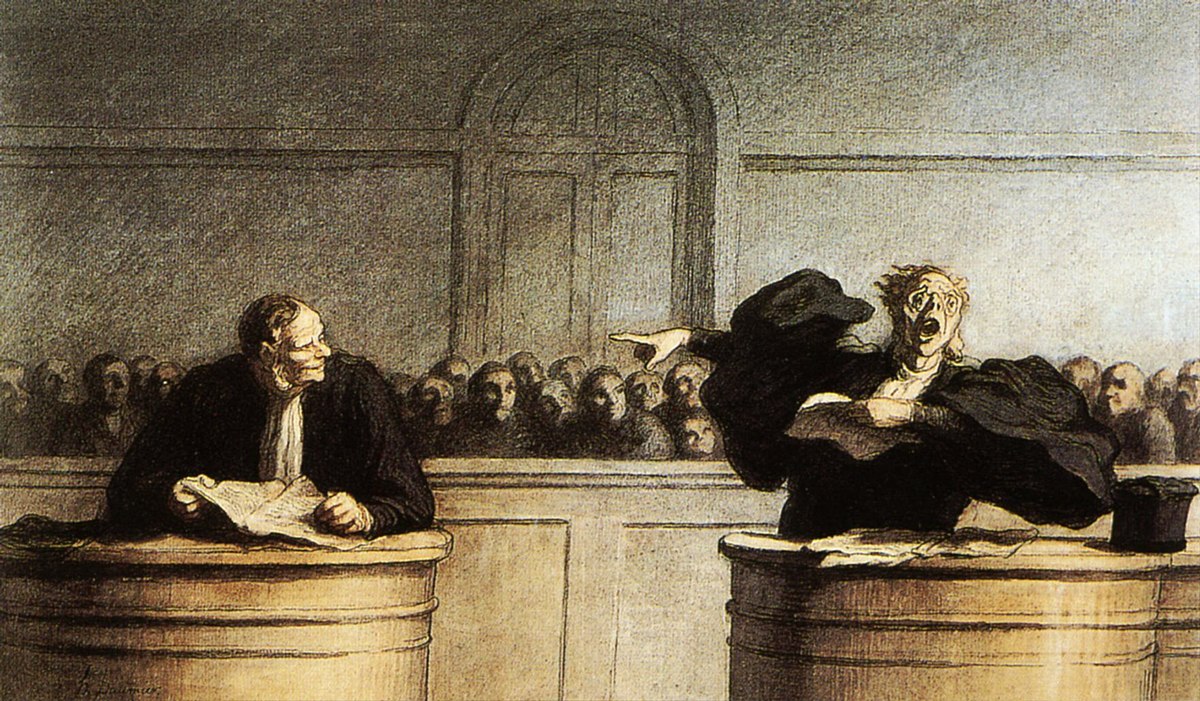
This is a cognitive distortion, an irrational mental filter that twists reality to fit a negative narrative, like a lawyer who only argues for the prosecution.
Gouache painting by Honoré Daumier titled "Une cause célèbre" (A Famous Case), circa 1862, depicting a dramatic courtroom scene. Honoré Daumier, Public domain, via Wikimedia Commons
The courtroom in your head
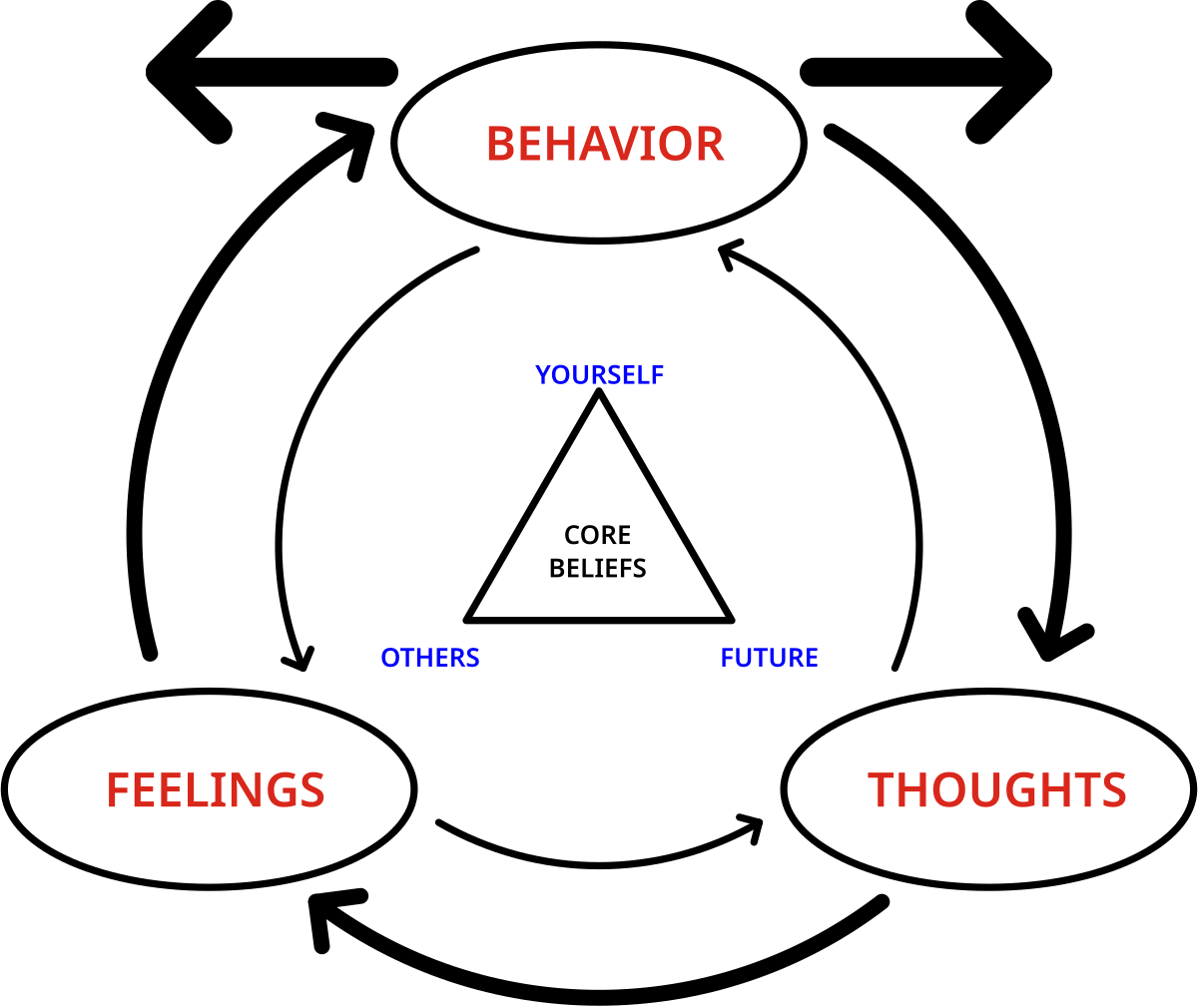
Beck realized he could treat these patterns by teaching patients to cross-examine their own thoughts. This became the foundation of Cognitive Behavioral Therapy (CBT).
Diagram illustrating the basic tenets of Cognitive Behavioral Therapy (CBT), showing interconnected cycles between "BEHAVIOR", "FEELINGS", and "THOUGHTS". Urstadt, CC BY-SA 3.0, via Wikimedia Commons
Instead of accepting the thought as fact, you treat it as a claim that needs evidence. When you catch the distortion, you can dismantle the lie and stop the spiral before it starts.
How distorted thinking creates a cycle
Aaron Beck developed a model showing that distorted thinking operates through negative schemas, which are core mental frameworks about the world. When a person uses these biased schemas, their automatic thoughts focus on self-criticism, treating minor setbacks as catastrophes and harmless remarks as attacks.
These thoughts feel accurate because they happen automatically without time for reflection. In Beck's cognitive triad, these negative assumptions target three domains: the self, the environment, and the future. Over time, the distorted thoughts lead to behaviors such as neglecting self-care or giving up, which reinforces the original negative outlook.
Common types of cognitive distortions
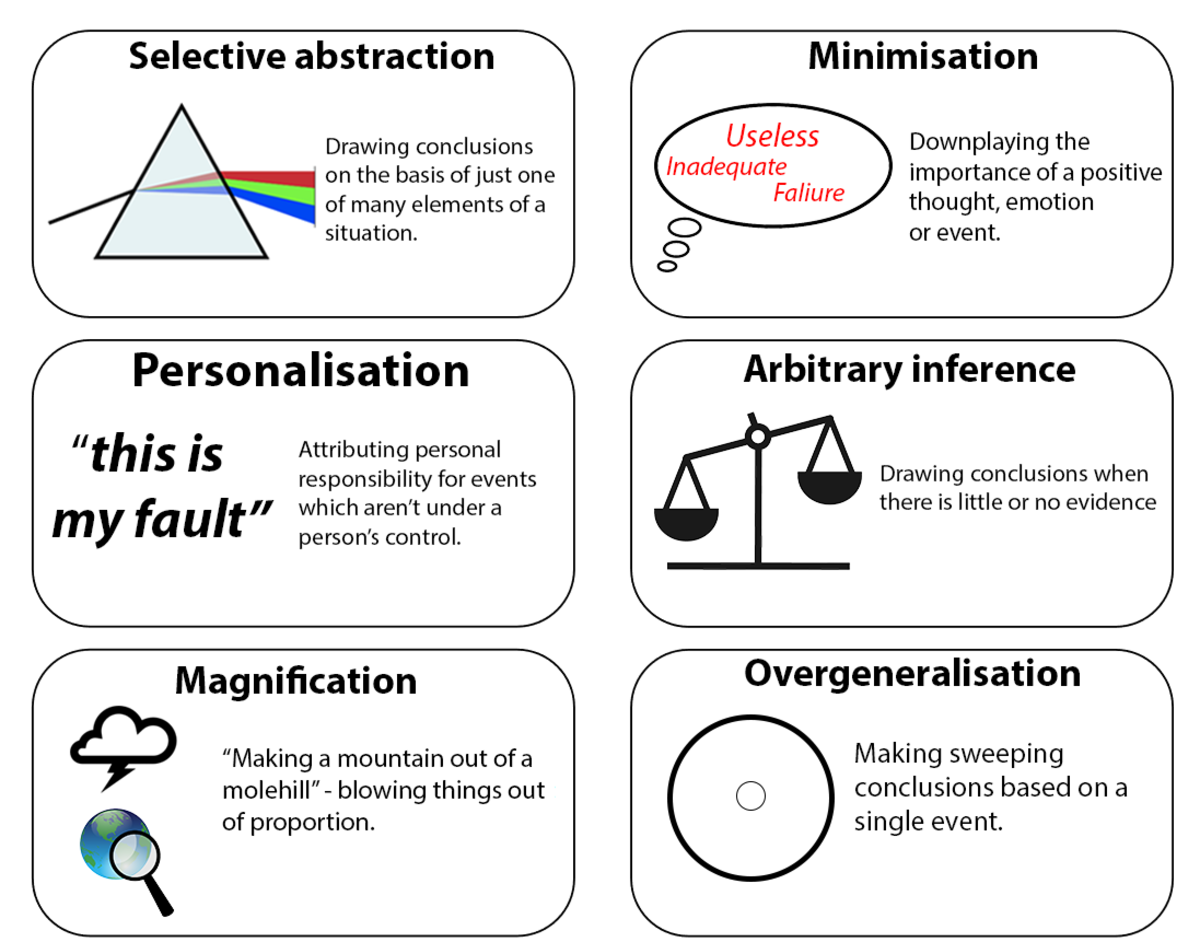
Distortions show up in several distinct forms, including emotional reasoning, fortune telling, and mind reading. In all-or-nothing thinking, also known as splitting or black-and-white thinking, an individual views circumstances purely in extremes with no middle ground.
Common cognitive distortions that psychologists teach patients to identify and reframe during cognitive behavioral therapy. LoudLizard, CC BY-SA 4.0, via Wikimedia Commons
A person caught in black-and-white thinking treats anything short of perfection as total failure. In The Feeling Good Handbook by David D. Burns, an example describes a woman who eats a single spoonful of ice cream and instantly decides she is a complete failure. Because partial success is ignored, minor errors collapse into severe self-blame.
How the concept developed
In 1957, Albert Ellis created rational emotive behavior therapy (REBT) around the ABC model, representing activating events, irrational beliefs, and consequences. Ellis demonstrated that activating events do not cause emotional consequences directly; instead, a person's irrational beliefs about the event produce the emotional reaction.
Beck later formalized cognitive therapy after noticing that psychoanalysis lacked empirical evidence for treating depression. His 1972 book, Depression: Causes and Treatment, outlined cognitive symptoms such as self-criticism and negative expectations, which Burns later popularized for the public in Feeling Good: The New Mood Therapy.
Test yourself
How does Cognitive Behavioral Therapy fundamentally address cognitive distortions?
By treating thoughts as claims requiring evidence. Instead of accepting thoughts as absolute truth or just ignoring them, CBT teaches individuals to cross-examine their internal assumptions with actual evidence.
When someone experiences cognitive distortions, what is the primary function of these mental patterns?
They reinforce a negative narrative. Cognitive distortions act as mental filters that twist reality specifically to support a preconceived negative narrative rather than providing an objective assessment.
In cognitive distortions like all-or-nothing thinking, how does the brain treat an isolated error?
As proof of a global failure. Cognitive distortions take a single minor mistake and expand it into a sweeping negative narrative about oneself.
Play the lesson in edgi and the card is yours. It lands on your Map next to the ideas it connects to, and turns from matte to foil to gold as you learn more around it.
What is the origin of the term cognitive distortion?
Cognitive comes from the Medieval Latin word cognitivus, meaning known. Distortion comes from the Latin prefix dis-, meaning apart or reverse, and torquere, meaning to twist.
What categories do researchers use to organize these distortions?
John C. Gibbs and Granville Bud Potter organized cognitive distortions into four main categories: self-centered, blaming others, minimizing-mislabeling, and assuming the worst.