PsychotherapyWhy the method matters less than the bond
Psychotherapy is the use of psychological methods, usually through regular personal interaction, to help someone change their behavior, improve their mental health, and work through problems. While people often call it talk therapy, hundreds of different techniques exist across individual, family, and group settings. Clinical research shows that despite major differences in technique, treatments often produce similar results because the personal connection between client and therapist is the main driver of success.
By the edgi team We find the most surprising true thing about an idea and build a 60-second lesson around it.
In the 1930s, psychologist Saul Rosenzweig borrowed a line from Alice in Wonderland to describe a strange finding in clinical research. In the book, the Dodo Bird declares after a race: 'Everybody has won, and all must have prizes.'
The cover of the 1865 edition of "Alice's Adventures in Wonderland," featuring a deep red binding with gold embossed details. Lewis Carroll, Public domain, via Wikimedia Commons
Psychologists call this the Dodo bird verdict: studies repeatedly show that no single type of psychotherapy is consistently superior to others.
The real engine
If the method doesn't matter, what does? Decades of data point to the therapeutic alliance. This is the collaborative bond between you and your therapist. It is the single strongest predictor of success across all treatments.
Before the 1950s, therapy was often cold, with the doctor acting as an aloof expert.
Sigmund Freud's psychoanalytic couch, covered with a richly patterned oriental rug and several cushions, located in a room with other artifacts. ROBERT HUFFSTUTTER, CC BY 2.0, via Wikimedia Commons
The human shift
Carl Rogers changed the field by arguing the therapist shouldn't be a blank slate, but a genuine, empathetic partner. Whether you choose Cognitive Behavioral Therapy or psychoanalysis, you are essentially paying for a safe, structured, and non-judgmental human connection.
That relationship allows you to externalize your thoughts, see them clearly, and finally change them.
How does psychotherapy work?
Different types of psychotherapy rely on widely different psychological ideas, yet they tend to achieve similar outcomes. Instead of one specific technique outperforming the rest, the primary engine of change is common factors across methods, especially the collaborative working relationship known as the therapeutic alliance.
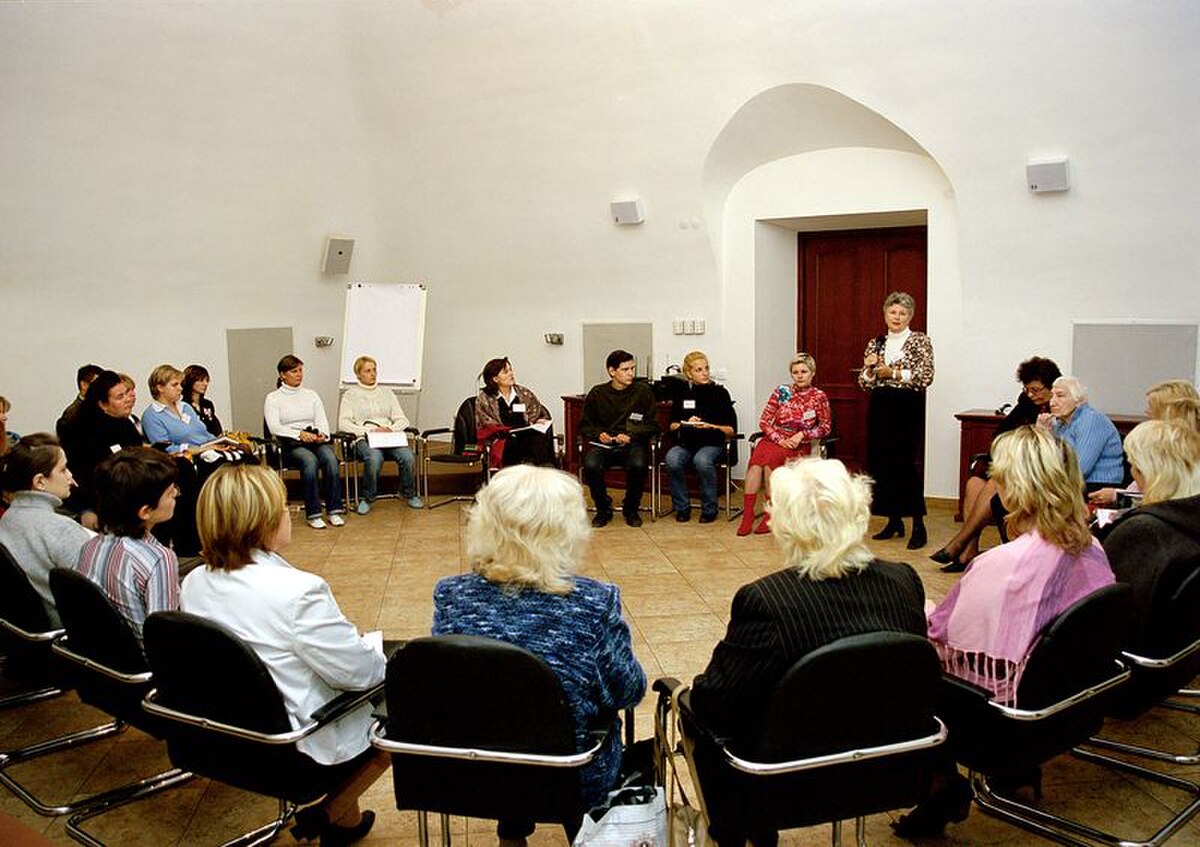
A group therapy session in Ukraine illustrates how therapeutic interactions can take place among peers rather than exclusively in one-on-one settings. http://polinar-clinic.com/help/about_psychotherapy/55, CC BY-SA 4.0, via Wikimedia Commons
Therapy helps people change unhelpful thoughts, emotions, and compulsions in directions they choose. Although it often takes place as spoken conversation between two people, therapists also work with couples, families, and larger groups.
Psychotherapies generally produce longer-lasting effects than medication alone. They are supported by neuroscience and can enhance the effects of drug treatments, including therapies that involve psychedelics.
Does therapy always rely on talking?
Therapy does not require verbal conversation. Play therapy, for instance, lets children and people with intellectual disabilities communicate and process problems non-verbally through toys, role-play, and drawing.
A remote telemental health session shows how therapy can be delivered online without in-person office visits. U.S. Department of Agriculture Lance Cheung/Multimedia PhotoJournalist, Public domain, via Wikimedia Commons
Clinicians also use written exercises, artwork, drama, and music to help clients express and examine their thoughts. Modern delivery extends beyond face-to-face meetings in an office: care occurs over telephone sessions, online video calls, and computer-assisted tools like virtual reality for behavioral exposure.
Test yourself
Two experts use entirely different methods with equal success. What usually explains this?
The quality of the human connection. Different techniques often yield the same results because the shared human element drives the outcome, not the theoretical framework.
Research proves that certain therapy techniques produce better clinical outcomes.
False. Decades of research show no single technique is consistently superior. Success depends far more on the strength of the therapeutic alliance than on the specific school of thought used.
Play the lesson in edgi and the card is yours. It lands on your Map next to the ideas it connects to, and turns from matte to foil to gold as you learn more around it.
Psychotherapists come from several backgrounds, including psychiatrists, psychologists, clinical social workers, mental health nurses, and licensed professional counselors. Depending on the legal jurisdiction, the term psychotherapist may be legally protected, voluntarily regulated, or unregulated.
What is the difference between psychotherapy and counseling?
Counseling often focuses on shorter guidance for everyday problems with less of a medical emphasis, while psychotherapy addresses deeper behavioral, emotional, and personality disorders. The two practices frequently overlap, particularly in client-centered methods.
What are the main challenges facing psychotherapy?
Major challenges include high client dropout rates, potential adverse effects, and a limited understanding of the exact biological mechanisms behind change. Researchers also face ongoing debates over whether randomized controlled trials or individualized tracking best measure treatment success.