Exposure therapyWhy facing fear rewrites the brain
Exposure therapy is a behavior therapy technique that treats anxiety disorders by deliberately placing people in contact with the things or situations they fear. It works because staying in the fearful context without escaping allows the body's natural alarm response to peak and subside. Over time, the brain forms new safety memories that override the old threat signals.
By the edgi team We find the most surprising true thing about an idea and build a 60-second lesson around it.
Anxiety lives in the gap between fear and escape. Every time you run away, your brain marks the situation as 'deadly' and congratulates you for surviving.
This creates a loop: the only way to feel safe is to avoid the trigger, which makes the fear grow stronger.
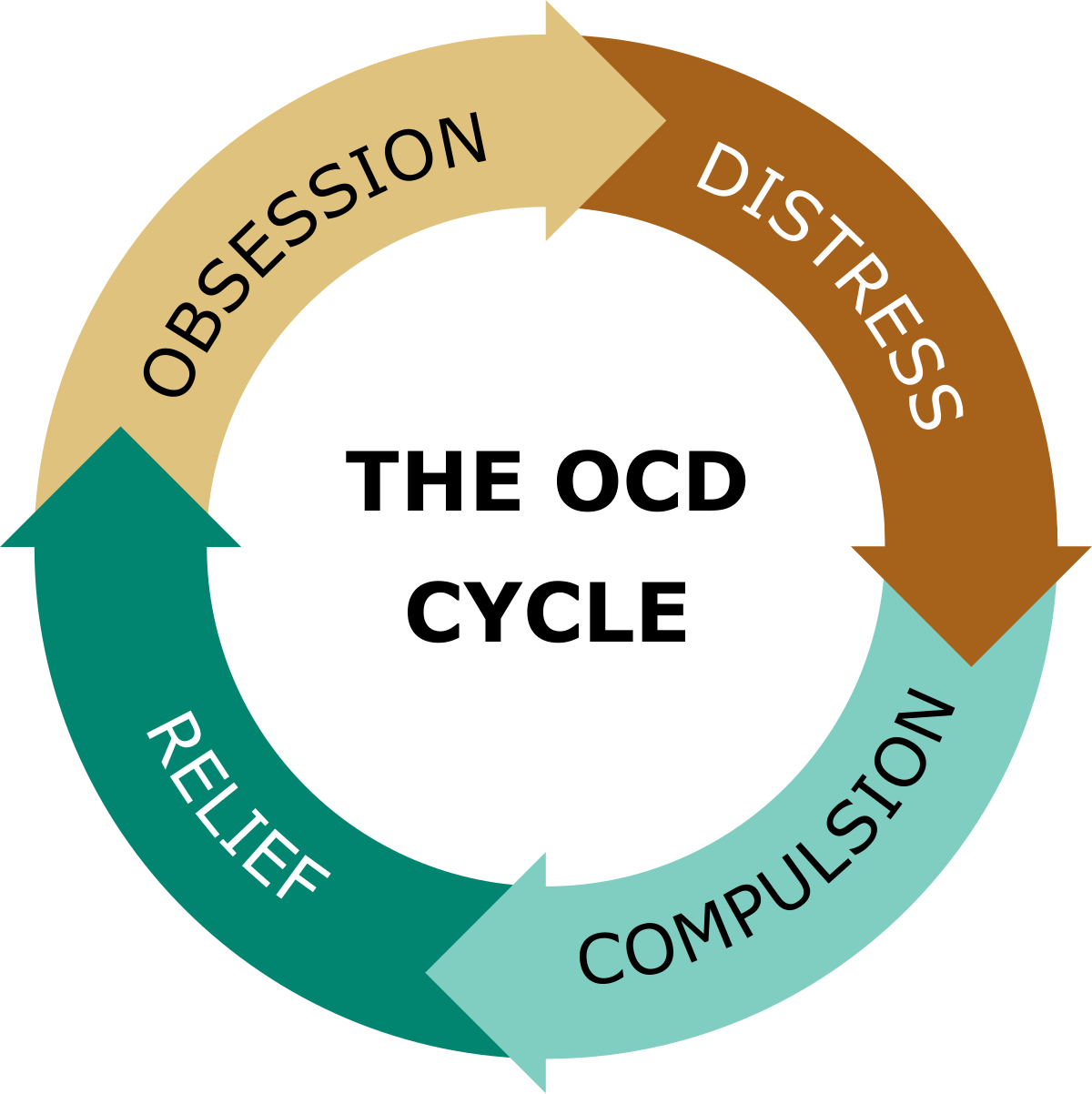
Diagram illustrating "THE OCD CYCLE" as a circular flow of four stages: Obsession, Distress, Compulsion, and Relief. M.Bitton, CC BY-SA 4.0, via Wikimedia Commons
The cats of joseph wolpe
In the 1950s, psychologist Joseph Wolpe helped cats unlearn their fear of cages. He fed them while gradually moving them closer to the source of their terror.
A cat cage at a cat show, adorned with five colorful ribbons indicating awards. en:User:Pschemp, CC BY-SA 3.0, via Wikimedia Commons
He realized humans didn't need food, just time. If you stay in the fear long enough, your biological alarm eventually runs out of adrenaline.
Rewriting the alarm
This is exposure therapy. It isn't about being brave; it's about waiting for your body's 'fight or flight' response to naturally reset. Once the panic peaks and fades without you fleeing, your brain finally updates its file on the threat.
It learns that the trigger is safe, not because you escaped, but because nothing happened.
How exposure therapy changes fear responses
Exposure therapy is based on Pavlovian extinction and respondent conditioning. When an individual confronts a feared object or memory without performing an escape response, they break the cycle that keeps fear alive. The older view assumed this worked purely through habituation, where the body simply gets used to the stimulus. The dominant model as of 2022 is inhibitory learning.
Under the inhibitory learning model, original fear memories do not vanish completely. Instead, the brain builds brand new learning that inhibits the old associations. The person learns through direct experience that the expected catastrophe does not actually happen.
Types of exposure methods
Therapists tailor exposures using different formats. In vivo exposure places a patient in real-life situations, such as having someone with social anxiety give a speech to a small group. When physical objects or locations are inaccessible, virtual reality simulation or imaginal exposure (confronting thoughts and memories directly) provide alternatives. Interoceptive exposure triggers internal sensations, such as an elevated heart rate or shortness of breath, for panic symptoms.
Pacing also varies. A static or dynamic hierarchy allows patients to tackle steadily escalating challenges step by step. Flooding takes the opposite route by beginning immediately at the most feared challenge on the list. In all graded approaches, the patient retains the ability to stop the session at any time.
Exposure and response prevention
Exposure and response prevention (ERP) requires patients to confront their triggers while actively refusing to perform their usual avoidance or compulsive rituals. This non-avoidance is practiced continuously, both in sessions and daily life. The American Psychiatric Association recommends ERP as a first-line psychotherapy for obsessive-compulsive disorder.
ERP is highly effective for both adults and children, delivered in person or via telehealth. Better outcomes correlate with strong adherence to homework and lower avoidance behaviors, whereas adding SSRI medications during treatment does not appear to correlate with superior results.
Test yourself
In exposure therapy, what keeps the avoidance trap active?
Escaping before the fear peaks. Escaping teaches the brain that survival depended solely on fleeing, which reinforces the fear loop rather than letting it reset.
How does exposure therapy permanently reduce anxiety?
By letting adrenaline naturally deplete. Exposure therapy works biologically by allowing the body's alarm system to run out of adrenaline while you remain in the situation, proving the trigger is harmless.
In exposure therapy, does anxiety decrease because you learn to fight the fear or because your adrenaline naturally exhausts itself?
Adrenaline naturally exhausts itself. Exposure therapy relies on staying in the feared situation until your biological alarm runs out of adrenaline, proving the trigger is safe.
Play the lesson in edgi and the card is yours. It lands on your Map next to the ideas it connects to, and turns from matte to foil to gold as you learn more around it.
Studies demonstrate that exposure therapy treats specific phobias, social anxiety disorder, generalized anxiety disorder, obsessive-compulsive disorder, post-traumatic stress disorder, and depression.
How effective is exposure therapy for specific phobias?
Exposure therapy is the most successful known treatment for phobias. In studies of one-to-three-hour single sessions, 90 percent of participants retained significant reductions in fear and avoidance four years later, with 65 percent showing no remaining symptoms.
Why is exposure therapy underused by clinicians?
Despite its proven track record, barriers among psychologists include negative beliefs about the method, a lack of confidence in administering it, and the perception that it contradicts mainline psychological approaches.