The comparative method is a technique linguists use to study how languages develop by comparing features of related tongues and working backward to reconstruct their shared ancestor. By tracking regular shifts in sounds rather than relying on written records, researchers can rebuild entire unrecorded languages from thousands of years ago. It turns spoken words into historical evidence, revealing how ancient populations lived and spread across the world.
By the edgi team We find the most surprising true thing about an idea and build a 60-second lesson around it.
Linguists do not need time machines to hear ancient tongues. They use the comparative method. By lining up words from related languages, like English, Hindi, and Russian, they spot consistent patterns in how sounds changed over thousands of years.
The fairy tale discovery
Jacob Grimm, the man who collected fairy tales, realized consonants shift in predictable, law-like ways. This is why the English father and the Latin pater are the same word. The p sound did not just disappear; it shifted to f in a systematic, traceable way.
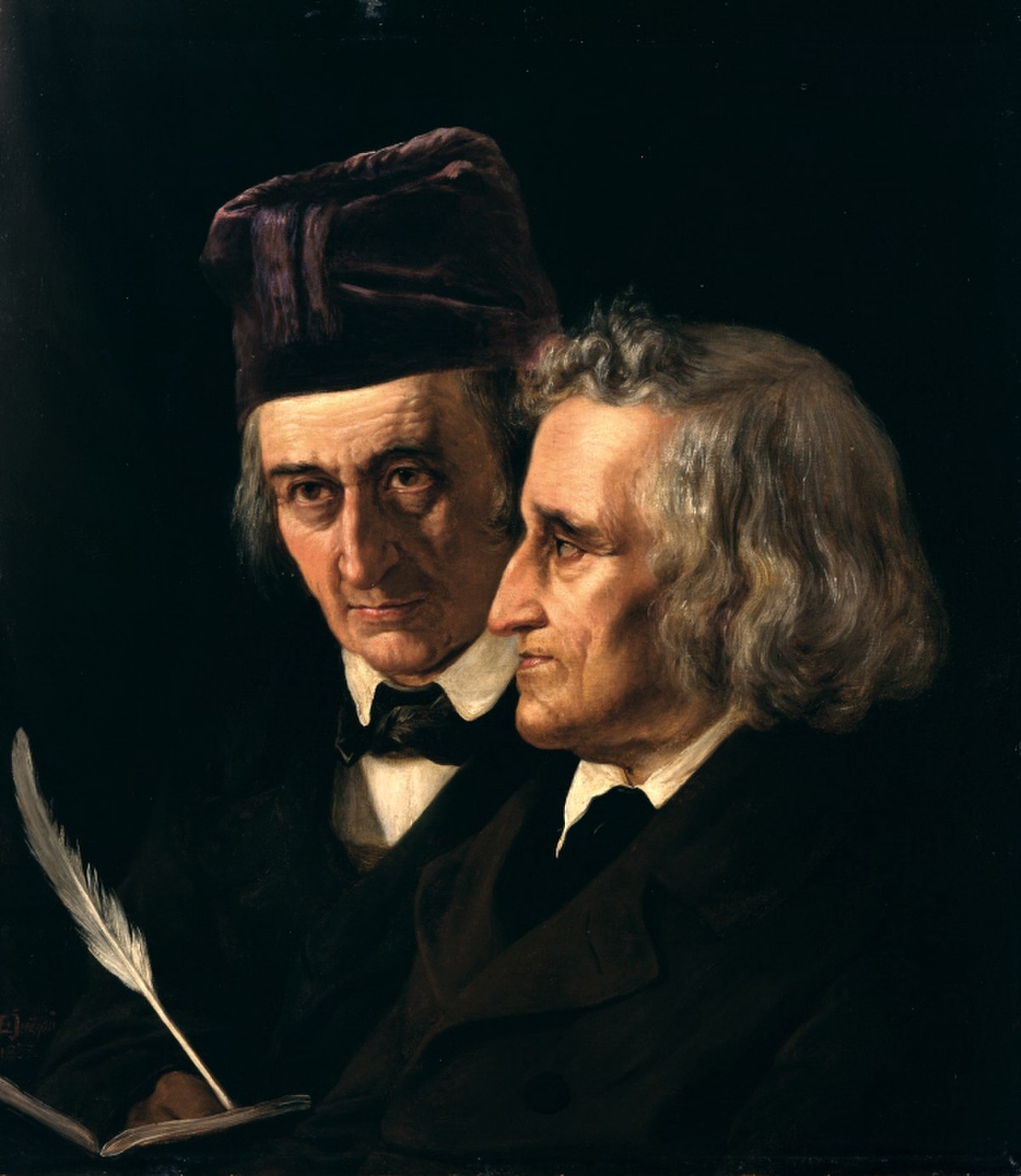
1855 painting by Elisabeth Jerichau-Baumann depicting Wilhelm Grimm (left) and Jacob Grimm (right). Elisabeth Baumann, Public domain, via Wikimedia Commons
This discovery, known as Grimm's law, turned linguistics into a hard science.
Reconstructing the ghost
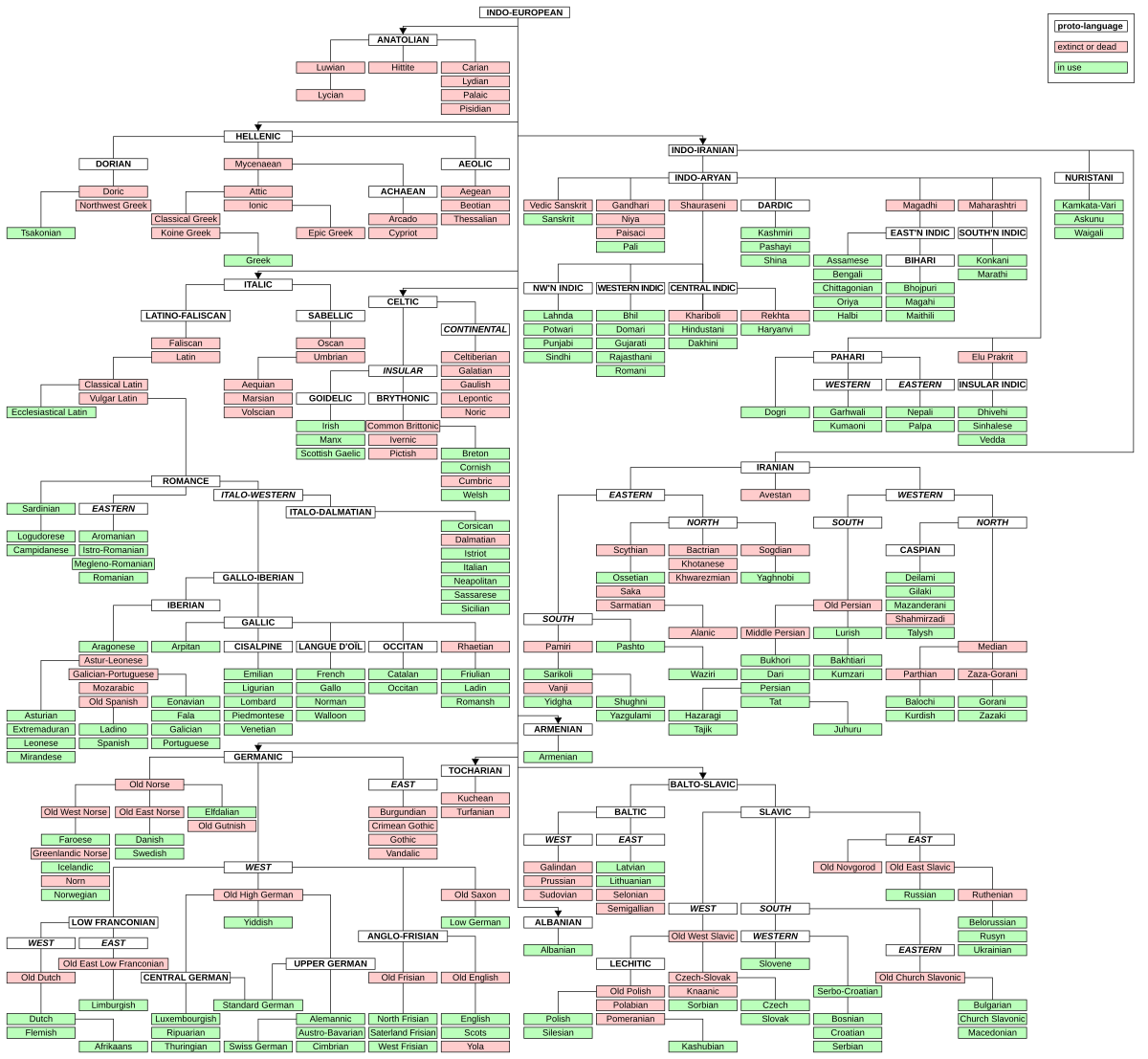
This is not just about etymology; it is about mapping history. By finding these cognates, linguists reconstructed a proto-language called Proto-Indo-European.
A phylogenetic tree diagram illustrating the classification of Indo-European languages, originating from Proto-Indo-European. Mandrak, CC BY-SA 3.0, via Wikimedia Commons
Because the reconstructed words for snow and honey exist in the root language, we know these ancient people lived where those things were common.
The echo in your mouth
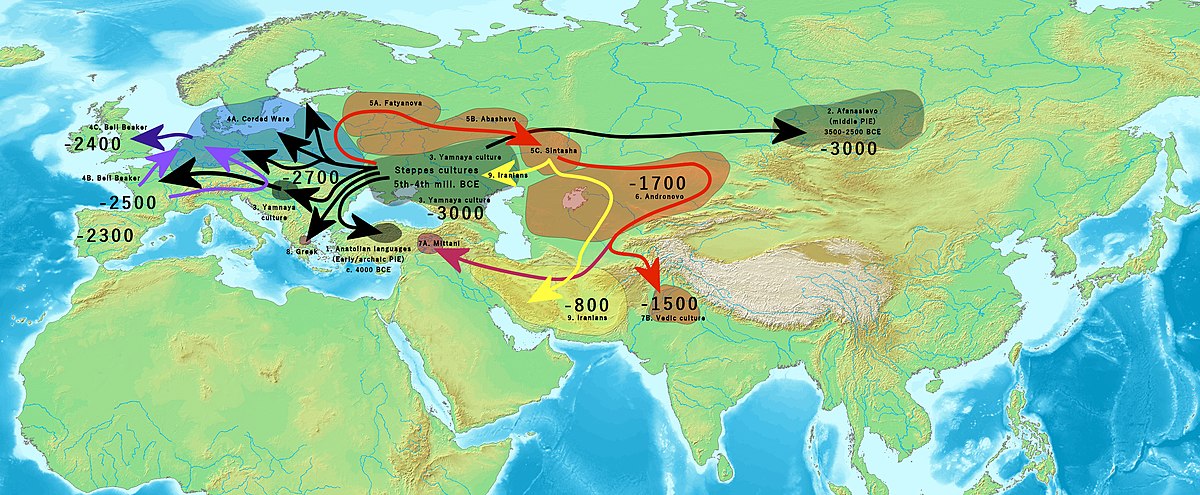
Every time you speak, you are using the echoes of a lost world. You are carrying around a fossilized vocabulary that tells the story of how your ancestors moved across the globe long before they ever wrote it down.
Map illustrating early Indo-European migrations from the Pontic steppes and across Central Asia according to the Kurgan hypothesis. Background: Map created from DEMIS Mapserver, which are public domain. Koba-chan Drawings: पाटलिपुत्र (talk), CC BY-SA 3.0, via Wikimedia Commons
How sound laws rebuild forgotten speech
The comparative method relies on the fact that sound changes do not happen at random. Consonants and vowels shift across generations in predictable, law-like patterns. When scholars compare sister languages, they look for systematic correspondences in sound and meaning that cannot be explained by chance or vocabulary borrowing.
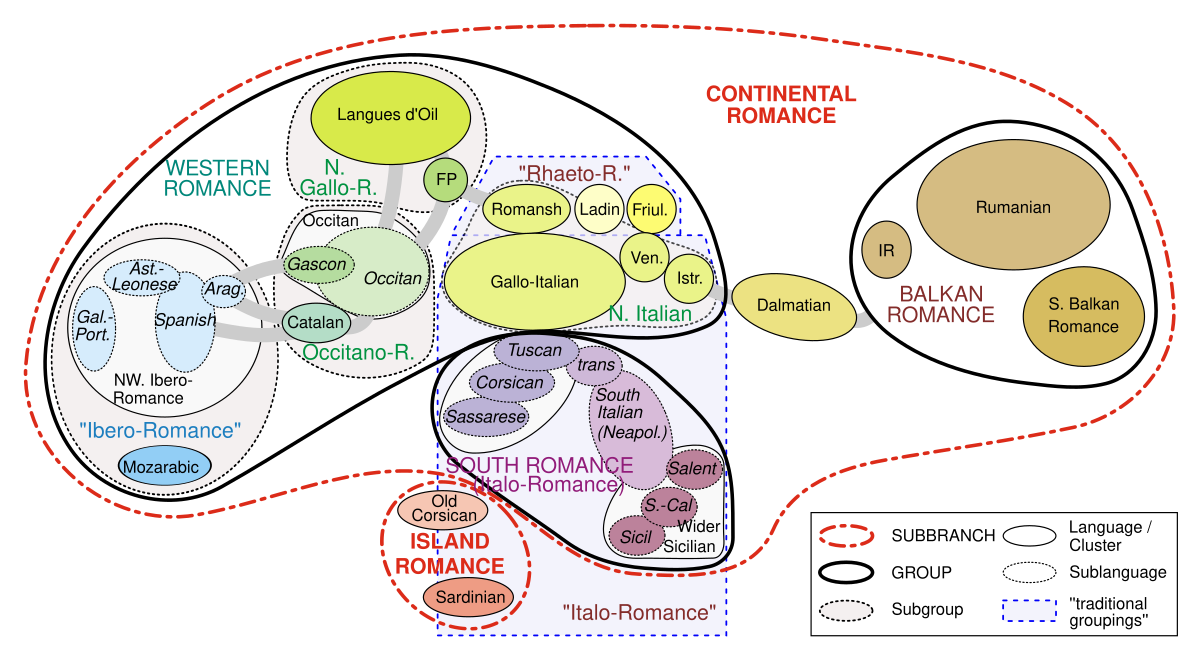
This diagram organizes the Romance languages into branching groups based on systematic shared features inherited from Latin. Original: Koryakov Yuri Vector: Mrmw, CC0, via Wikimedia Commons
Jacob Grimm established that sound shifts operate consistently across related languages, a principle now known as Grimm's law. For example, the initial p sound in the Latin word pater consistently corresponds to the f sound in the English word father. Because this relationship repeats across numerous words, linguists can formulate precise rules to reverse the changes and reconstruct the ancestral forms.
Subgroups and shared innovations
Two languages are genetically related if they descend from the same parent language through unbroken transmission across generations. Italian and French, for instance, both descend from Vulgar Latin and form part of the Romance family. Simply sharing borrowed words does not make languages related: Modern Persian borrowed heavily from Arabic, but it remains an Indo-Iranian tongue descended from Proto-Indo-Iranian.
Degrees of relatedness depend on shared innovations, which are new sound changes or grammar rules that developed in an intermediate ancestor. English and German both underwent the shifts described by Grimm's law before they split apart, which places them together in the Germanic subgroup of Indo-European. Russian shares an older ancestor with them, Proto-Indo-European, but it never underwent those specific Germanic sound shifts.
The origin of language reconstruction
While ancient Romans noticed similarities between Latin and Greek, they explained them through mythology rather than systematic analysis. Scientific comparison began developing in the early 19th century with the birth of Indo-European studies through scholars like Rasmus Rask and Jacob Grimm.
In 1861, August Schleicher published the first reconstructed forms of an unrecorded ancestral language in his Compendium. His work established that linguists could prove relationships beyond a reasonable doubt by methodically deriving attested modern words from reconstructed ancestral forms.
Test yourself
In the comparative method, what supports linking words across related languages?
A recurring, systematic sound correspondence. Regular sound correspondences across multiple cognates support a historical link; meaning or one resemblance alone can be coincidental.
In the comparative method, what supports linking words across related languages?
A recurring, systematic sound correspondence. Regular sound correspondences across multiple cognates support a historical link; meaning or one resemblance alone can be coincidental.
In the comparative method, what supports linking words across related languages?
A recurring, systematic sound correspondence. Regular sound correspondences across multiple cognates support a historical link; meaning or one resemblance alone can be coincidental.
Play the lesson in edgi and the card is yours. It lands on your Map next to the ideas it connects to, and turns from matte to foil to gold as you learn more around it.
What is the difference between the comparative method and internal reconstruction?
The comparative method compares features across two or more related languages to infer their shared ancestral tongue. Internal reconstruction analyzes patterns and irregularities within a single language to deduce its earlier prehistoric stages.
What is a proto-language?
A proto-language is the common ancestral language that linguists reconstruct by comparing its surviving daughter languages. Proto-Indo-European is one of the most famous examples, reconstructed through systematic sound correspondences across languages like English, Latin, Hindi, and Russian.
Why aren't shared retentions used to group languages together?
Shared retentions are features that multiple languages kept unchanged from an ancient ancestor, rather than new changes they developed together. For example, German and Russian both keep the older distinction between dative and accusative cases, but this simply shows English lost the distinction later, not that German is closer to Russian than to English.