A sound shift is a permanent change in how a speech sound is pronounced across an entire language over time. Rather than altering individual words at random, a shift mechanically transforms every word that contains the targeted sound. Because these changes follow regular rules, linguists can track them backward across centuries to reconstruct prehistoric ancestral languages.
By the edgi team We find the most surprising true thing about an idea and build a 60-second lesson around it.
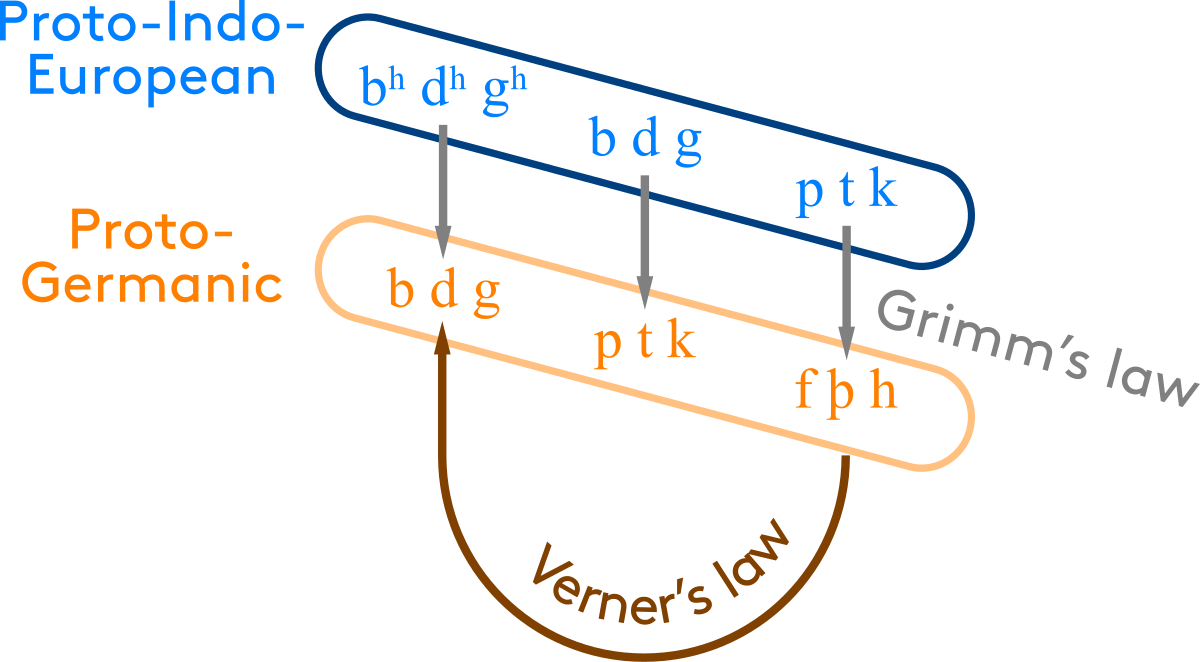
In 1822, Jacob Grimm, the same man who collected fairy tales, realized that language differences were not random. He noticed that whenever Latin used a 'p' sound, like in 'pater', Germanic languages consistently used an 'f' sound, like in 'father'.
Diagram illustrating Grimm's law and Verner's law, showing sound changes from Proto-Indo-European to Proto-Germanic. DDG9912, CC BY 4.0, via Wikimedia Commons
This became known as Grimm's Law. It proved that languages transform according to predictable, rule-based patterns over centuries.
The systemic shift
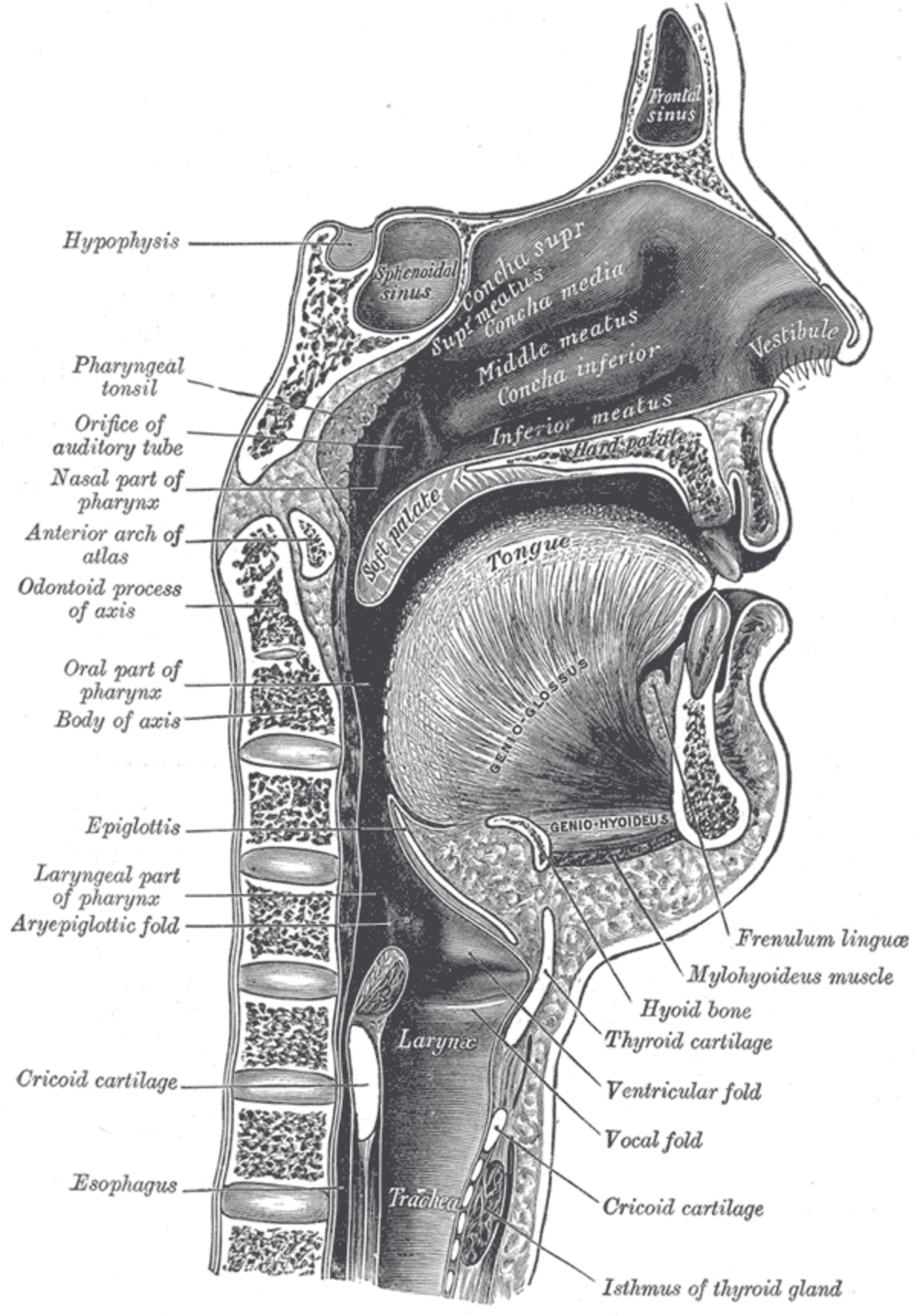
A sound shift isn't slang or a vocabulary trend. It is a fundamental rewrite of the mouth's physical habits affecting a specific phoneme. When a shift occurs, it sweeps through the entire language like a wave.
Sagittal view diagram of the human head and vocal tract, showing various anatomical structures. Henry Vandyke Carter, Public domain, via Wikimedia Commons
If a sound shifts, every single word containing that sound changes simultaneously, creating a systematic, predictable transformation.
The ghost language
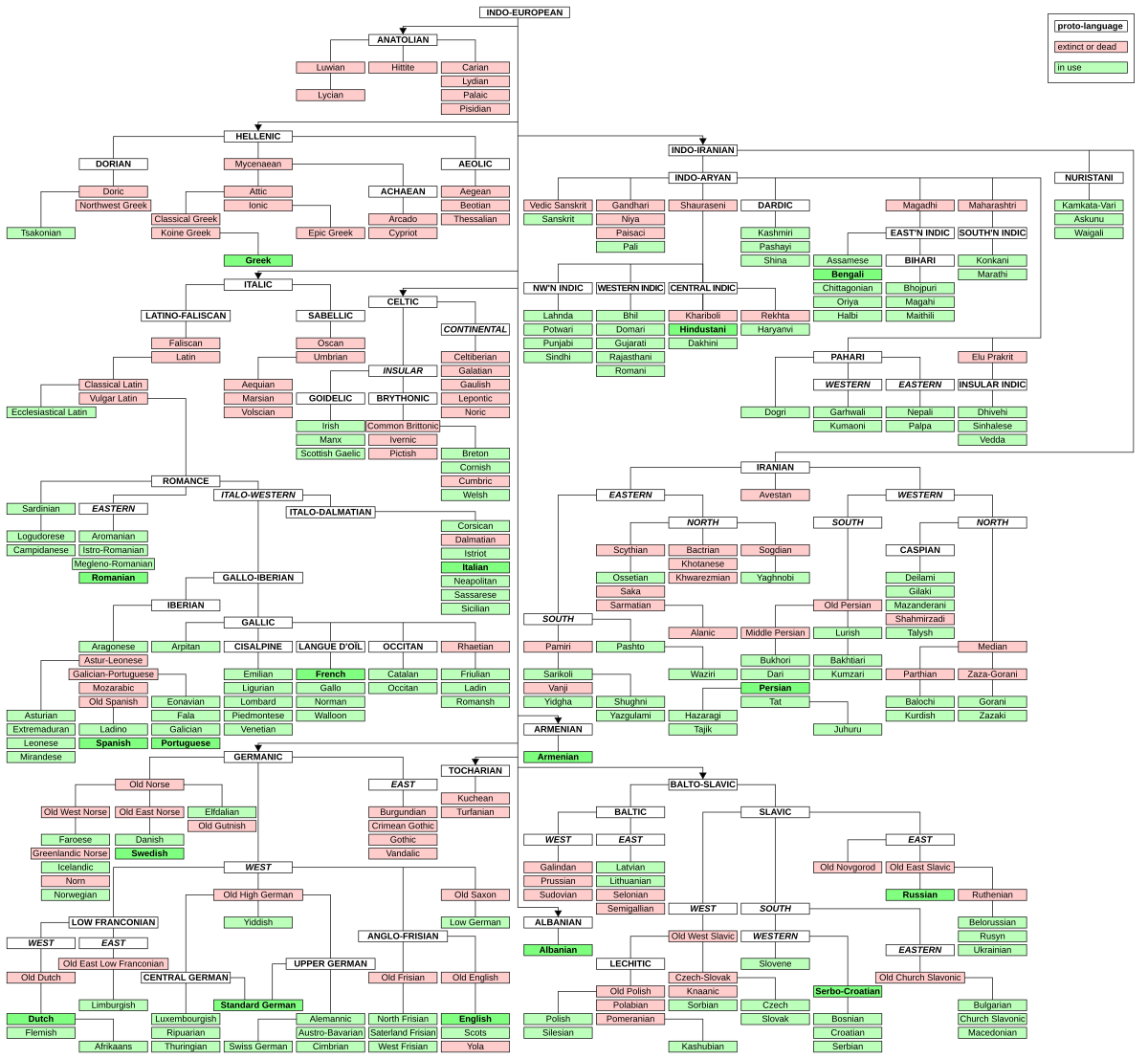
By mapping these shifts backward, linguists can reverse-engineer the 'lost' ancestors of modern tongues. This Comparative Method allowed us to reconstruct Proto-Indo-European, a language with no written record that hasn't been spoken for 5,000 years.
A detailed Indo-European language family tree, showing the relationships and divergence of various language branches. Mandrak, CC BY-SA 3.0, via Wikimedia Commons
It’s how we know the English word 'wheel' and the Sanskrit word 'chakra' descend from the same ancient root.
How regular sound changes work
A sound shift operates blindly across a language's sound system. In historical linguistics, researchers work under the principle that regular sound changes apply mechanically whenever their physical conditions are met, completely ignoring the meaning of words or whether a word is a noun or an adjective.
Sound change also has no memory. If two distinct sounds previously merged into a single sound, any new shift cannot selectively target only one of those original sources. It must affect the entire merged sound across the board.
Linguists write these transformations with simple notations like A > B, which means sound A evolved into sound B. For example, Latin words with a 'b' between two vowels shifted into 'v' in Italian, turning 'caballum' into 'cavallo' and 'debet' into 'deve'.
Conditioned shifts and apparent exceptions
Not all sound changes apply everywhere. An environmentally conditioned change occurs only in specific sound positions, such as at word boundaries, in unstressed syllables, or between vowels. In the Tuscan dialect, the 'k' sound in words like 'di Carlo' shifted to an 'h' sound after vowels ('di [h]arlo'), while staying a 'k' in other positions like 'con Carlo'.
When exceptions appear, they often stem from dialect borrowing, grammatical analogy, or unrecognized conditioning factors. Nineteenth-century Neogrammarian linguists formulated these patterns as 'sound laws', such as Grimm's Law, to capture the strict regularity that allows the comparative method to trace modern vocabularies back to shared ancestral roots.
Play the lesson in edgi and the card is yours. It lands on your Map next to the ideas it connects to, and turns from matte to foil to gold as you learn more around it.
What is the difference between a sound shift and an alternation?
A sound shift is a diachronic change that permanently alters a language's underlying sound system over generations. An alternation happens synchronically within the speech of an individual speaker, such as pronouncing the plural '-s' as an 's' sound in 'bets' but as a 'z' sound in 'beds'.
Can writing or media stop sound changes from happening?
No. Sound change is inevitable across all human languages over time and space. Neither written records nor modern broadcast media can freeze physical pronunciation habits or prevent languages from shifting.