Controlled Substances ActFive schedules for US drugs
The Controlled Substances Act is the 1970 federal law that regulates the manufacture, importation, possession, and distribution of certain drugs in the United States. It unified decades of separate drug statutes into a single system governed by five tiered categories called schedules. Two federal agencies, the Drug Enforcement Administration and the Food and Drug Administration, decide which substances go on which schedule.
By the edgi team We find the most surprising true thing about an idea and build a 60-second lesson around it.
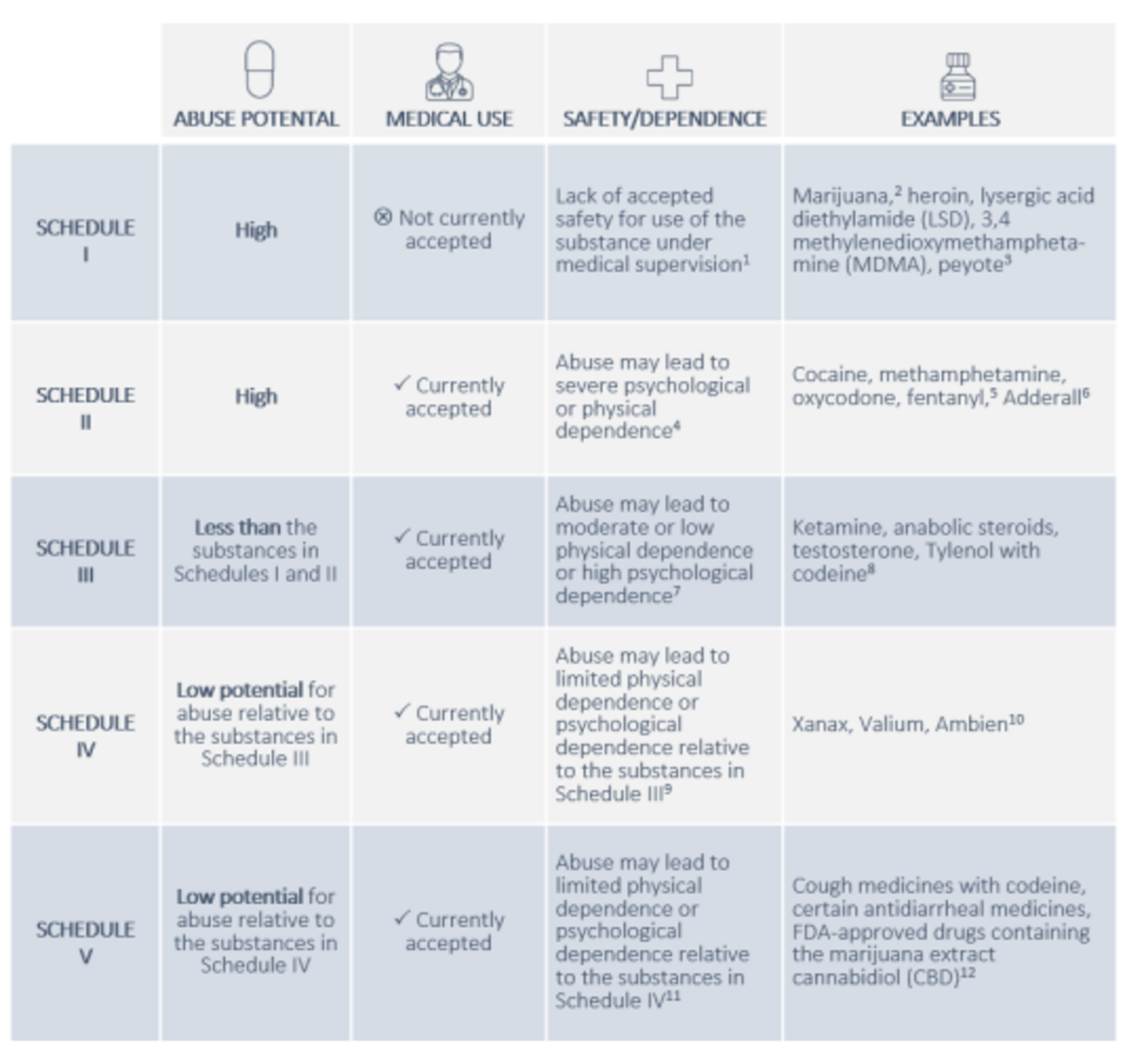
The Controlled Substances Act places drugs into five distinct tiers, known as schedules. Schedule I drugs are deemed to have a high potential for abuse and no accepted medical use.
A table outlining the Controlled Substance Act Scheduling Criteria, categorizing substances into five schedules based on abuse potential, medical use, safety/dependence, and providing examples. Joanna R. Lampe, Public domain, via Wikimedia Commons
Schedules II through V permit progressively lower restrictions for substances with recognized medical value.
The 1970 overhaul
Before 1970, federal drug laws were a patchwork of separate statutes targeting specific substances like opium and marijuana. President Richard Nixon signed the Comprehensive Drug Abuse Prevention and Control Act to unify federal policy.
A close-up view of a pink opium poppy (Papaver somniferum) flower shows its delicate petals and central seed pod. Louise Joly, one half of AtelierJoly, CC BY-SA 1.0, via Wikimedia Commons
Title II of this legislation became the Controlled Substances Act, giving the government sweeping regulatory power.
The legacy
The law created the Drug Enforcement Administration to police the manufacturing and distribution of these substances. Decades later, decisions made under the CSA continue to shape debates over medical research, criminal justice, and drug policy.
The official seal of the United States Drug Enforcement Administration (DEA), a circular emblem with an eagle with outstretched wings over a blue sky and green land. US Government, Public domain, via Wikimedia Commons
How the five drug schedules work
The statute organizes regulated drugs into five tiers based on criteria that include their potential for abuse, their accepted medical value, and international treaty obligations. The term 'potential for abuse' is left undefined in the statute itself.
Schedule I sits at the top with the strictest controls, reserved for substances judged to have a high potential for abuse and zero accepted medical use in the United States. Schedules II through V place progressively fewer restrictions on substances that have recognized medical applications.
Two federal agencies share the responsibility of modifying these lists: the Food and Drug Administration and the Drug Enforcement Administration. Congress also intervenes directly through new legislation. In 2000, lawmakers placed GHB into Schedule I while assigning its isolated sodium salt to Schedule III for specific FDA-approved medical uses.
Why the law was passed in 1970
Before 1970, federal drug rules were scattered across individual statutes targeting specific substances like opium and cannabis. In 1969, President Richard Nixon announced that Attorney General John N. Mitchell was preparing a measure to replace this patchwork by combining all existing federal drug laws into one statute.
Drafted as Title II of the Comprehensive Drug Abuse Prevention and Control Act of 1970, the bill eliminated mandatory minimum sentences and supported drug treatment and research. Its rehabilitation clauses were a compromise with Senator Harold Hughes, who favored a moderate approach. Alongside the federal statute, the Department of Justice drafted the Uniform Controlled Substances Act to encourage state legislatures to adopt matching statutory language across the country.
Play the lesson in edgi and the card is yours. It lands on your Map next to the ideas it connects to, and turns from matte to foil to gold as you learn more around it.
Created under the 1970 Act to study cannabis, the commission recommended decriminalizing small amounts of marijuana for personal possession. Its chairman argued that criminal law was too harsh a tool for private drug use.
How does the law handle newly invented synthetic drugs?
The 1986 Federal Analog Act amended the system to cover unlisted chemicals that are substantially similar to Schedule I or II drugs. Later legislation in 2012 specifically added chemical categories to capture synthetic cannabinoids.