Default Mode NetworkWhy rest is an active brain state
The default mode network is a coordinated set of brain regions that fires up when you are not focused on the outside world. Instead of shutting down during rest, the brain uses this network to daydream, recall memories, and construct an ongoing sense of self. It proves that a resting brain is almost as active and energy-hungry as one solving hard problems.
By the edgi team We find the most surprising true thing about an idea and build a 60-second lesson around it.
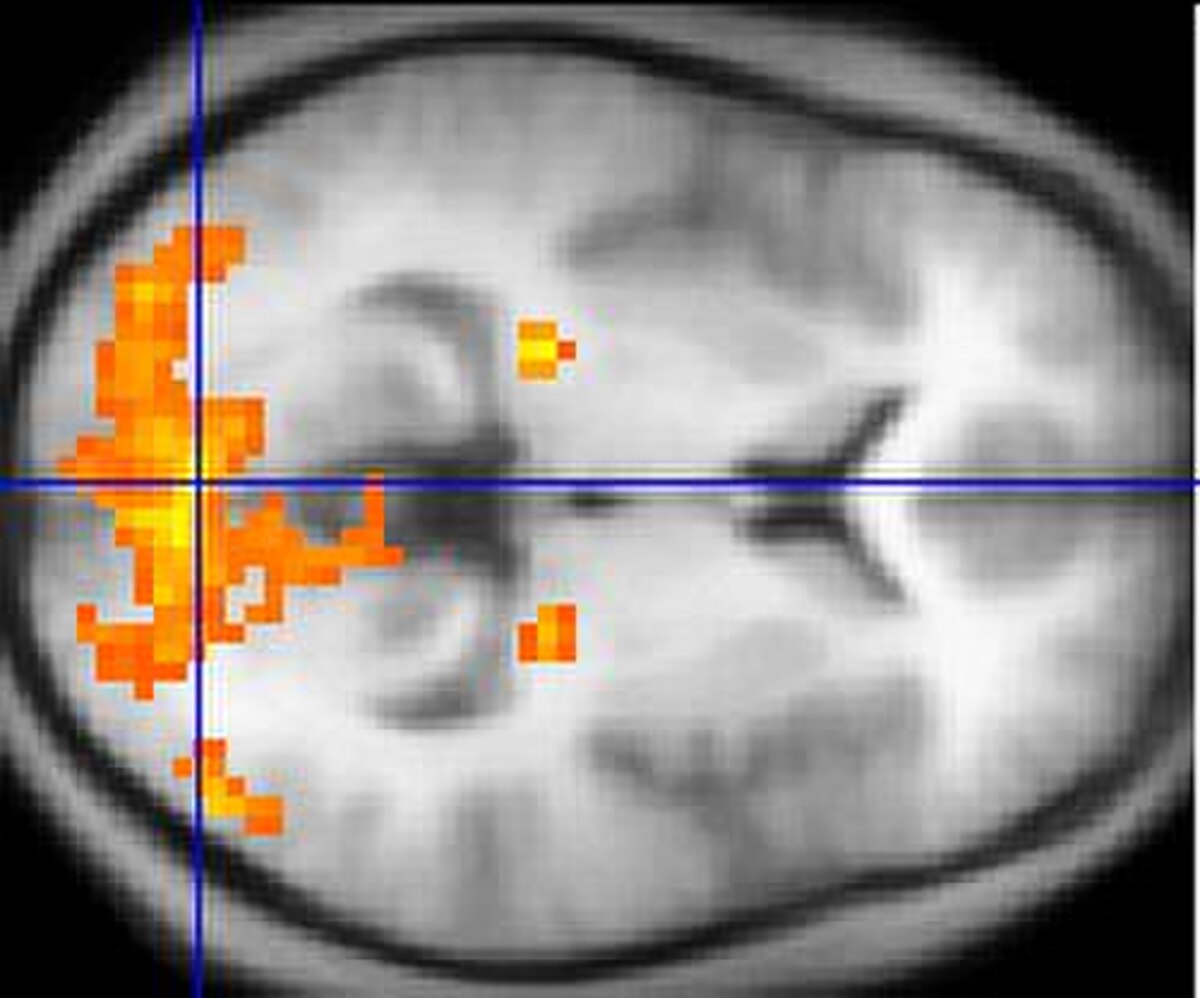
In the 1990s, neurologist Marcus Raichle noticed a strange pattern in brain scans. Researchers were throwing away 'resting' data, assuming it was just background noise. He realized that when people stopped focusing on a task, specific regions like the medial prefrontal cortex didn't turn off. They actually flared to life.
A functional magnetic resonance imaging (fMRI) brain scan showing areas of increased brain activity highlighted in orange and yellow. Washington irving at English Wikipedia, Public domain, via Wikimedia Commons
The engine of self
This network, the Default Mode Network, is the brain's internal storyteller. It is most active when you are daydreaming, reflecting on your past, or worrying about the future.
A 1912 postcard illustrates the concept of a man daydreaming about a woman who is not present, showing a seated man with a mustache, looking thoughtfully into the distance, while a translucent,… Unknown authorUnknown author, Public domain, via Wikimedia Commons
It constructs your personal narrative, constantly rehearsing social scenarios and linking your memories to your current identity.
The brain's toggle switch
When you need to focus on the physical world, your brain's salience network acts as a toggle switch. It shuts down the internal storyteller so your executive function can take over and solve the problem at hand.
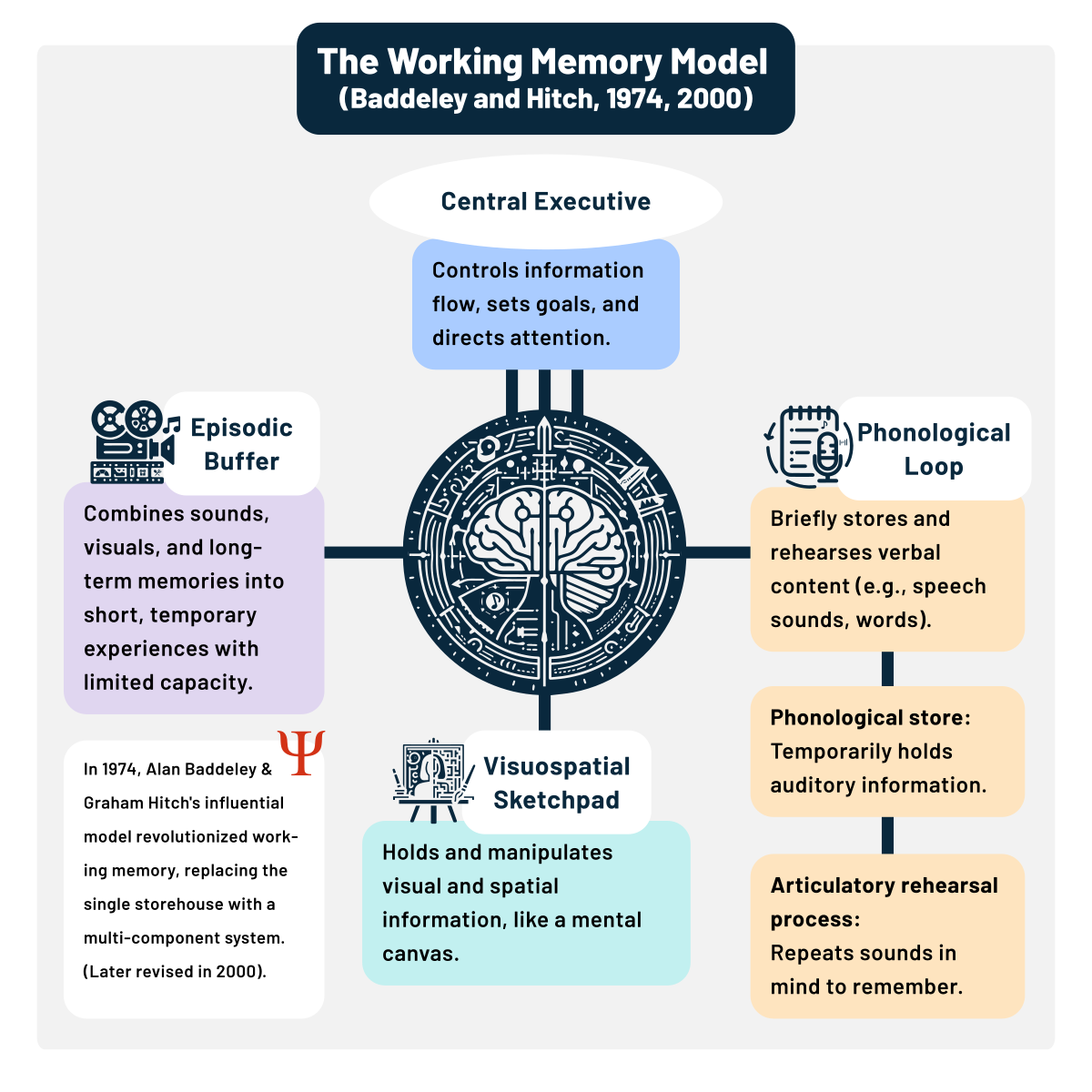
Diagram of The Working Memory Model by Baddeley and Hitch (1974, updated 2000), illustrating its main components: the Central Executive, Episodic Buffer, Phonological Loop, and Visuospatial Sketchpad. UX Stalin, CC BY-SA 4.0, via Wikimedia Commons
You are never truly quiet; you are either talking to the world or talking to yourself.
Which brain regions make up the network?
A resting brain consumes nearly the same amount of energy as one working through difficult math problems. Focused mental tasks raise baseline energy consumption by less than five percent.
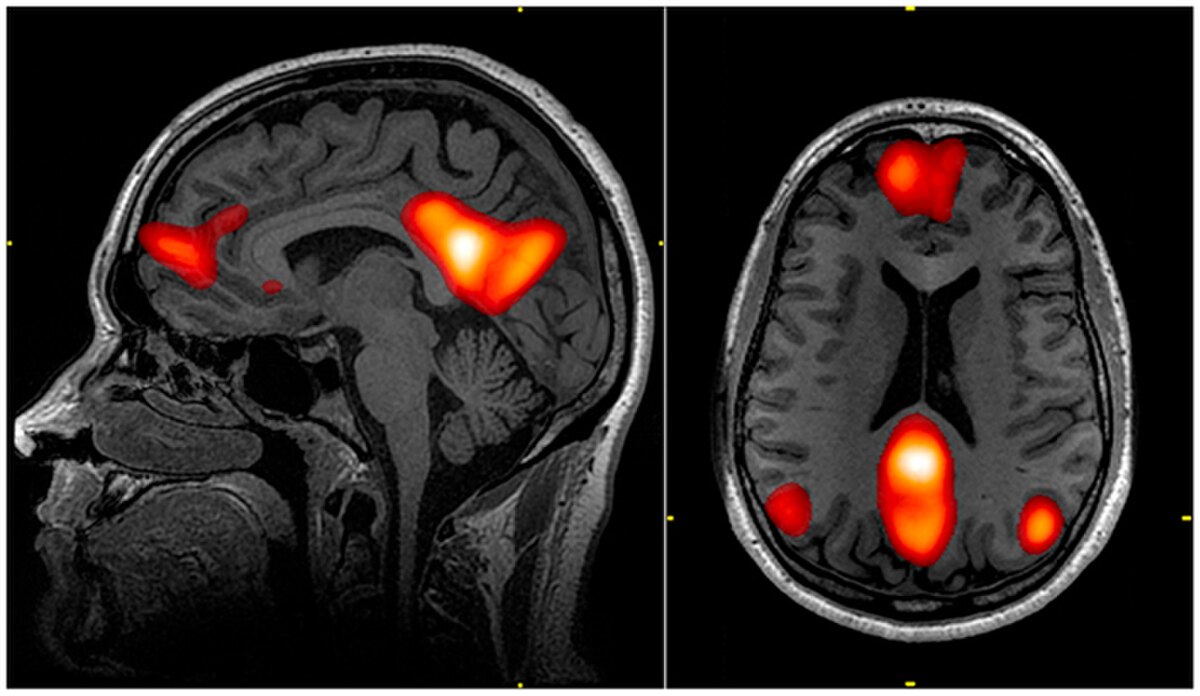
Highlighted areas in red and orange show the core brain regions that synchronize during wakeful rest. John Graner, Neuroimaging Department, National Intrepid Center of Excellence, Walter Reed National Military Medical Cent, Public domain, via Wikimedia Commons
The default mode network relies on several interconnected hubs. Key areas include the medial prefrontal cortex, which handles decisions about personal identity, and the posterior cingulate cortex alongside the precuneus, which combine attention with memory and perception. It also includes the angular gyrus.
These structures synchronize their activity when you reflect on yourself, think about other people, remember past events, or plan for the future.
Why is it no longer called the task-negative network?
Early brain scans showed these regions quieting down whenever participants performed goal-oriented external tasks like visual tracking or language tests. Researchers initially labeled it the task-negative network, assuming it only operated during passive downtime.
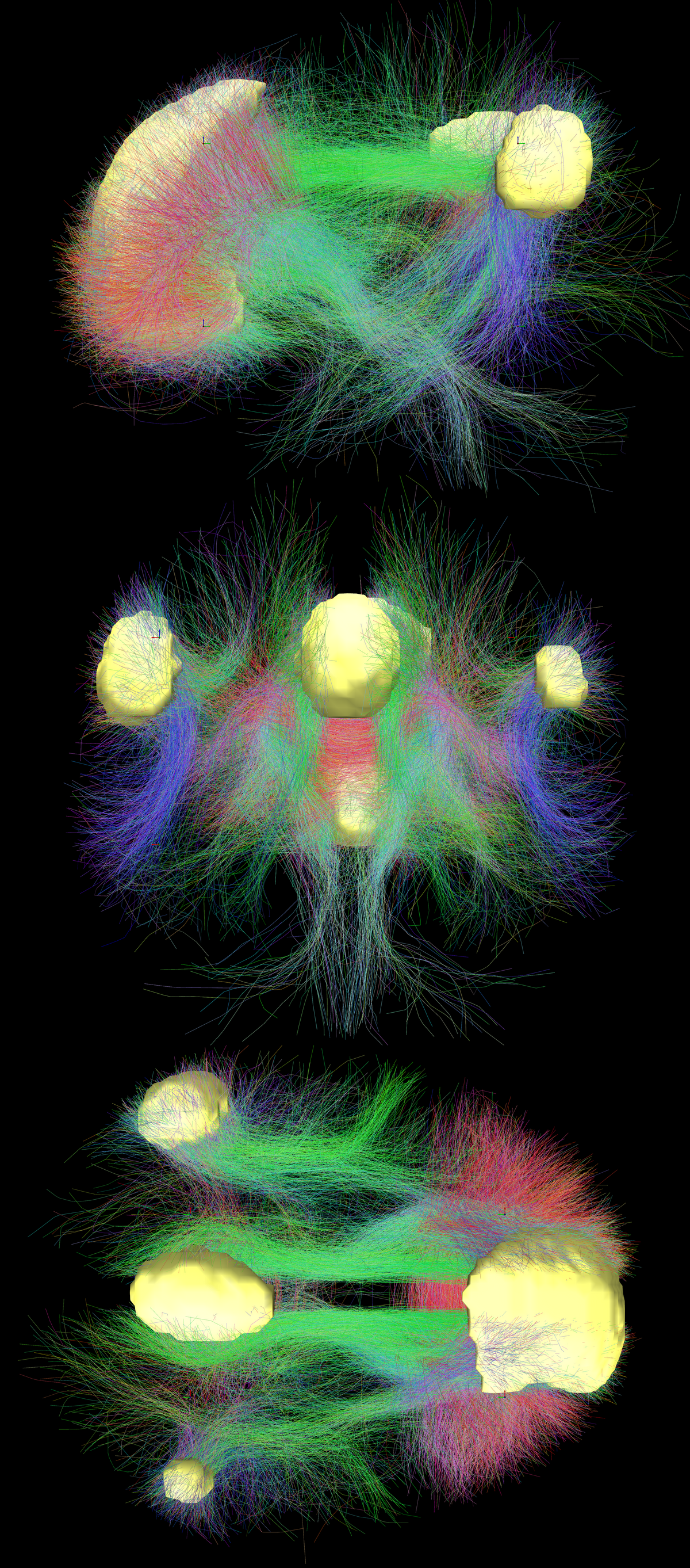
Yellow nodes and color-coded pathways map the structural connections linking different hubs across the brain. Andreashorn, CC BY-SA 4.0, via Wikimedia Commons
That label turned out to be misleading. The network actively engages during goal-directed internal tasks, including social working memory, spatial navigation, and detailed conceptual thinking.
Attention networks that track the outside environment often show negative correlation with the default mode network. When attention switches outward, default mode activity drops, and when external demands fade, internal processing resumes.
Play the lesson in edgi and the card is yours. It lands on your Map next to the ideas it connects to, and turns from matte to foil to gold as you learn more around it.
Neurologist Marcus Raichle coined the term in 2001 after observing consistent baseline activity in resting brain scans. His work built on decades of earlier clues, including Hans Berger's 1929 discovery that electrical brain oscillations continue during rest and Bharat Biswal's 1995 discovery of resting-state connectivity.
What medical conditions involve default mode network changes?
Researchers have identified disruptions in this network in people diagnosed with Alzheimer's disease and autism spectrum disorder. Compounds like psilocybin also produce significant activity changes across these same regions.