Dollar-cost averagingHow fixed buys beat average prices
Dollar-cost averaging is an investment strategy where you put a fixed amount of money into the same asset on a regular schedule, regardless of what it costs that day. Because your dollar amount never changes, you automatically buy more shares when prices are low and fewer shares when prices are high. This pulls your average cost per share below the average market price over time without requiring you to predict market movements.
By the edgi team We find the most surprising true thing about an idea and build a 60-second lesson around it.
Dollar-cost averaging means paying a fixed amount into the same investment on a fixed date, whatever the price is that day. The schedule decides, and it decides the same way every time. A fixed amount buys more units when the price is low and fewer when it is high, without anyone choosing to do that. The buying tilts towards the cheap months on its own.
Pay $400 in at $10 a unit and $400 more at $20, and you own 60 units for $800. That is an average cost of $13.33 against an average price of $15.
Two things share the name
Two different habits get called dollar-cost averaging. One is paying in from your income as it arrives; the other is holding a lump sum you already have and feeding it in over a year. Vanguard tested the second against investing the lump immediately. Putting it all in at once came out ahead about two thirds of the time, because the money spent more of the period in the market.
Spreading a windfall out therefore costs return on average. What it buys is a smaller worst case, and for some people a plan they will actually go through with. Paying in from income is the ordinary case, and there is nothing in it to optimise. The money arrives monthly, so it goes in monthly.
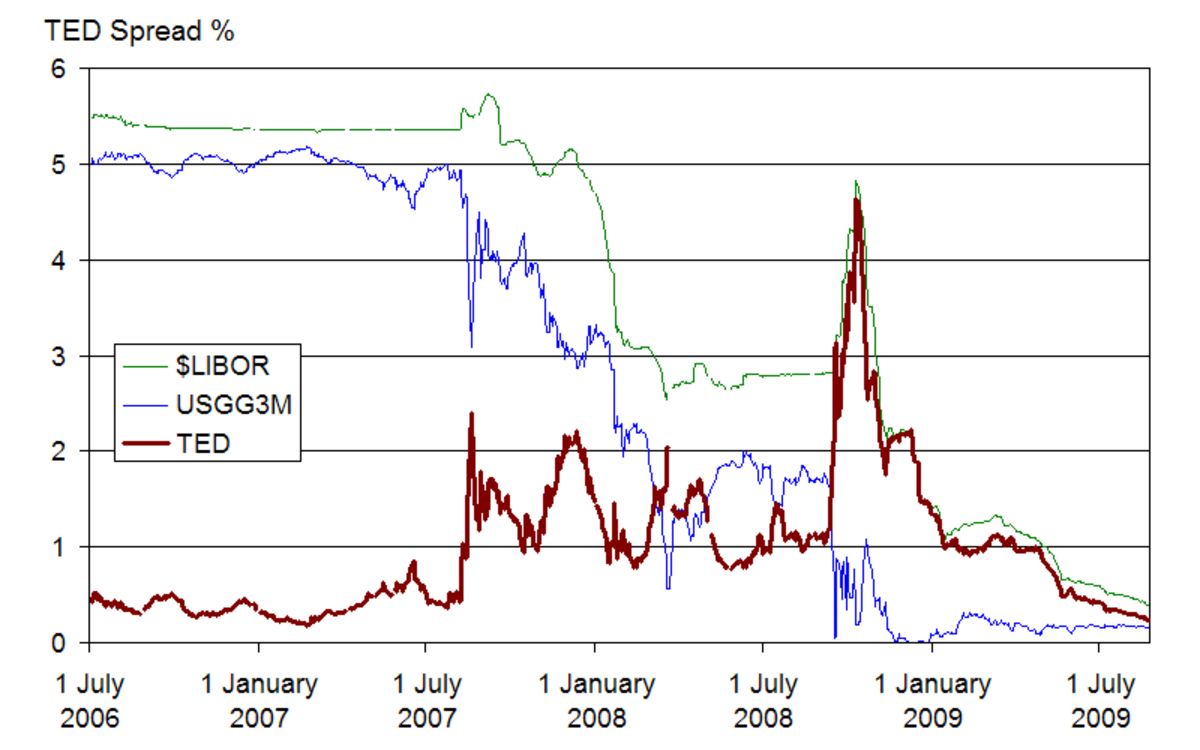
A graph showing the TED spread, $LIBOR, and USGG3M from July 2006 to 2009, indicating perceived credit risk in the financial system. Lawrencekhoo, Public domain, via Wikimedia Commons
Set it and forget the price
A standing order set up once runs 360 times over 30 years. Each of those payments would otherwise be a small question about whether this month looks like a good moment. Market timing is the alternative, and it needs a right answer twelve times a year. The schedule needs none. It buys at whatever the price is that morning.
A marble calendar of the dates of Easter for the 95 years from 532 to 626, displayed in the Museum of Ravenna Cathedral, Italy. Apatak, CC BY-SA 4.0, via Wikimedia Commons
What the schedule does need is to survive a bad year. Pick a monthly amount you would not cancel in a month when everything is down, because cancelling is its only real failure.
How the math lowers your average cost
A fixed cash investment automatically tilts your purchases toward cheaper periods. The average price you pay per share equals the harmonic mean of the market prices across your buying dates, which is mathematically lower than the standard arithmetic average. If you put $400 into an asset at $10 and another $400 in at $20, you own 60 units for an average cost of $13.33, beating the $15.00 average market price.
Benjamin Graham coined the term in his 1949 book The Intelligent Investor, pointing out that regular equal purchases in common stocks or commodities allow buyers to acquire more holdings at lower levels. The technique is also known as pound-cost averaging in the UK, unit cost averaging, incremental trading, or the cost average effect.
Setting parameters and managing transaction fees
Setting up the strategy requires only two decisions: how much money to commit and how frequently to invest it. Once chosen, the plan runs automatically through bank transfers or payroll deductions, eliminating twelve monthly timing decisions each year.
Fixed transaction fees can disrupt the strategy if contributions are too frequent. For instance, paying a $20 brokerage fee on a $500 fortnightly contribution costs 4%, easily wiping out short-term expected returns. Stretching the schedule to every four or ten weeks reduces the proportional drag of flat fees, though this issue disappears entirely when investing in assets with percentage-based fees or zero-cost managed funds.
Dollar-cost averaging versus lump-sum windfalls
The term dollar-cost averaging is often applied to two distinct situations: investing income as it arrives versus drip-feeding an existing windfall over time. Staging a lump sum into the market over months is formally known as a systematic implementation plan.
Vanguard found that investing a lump sum immediately outperforms staging it over time roughly two thirds of the time because the money spends longer in the market. While spreading out a windfall reduces the worst-case scenario during a market drop, ordinary dollar-cost averaging from a paycheck is simply putting money to work as soon as it is earned.
Test yourself
How does spreading a cash windfall out over time compare to investing it all at once?
It reduces average returns but lowers the worst-case risk. Lump-sum investing usually wins because money spends more time in the market, but spreading it out helps anxious investors stick to a plan.
What is the primary function of dollar-cost averaging?
Replacing individual choices with a schedule. Dollar-cost averaging removes the burden of deciding when to invest by letting a rigid schedule dictate every transaction.
You pay $600 in at $20 a unit, then $600 at $30. What is your average cost per unit?
$24.00, below the average price. The fixed payment buys 30 units at $20 and 20 at $30, so $1,200 buys 50 units. A fixed amount always buys more of the cheap ones.
Play the lesson in edgi and the card is yours. It lands on your Map next to the ideas it connects to, and turns from matte to foil to gold as you learn more around it.
What assets can dollar-cost averaging be applied to?
The strategy applies to common stocks, managed funds, and commodity markets such as gold. Any asset that allows recurring fractional or unit purchases can be bought this way.
Is dollar-cost averaging the same as a constant dollar plan?
No. A constant dollar plan is a portfolio rebalancing method, whereas dollar-cost averaging is a strategy for accumulating shares through fixed, regular monetary purchases.
What is the biggest risk to a dollar-cost averaging plan?
The primary risk is stopping the plan during a market downturn. Cancelling contributions when prices drop prevents the strategy from buying the cheaper units needed to lower the overall average cost.