Net worth is the total value of everything you own minus everything you owe. It measures an accumulated financial level on a specific date rather than an ongoing income rate. Because salary is not included, two people with identical earnings can end up with completely different wealth levels depending on what they save, buy, or owe.
By the edgi team We find the most surprising true thing about an idea and build a 60-second lesson around it.
Net worth is everything you own, valued at what it would sell for, minus everything you owe. House, pension, savings and car on one side; mortgage, loans and cards on the other. Your salary is not in it anywhere. Income is a rate, measured per month. Net worth is a level, measured on a date, and a raise reaches it only through whatever is left over.
So two people who have earned the same for ten years can be $200,000 apart. The distance between them is the sum of every difference between what came in and what went out.
The average describes somebody else
Both numbers come from the Federal Reserve's 2022 survey of family finances. The mean is five and a half times the median because a small number of very large fortunes pull it upwards. The median family is the one standing in the middle of the queue, with half of families on either side. The mean adds every fortune up and divides; the median only asks who is in the middle.
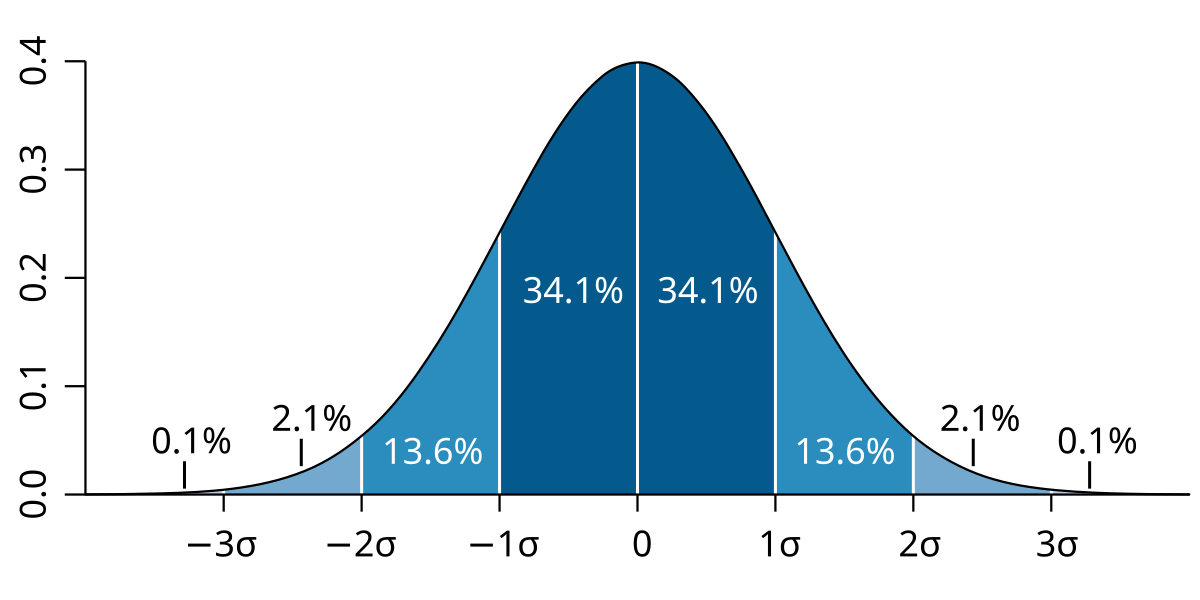
Diagram of a normal distribution curve, also known as a bell curve, illustrating the 68–95–99.7 rule for data points within standard deviations from the mean. M. W. Toews, CC BY 2.5, via Wikimedia Commons
For families in the middle, most of what they hold is the house they live in. Median home equity rose from $139,100 in 2019 to about $200,000 in 2022, the largest such rise the survey has recorded.
It is a subtraction
Net worth moves in only three ways: you add to what you own, you pay down what you owe, or the things you already hold change in price. Money that arrives and leaves inside the same month never reaches either side of that subtraction. It was income, and then it was not, and the level never moved.
Which is why the number is worth writing down once a year rather than watching. It moves slowly, and the only lever on it is the gap between what comes in and what goes out.
How net worth is calculated
Net worth equals assets minus liabilities. Assets include financial holdings like bank accounts, money market accounts, stocks, bonds, and retirement accounts, alongside physical property such as houses and vehicles. Liabilities cover financial obligations like mortgages, personal loans, consumer debt, and accounts payable.
Intangible assets like educational degrees are left out of personal net worth calculations, even though they improve earning power. The total changes only when you acquire new assets, pay down debts, or hold assets whose market values rise or fall. Any money earned and spent within the same month never alters the total.
Net worth in businesses and whole countries
In business, net worth is called equity and is calculated using the carrying value of assets and liabilities on a balance sheet. When accumulated losses surpass shareholder equity, a company's net worth turns negative. A firm's accounting net worth does not necessarily reflect its market value if sold as an operating business.
Governments construct balance sheets using accrual-based or cash accounting systems to track their own net worth as an indicator of financial strength. When you combine the net worth of all resident individuals, domestic companies, and the government, you get the net worth of an entire country. For the United States, this combined financial position reached $123.8 trillion in 2014.
Test yourself
When calculating net worth, how is monthly salary treated?
Excluded unless retained as an asset. Salary is a rate of income rather than a static level of wealth. It only impacts net worth if the leftover funds are saved as an asset or used to pay down a liability.
Why does a population's mean net worth often significantly exceed its median net worth?
A few very large fortunes pull the mean up. The mean divides total wealth by the population, meaning extreme fortunes heavily skew it upward. The median simply identifies the exact middle family.
Median US family net worth is $192,900 and the mean is about $1.06 million. Why the gap?
A few very large fortunes pull the mean up. The median is the family standing in the middle. The mean adds every family's wealth and divides, so a small number of very large fortunes lifts it far above the middle.
Play the lesson in edgi and the card is yours. It lands on your Map next to the ideas it connects to, and turns from matte to foil to gold as you learn more around it.
Should primary home equity be included in retirement planning?
Some personal finance experts recommend excluding home equity when calculating net worth meant for retirement income. While a home is a major physical asset, its equity cannot directly provide spendable cash unless sold or borrowed against.
What happens to personal net worth after death?
When an individual dies, their net worth determines the value of their estate during the legal process of probate. The estate settles outstanding liabilities with remaining assets before distributing what is left to heirs.