Locus of controlHow your view of luck shapes effort
Locus of control is the degree to which you believe your own actions determine what happens to you, rather than outside forces like luck, fate, or powerful people. It shapes whether you decide to act at all, because people who believe outcomes are out of their hands rarely see a reason to try. Research shows it is a continuous spectrum rather than a rigid personality type.
By the edgi team We find the most surprising true thing about an idea and build a 60-second lesson around it.
In 1966 Julian Rotter published a test made of paired sentences. You read both and choose the one closer to what you believe. One pair reads: "People's misfortunes result from the mistakes they make." Against: "Many of the unhappy things in people's lives are partly due to bad luck."
Twenty-three pairs like that. Rotter called what they measure locus of control: where you put the cause of your outcomes. Put it in what you do and that is the internal end. Put it in luck, timing and other people and that is the external end. Most people sit at different points for work and for health.
It decides whether you bother
The tilt sets whether acting seems worth it. Read your promotion as good timing and there is nothing there to repeat. Read it as the work and there is. Rotter and his student Pearl Gore tested that in 1963, at a Black college in the American South, where committing to a civil rights march carried a real cost.
Students took the scale and were then asked to sign up for actual things: a rally, a petition, a silent march, the Freedom Riders. The internal scorers committed at higher rates. Same movement, same risk, same week. The difference was where they thought their own actions landed.
Where the belief stops working
The internal reading has a limit, and past it the belief costs you. If every outcome is yours, then so is every layoff, every illness and every decision somebody else made about you. It fails in the other direction too. Ellen Langer sold office workers lottery tickets, some picked by the buyer and some handed over, then offered to buy them back.
The people who had chosen their own held out for about four times as much. The draw does not care who picked the numbers. That is the illusion of control. So the useful question is not which type you are. It is whether this particular thing has a handle on it, and the answer changes every time.
How internal and external control work
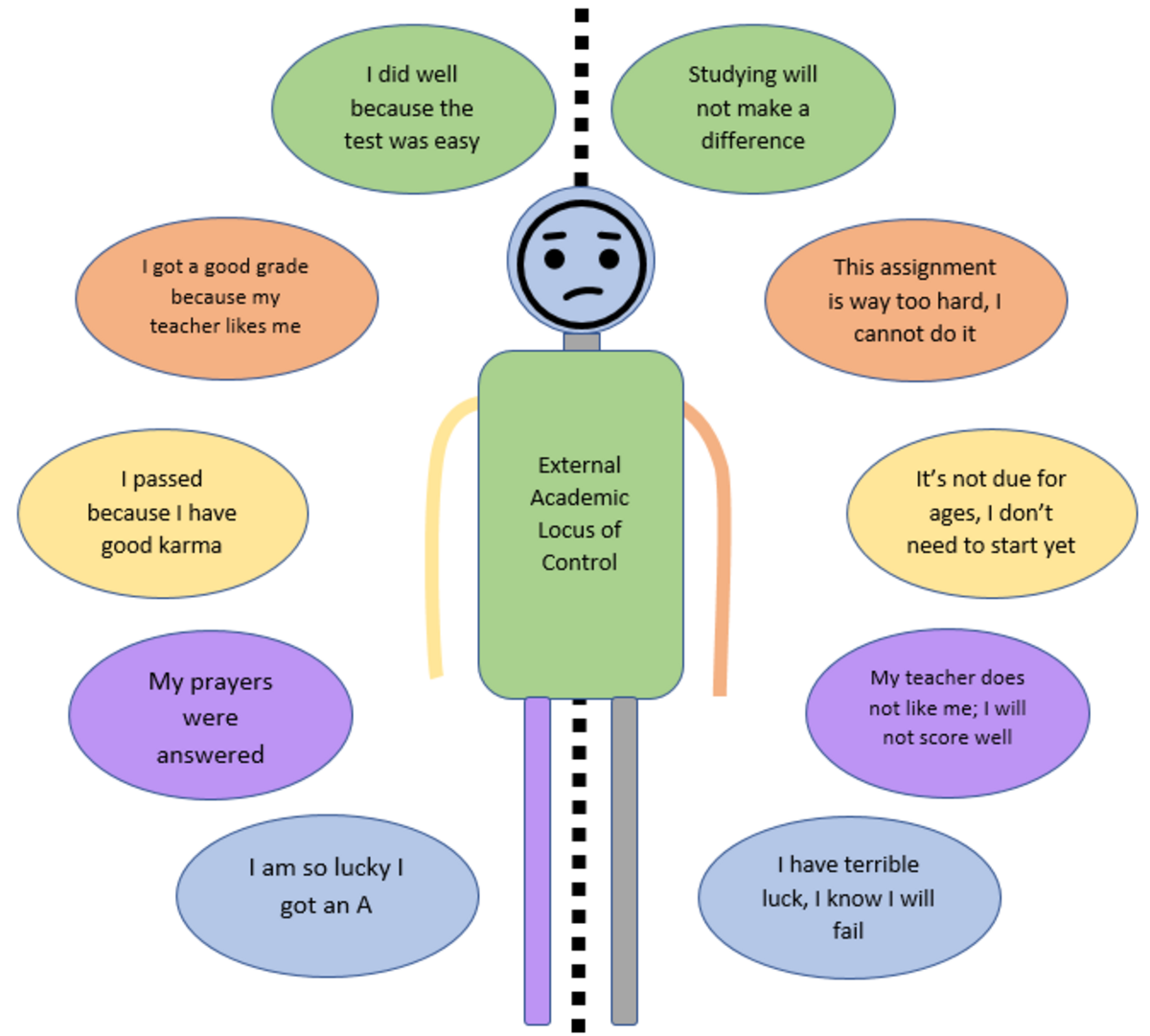
In 1954, psychologist Julian B. Rotter developed locus of control as part of his social learning theory of personality. The word locus comes from the Latin word for place. People with an internal locus believe that their abilities and hard work produce their results, such as crediting their own preparation for a strong exam score. People with an external locus attribute the same exam score to good luck, an easy test, or a lenient teacher.
This chart shows how someone with an external locus assigns academic success or failure to outside forces rather than personal effort. U3142852, CC BY-SA 4.0, via Wikimedia Commons
Rotter emphasized that internality and externality are two ends of a single continuum rather than a strict either-or category. Those leaning external often see life as controlled by chance, fate, or complex systems like corporations and governments. Because they feel they lack influence over their circumstances, externals tend to experience higher stress and show greater vulnerability to clinical depression.
Why control beliefs predict real-world outcomes
Rotter identified two core characteristics in people with an internal locus: high achievement motivation and low outer-directedness. Because internals assume effort connects directly to results, they show a stronger need for achievement and higher engagement in demanding tasks.
Locus of control also serves as one of the four dimensions of core self-evaluations, alongside neuroticism, self-esteem, and self-efficacy. Studies by Judge, Locke, and Durham in 1997 showed that these core appraisals reliably predict job performance and job satisfaction. Later work suggested that these four traits share a single underlying core.
Test yourself
How does locus of control influence whether a person takes action in a challenging situation?
It determines if effort feels worth trying. Believing outcomes depend on your own actions makes striving feel worthwhile, whereas attributing results entirely to luck discourages effort.
Does locus of control remain fixed across every domain of life for an individual?
No, it varies by domain. Locus of control is not a single global score. A person might hold an internal locus for their career while maintaining an external locus for their health.
Office workers are sold lottery tickets. Some choose their own, some are handed one. Later everyone is offered cash for their ticket. What happens?
The choosers hold out for several times more money. Langer's result. Choosing feels like influence even where there is provably none, so the ticket you picked feels worth more than the one you were given. Same draw, same odds, different price.
Play the lesson in edgi and the card is yours. It lands on your Map next to the ideas it connects to, and turns from matte to foil to gold as you learn more around it.
How is locus of control different from attributional style?
Locus of control deals with generalized expectations about future outcomes across many situations. Attributional style focuses on how people explain specific events that already happened in the past.
What are expectancy shifts?
Expectancy shifts describe whether a person expects their next outcome to match their previous result. People who attribute success to ability tend to expect another success, while those who credit luck often expect the next outcome to be completely different.