Learned helplessnessControl is learned, not passivity
Learned helplessness is a state where an individual stops trying to escape painful or difficult situations after experiencing stress they could not control. Modern neuroscience shows that shutting down under stress is actually the brainstem's automatic default response. The brain only overrides this shutdown when the prefrontal cortex actively learns that its actions change the outcome.
By the edgi team We find the most surprising true thing about an idea and build a 60-second lesson around it.
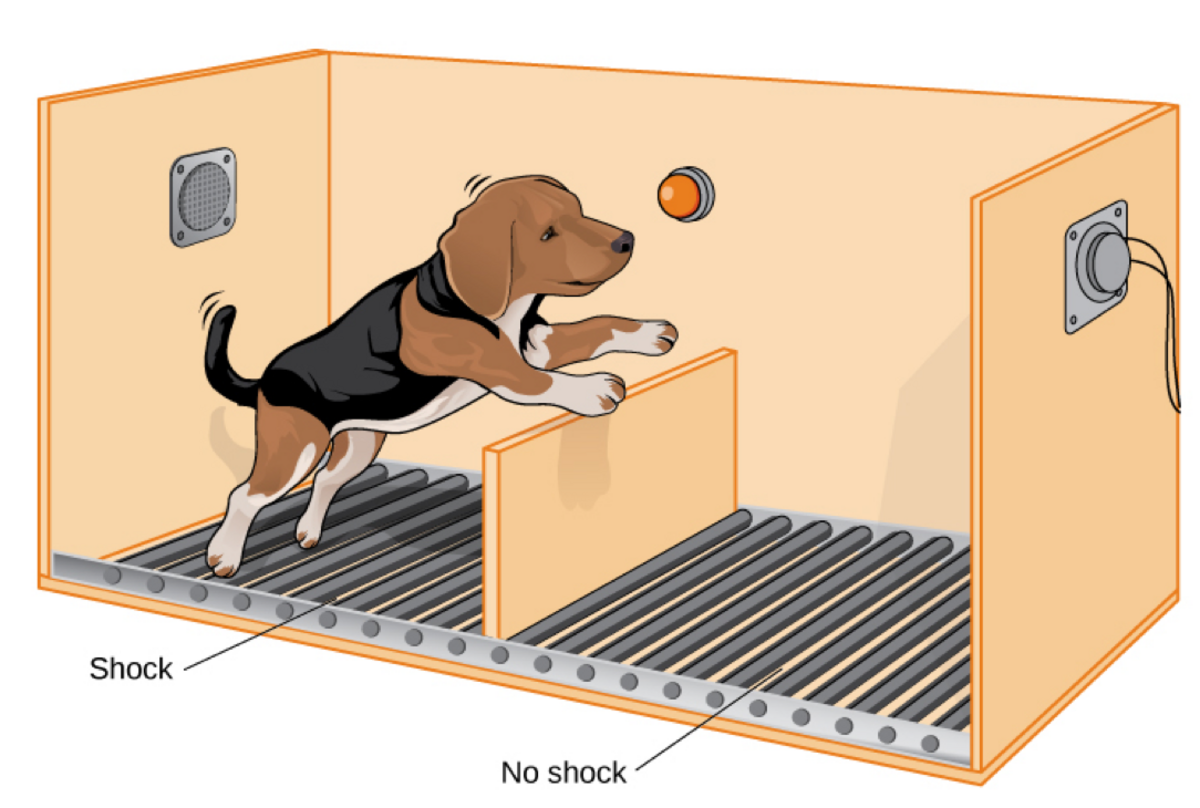
In 1967 two young researchers, Steven Maier and Martin Seligman, gave dogs electric shocks that nothing the dogs did would stop. Later those dogs went into a box split by a low wall. Shock on one side, none on the other, and one step over the wall ends it.
A diagram illustrates a beagle dog inside a shuttle box, a two-compartment enclosure used in learned helplessness experiments. Rose M. Spielman, PhD, CC BY 4.0, via Wikimedia Commons
About two-thirds of them stayed where they were and took it. Dogs that had never had the inescapable shocks stepped over almost at once. They called it learned helplessness. The animal had learned that nothing it did mattered, and had carried the lesson into a room where it was false.
Fifty years on, backwards
Maier spent the following decades on the brain circuits underneath. In 2016 he and Seligman published a paper saying their own explanation had been the wrong way round. Helplessness is not learned. Lock an animal in with pain it cannot stop and shutting down is what the brainstem does by default, with no training at all.
The learning was the other thing. The prefrontal cortex, behind your forehead, detects when your actions are changing the outcome, and while it does, it holds the shutdown switch off. So the dogs in the box had not learned to be helpless. They had never been given the chance to learn control.
What that changes
If control is the part that gets learned, it can be installed in advance. Rats first given shocks they can switch off do not shut down when they later meet shocks they cannot. So the thing that lifts a stuck week is not a better argument with yourself. It is one action small enough that it definitely changes something.
What matters is that the change is visible, not that the task is worthy. You are not lifting your mood. You are giving the detector something to detect.
The brainstem default and the prefrontal brake
Passivity under unavoidable pain requires no learning at all. In inescapable stress, the brainstem automatically triggers a shutdown response. The prefrontal cortex, located behind your forehead, is the structure responsible for detecting whether your behavior alters your environment.
When the prefrontal cortex detects that an action successfully stops a stressor, it alters the excitability of its neurons and actively holds the brainstem shutdown switch off. Prolonged stress without control prevents this circuit from activating, leaving the default passive state in place. If an animal experiences control in advance, the prefrontal circuit protects it from shutting down during later uncontrollable stress.
How helplessness shows up in humans
In humans, learned helplessness connects closely to self-efficacy, which is a person's belief in their ability to achieve goals. It also forms a major foundation for understanding clinical depression, which often stems from a real or perceived absence of control over outcomes.
People react differently depending on their explanatory style. Those with a pessimistic style tend to view bad events as internal (their own fault), stable (permanent), and global (affecting everything). This mindset makes them far more likely to experience helplessness. In experiments with distracting noise or unsolvable chess problems, people who realize their choices do not change outcomes quickly show drops in performance and symptoms of helplessness.
How the passivity gets broken
Breaking helplessness requires concrete, physical proof of control. In early animal trials, demonstrations, threats, and rewards failed to move animals that had stopped trying. Experimenters had to manually pick up the animals and move their legs across the barrier multiple times before the animals began escaping on their own.
Similarly, simply knowing a shut-off switch exists helps human performance during stressful tasks. Action restores function only when the change is clearly visible to the brain.
Test yourself
In learned helplessness, is giving up a newly learned behavior or a default reflex?
A default reflex. Giving up in the face of inescapable pain is the brainstem's default shutdown response, not a skill that requires training.
How does learned helplessness get prevented or reversed according to modern findings?
Experiencing an action that visibly works. The prefrontal cortex needs to detect that your actions successfully change an outcome to hold the shutdown switch off.
Someone has felt flat and stuck for weeks. On Maier and Seligman's 2016 account, what is most likely to shift it?
Doing one small thing that visibly changes something. The circuit that switches the shutdown off is looking for current evidence that this animal's actions are moving this situation. Past wins and reassurance are true and give it nothing to register.
Play the lesson in edgi and the card is yours. It lands on your Map next to the ideas it connects to, and turns from matte to foil to gold as you learn more around it.
The interference hypothesis suggested that animals failed to escape because they had accidentally learned an incompatible physical behavior during previous shocks. Researchers disproved this by paralyzing dogs with curare during the initial shocks; the dogs still became passive later, proving the issue was a lack of experienced control rather than motor habits.
What are the three dimensions of explanatory style?
The 1978 reformulation by Abramson, Seligman, and Teasdale identified three scales: internal versus external, stable versus unstable, and global versus specific. People who explain bad events using internal, stable, and global reasons are the most vulnerable to learned helplessness and depression.