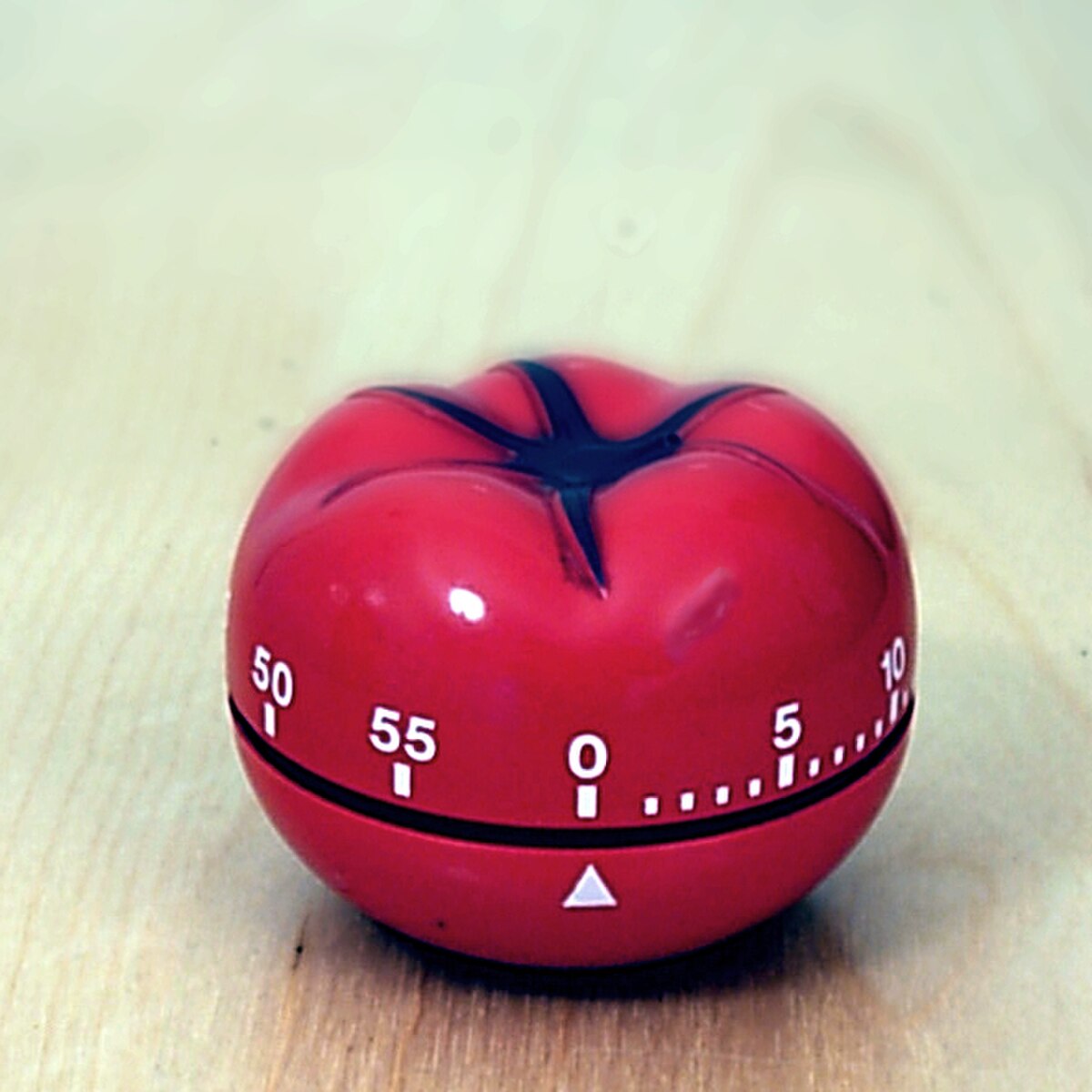
The Pomodoro Technique is a time-management method that splits work into focused 25-minute intervals separated by mandatory short breaks. Francesco Cirillo designed it around a mechanical tomato timer to preserve attention and manage interruptions. Skipping breaks undermines the system because brief rests prevent mental habituation and restore focus.
By the edgi team We find the most surprising true thing about an idea and build a 60-second lesson around it.
A first-year student in Rome in the late 1980s could not get through his reading. Francesco Cirillo made himself a small bet: ten minutes of studying, no stopping. He needed something to hold him to it, so he took the kitchen timer, which was shaped like a tomato. Pomodoro is Italian for tomato.
A red, tomato-shaped kitchen timer with white markings for minutes. The original uploader was Erato at Italian Wikinews., CC BY-SA 3.0, via Wikimedia Commons
He won the bet and kept the timer. The unit settled at twenty-five minutes of work and a five-minute break, and after four of those, a break of twenty to thirty minutes. That break is not a reward for finishing the twenty-five minutes. It sits inside the unit, and the Pomodoro Technique says you take it whether you feel like it or not.
Why the break is part of it
Attention on a long unbroken task does not run out like fuel. It fades through habituation: hold one goal in mind long enough and it fades, even while you are still working at it. Psychologists put 84 people on a repetitive computer task for fifty minutes. One group was pulled away twice to do something brief and unrelated. Everybody else went straight through.
The group that broke off held their performance for the full fifty minutes. Everybody else got steadily worse. Switching away and coming back reloads the goal. That is what the five minutes is doing, and it is why skipping the break does not buy you five minutes.
The rule people drop
Cirillo's other rule falls off in the retelling. A pomodoro cannot be split. Break off in the middle to deal with something and that pomodoro is void; it does not count. Voiding the whole pomodoro sounds punitive until you see what it is for. It turns every interruption into a decision you make out loud, right then, instead of drifting into one.
So the method hands every distraction somewhere else to go. You write the thing down, you agree to come back to it when the timer rings, and you carry on. The timer is not really a measuring device. It is an object outside your own head, and you can point at it when something asks for the next twenty-five minutes.
How the Pomodoro cycle works
The standard system divides work into four repeating steps: select a task, set a timer for 25 minutes, work until it rings, and take a 5 to 10 minute break. Each 25-minute block of work is called a pomodoro. After completing four pomodori in sequence, the worker takes an extended rest of 20 to 30 minutes before starting another cycle.
A central rule of the method is that an interval is indivisible. If an external distraction or internal urge interrupts the session, the worker must record the distraction on paper to address later, or abandon the pomodoro entirely. Tracking completed intervals on a daily list creates a clear record of effort.
Cirillo originally advocated for a physical kitchen timer and paper rather than digital apps. Winding the physical mechanism signals a clear decision to begin, the mechanical ticking serves as an external cue to stay focused, and the ring signals an absolute stop.
What research says about timed intervals
Unbroken attention on a single task fades over time because the brain habituates to constant stimuli. A laboratory experiment with 84 participants showed that people forced to briefly switch away from a 50-minute computer task maintained steady performance, while those working without interruption experienced a steady decline in accuracy and speed.
Comparative student studies show that self-regulated breaks often fail because people choose sessions that are too long, resulting in higher mental fatigue, lower motivation, and reduced concentration. Structured time intervals enforce rest before cognitive fatigue sets in.
A 2025 scoping review confirmed that time-structured Pomodoro intervals consistently improve focus and sustained task performance while reducing mental fatigue when compared to self-paced breaks. The structure is also closely related to timeboxing and iterative development used in software engineering and pair programming.
Test yourself
The timer rings and you are mid-flow. Skip the break and keep going?
Take it, the break is the mechanism. The break is not a reward bolted onto the end. Performance on a long unbroken task falls off because the goal itself stops being fresh, and switching away and back is what reloads it. Of 84 people on a fifty-minute task, only the group pulled away twice held their level. Everybody else got steadily worse.
A proofreader works four hours straight and misses more errors near the end. Why?
The goal fades from mind over time. This is not tiredness in the ordinary sense. On a long unbroken task the goal habituates, so you keep going through the motions while the thing you are checking for stops being sharp in your mind. Briefly switching to something else and coming back reloads it, which is why a short break restores accuracy better than pushing on does.
Play the lesson in edgi and the card is yours. It lands on your Map next to the ideas it connects to, and turns from matte to foil to gold as you learn more around it.
What happens if an interruption cannot be delayed?
If an interruption demands immediate attention and cannot be postponed, the current pomodoro is voided. It is not paused or resumed later; the timer is reset to 25 minutes once work begins again.
What is the inform, negotiate, schedule, call back strategy?
It is Cirillo's protocol for managing interruptions from other people. You inform the person that you are working, negotiate a brief deferral, schedule a specific time to follow up, and contact them once your timer rings.