Distraction is the process of pulling attention away from a chosen focus, which blocks or reduces the intake of relevant information. The human brain cannot multitask simultaneously, treating attention as a selective filter that suppresses other data to prevent sensory overload. Because of this, high-intensity shifts in focus can make people effectively blind to events happening directly in front of their eyes.
By the edgi team We find the most surprising true thing about an idea and build a 60-second lesson around it.
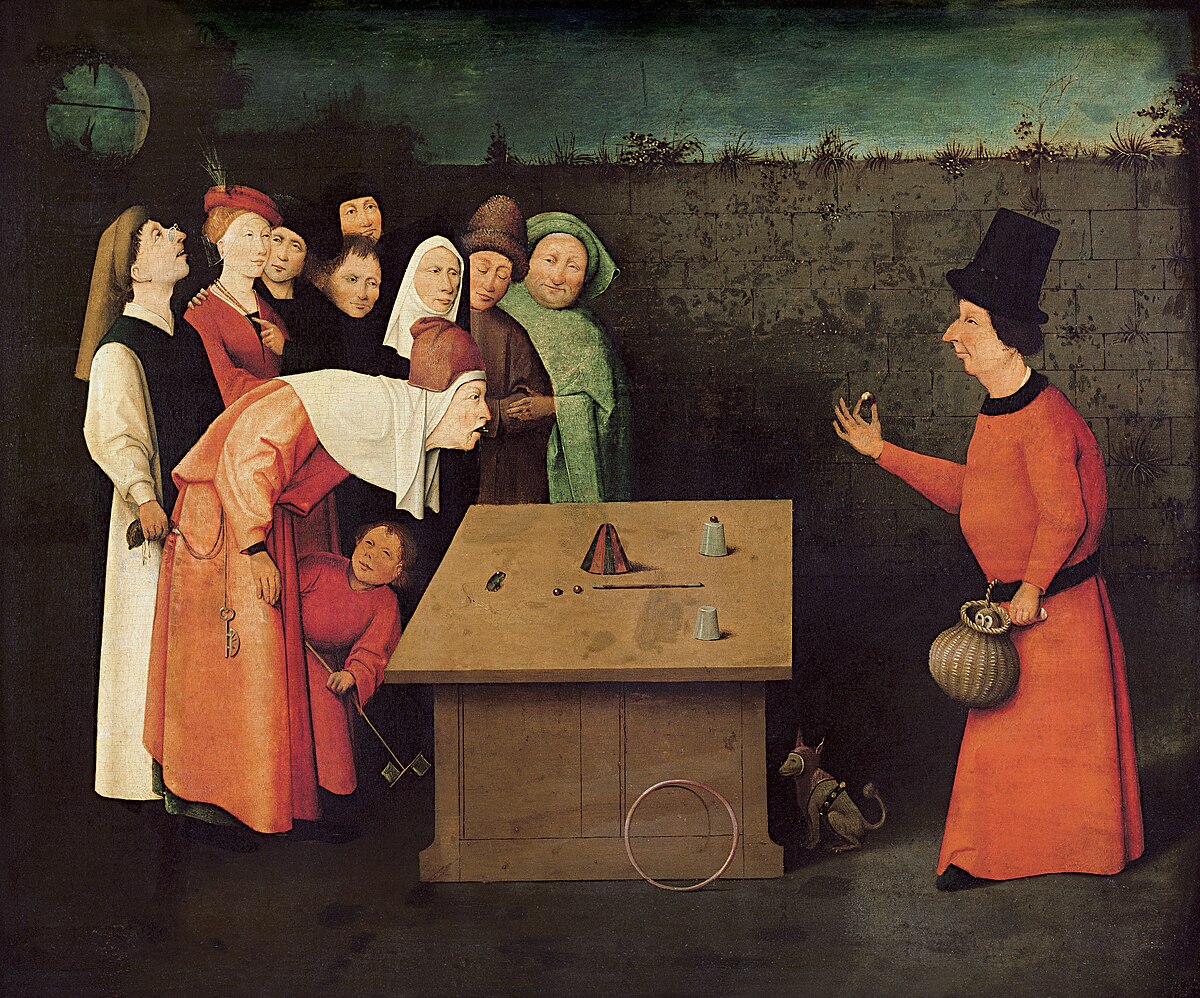
A master of pickpocketing doesn't rely on sleight of hand. They rely on your brain's inability to multitask. By tapping your shoulder or dropping a coin, they trigger an involuntary shift in attention.
Hieronymus Bosch's painting "The Conjurer" (1475–1480) depicts a magician performing a cup-and-ball trick for a captivated audience, while a pickpocket on the far left, in cahoots with the conjurer,… Hieronymus Bosch and workshop / Workshop of Hieronymus Bosch / After Hieronymus Bosch, Public domain, via Wikimedia Commons
While your brain is busy processing that sudden, high-intensity event, you become effectively blind to the hand sliding into your pocket.
The attention filter
In the early 2000s, neuroscientists studied magicians like Apollo Robbins to understand how the eyes can look directly at a theft and not see it. They discovered that attention isn't a spotlight; it's a filter that actively suppresses data to prevent sensory overload.
Robbins found that moving his hand in a curved arc, rather than a straight line, forces your eyes to track the motion, making his other hand invisible to your conscious mind.
The modern pickpocket
Modern apps are designed with that same 'curved motion' logic to keep us in a state of constant human multitasking. We aren't actually doing two things at once. We are just rapidly oscillating our focus until our mental resources are depleted.
Four young women sit on a park bench, each engrossed in their smartphones, illustrating how technology can change social interaction. GHCassel, CC0, via Wikimedia Commons
True mindfulness is the rare, deliberate ability to notice the 'curved hand' before it pulls you away from the present.
What causes distraction?
Distraction happens through external triggers or internal mental states. External sources include visual stimuli, text messages, phone calls, social interactions, and music. Internal sources stem from physical and emotional conditions, including hunger, fatigue, illness, worrying, and daydreaming.
A person loses focus because of a lack of interest, a natural inability to maintain attention, or the sudden attractiveness, novelty, or intensity of an outside event. When conflicting stimuli compete for attention, brain neuron circuits show a drop in the ability to stay focused on goal-related tasks.
How distraction affects work and driving
In the workplace, interruption science reveals that the average knowledge worker switches tasks every three minutes. Once distracted, a worker requires nearly thirty minutes to return to the original task, depleting cognitive resources through rapid oscillation.
Running multiple unrelated applications simultaneously contributes to frequent task switching and longer recovery times at work. MrChrome at English Wikipedia, CC BY 3.0, via Wikimedia Commons
Behind the wheel, distracted driving produces effects similar to driving under the influence of alcohol. Drivers experience a 'looking but not seeing' state where their eyes register road objects, but the brain fails to process the meaning of the image due to attention being absorbed by mobile phones.
Medical and strategic uses of distraction
Distraction serves as a deliberate tool in pain management and warfare. Dentists use small talk or humming to divert focus away from dental surgery. Topical treatments with capsaicin or clove oil generate minor surface burning sensations, redirecting attention away from deeper arthritis or toothache pain.
Clove oil creates a mild burning sensation on the gums to distract the brain from deeper toothache pain. Itineranttrader, Public domain, via Wikimedia Commons
Military history uses distraction to create fake targets and exploit enemy focus. In the Trojan War legend, the Greeks feigned a retreat and left behind a wooden horse, distracting the Trojans with a false token of victory while soldiers hid inside to breach the city walls.
Test yourself
When someone rapidly switches between tasks, what are they actually doing?
Rapidly oscillating focus. True multitasking is an illusion. The brain simply jumps back and forth until mental resources are depleted.
What is a pickpocket's primary tool?
Rewriting your focus. Master thieves do not rely on speed alone. They trigger an involuntary shift in attention that makes your brain actively suppress incoming visual data.
Why does a sudden loud noise make it easy for someone to sneak past you?
Your brain filters out other data to process the noise. Attention acts as a strict filter against sensory overload, so processing one high-intensity event temporarily blinds you to everything else.
Play the lesson in edgi and the card is yours. It lands on your Map next to the ideas it connects to, and turns from matte to foil to gold as you learn more around it.
Why is distraction used in comedy and storytelling?
Writers use distraction, known as comic relief, to break up sustained tension or sorrow. In Hamlet, William Shakespeare included a scene of gravediggers joking about death to give theater audiences a brief respite from the tragedy.
How does distraction relate to procrastination?
Distraction operates as an emotional coping mechanism. When faced with an unpleasant task like work, people often shift their attention to another reality to maintain a positive mental state.