Quantum entanglement is a physical link between particles where the state of one cannot be described separately from the state of the others, no matter how far apart they travel. Measurements of a property like spin on the two particles can be perfectly correlated. Experiments show those correlations can't come from local hidden variables, instructions the particles carried with them from the start.
By the edgi team We find the most surprising true thing about an idea and build a 60-second lesson around it.
Imagine two coins that always land on opposite sides, even if you flip one in London and one in Tokyo. That is entanglement. Two particles become so linked they share one wave function. They aren't two separate objects anymore; they are one system existing in two places at once.
A hand flipping a coin into the air, with a blurred background of buildings and trees. Филип Романски, CC BY-SA 3.0, via Wikimedia Commons
Einstein's doubt
Albert Einstein hated this. He argued the particles must have hidden variables, like a pair of gloves where one is left and one is right, but you just didn't know which was which. He proposed the EPR paradox to argue that quantum mechanics was incomplete. He believed the particles were pre-programmed, not deciding their state on the fly.
A pair of chainsaw gloves, with the left glove featuring orange protective fabric on the back and a chainsaw safety label. Andy Dingley, CC BY-SA 3.0, via Wikimedia Commons
The bell proof
Decades later, physicist John Bell created a mathematical test to prove if Einstein was right. Experiment after experiment showed Einstein was wrong. There are no hidden variables. The particles truly decide their state the moment you look at them, influencing each other instantly.
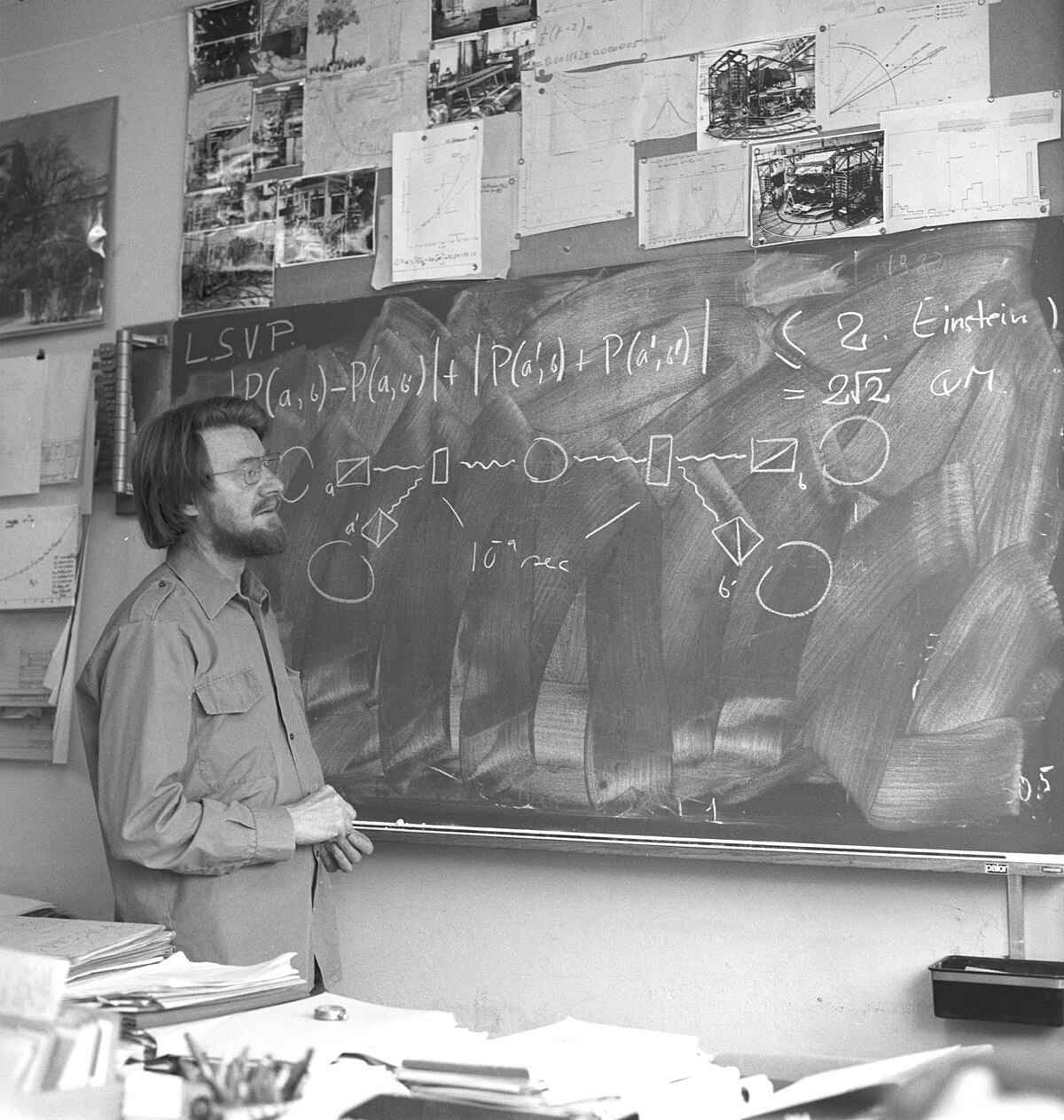
A black and white photograph shows John Stewart Bell discussing Bell's inequality at CERN in 1982, standing in front of a blackboard filled with physics equations and diagrams. CERN, CC BY 4.0, via Wikimedia Commons
The limit
This does not mean you can send text messages faster than light. Because the outcome is random, you cannot force a specific result on the other end. It is not a faster-than-light telephone; it is a fundamental, non-local weaving of the universe that does not violate causality.
A close-up of a bundle of fiber-optic cables, with light emanating from the ends of several fibers. BigRiz, CC BY-SA 3.0, via Wikimedia Commons
How does entanglement work?
When two particles become entangled, they share a single quantum state. Measuring one particle causes an apparent, irreversible collapse of that shared wave function, which alters the state of the entire system as a whole. For instance, if two entangled particles share a total spin of zero, measuring clockwise spin on one axis for the first particle guarantees the second particle will show counterclockwise spin on that same axis.
This connection persists regardless of distance. Laboratory tests have verified entanglement across photons, electrons, top quarks, whole molecules, and even small diamonds. The individual measurement outcomes remain completely random, meaning no user can force a specific result to transmit signals faster than light.
The EPR paradox and Bell's inequality
In 1935, Albert Einstein, Boris Podolsky, and Nathan Rosen published the EPR paradox to argue that quantum mechanics was incomplete. Einstein considered such behavior impossible because it broke local realism, and he later mocked it as spooky action at a distance.
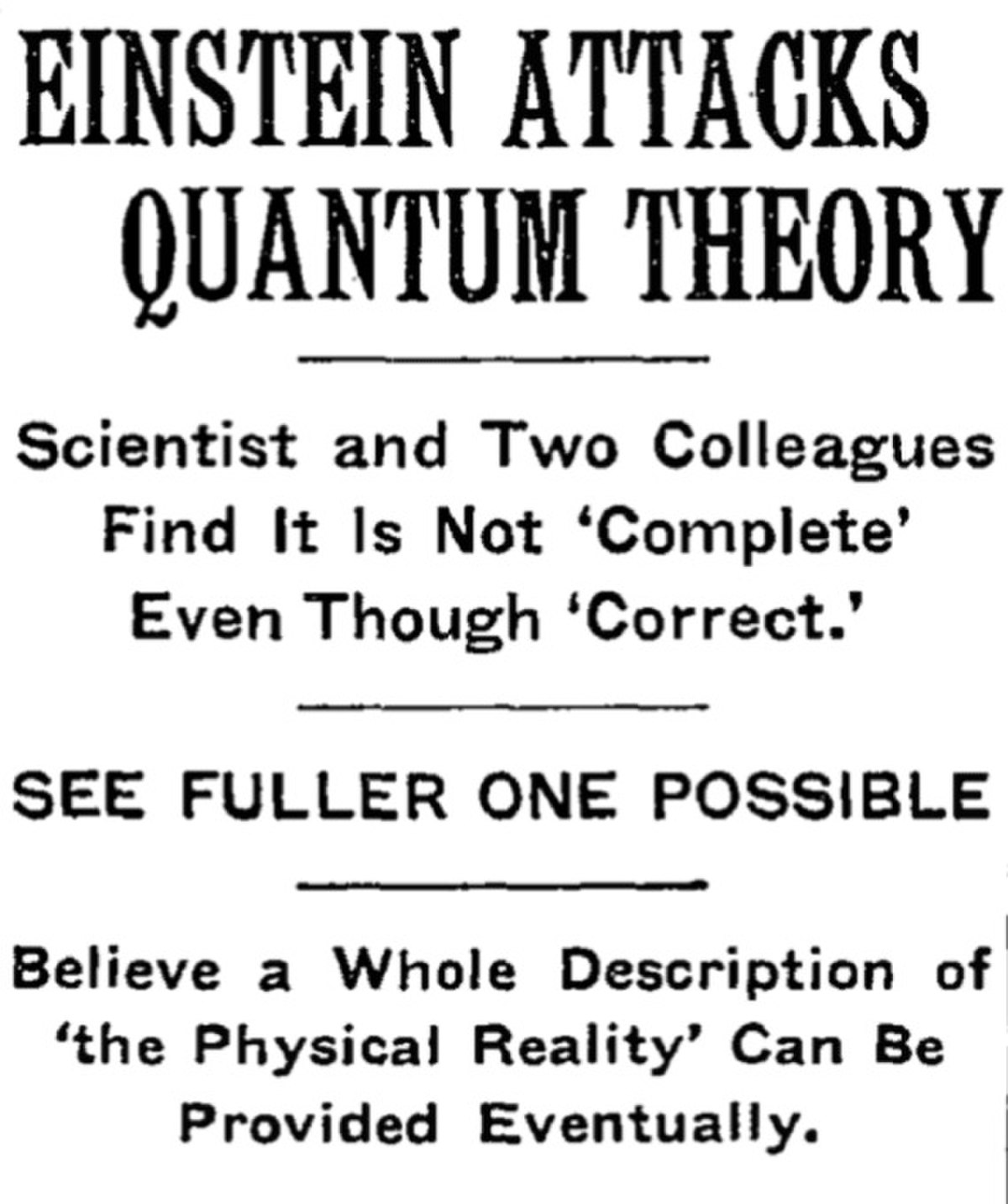
A New York Times headline from 4 May 1935 on the Einstein–Podolsky–Rosen paper, which argued that quantum mechanics was incomplete. New York Times, Public domain, via Wikimedia Commons
In 1964, physicist John S. Bell formulated Bell's inequality, a mathematical limit on how strongly correlated separate measurements could be under any theory based on local realism. Starting with experiments by Stuart Freedman and John Clauser in 1972 and Alain Aspect in 1982, tests consistently violated Bell's inequality. They established that entanglement's correlations cannot be explained by local hidden variables, work that won Aspect, Clauser and Anton Zeilinger the 2022 Nobel Prize in Physics.
Physicist Erwin Schrödinger coined the term entanglement from the German Verschränkung in response to the 1935 EPR paper. He identified it as the defining trait of quantum mechanics that separated it completely from classical physics.
Test yourself
What can entanglement let two distant observers find when they compare results?
Correlations that exceed classical limits. Entangled measurements can show stronger correlations than classical models allow, but random outcomes cannot carry a controllable message or establish a signal's order.
In quantum entanglement, what makes the particles behave as a linked system?
They share a joint quantum state. Entangled particles are described by one joint quantum state, not simply by separate pre-set properties or messages passed at measurement.
Does measuring one particle in quantum entanglement allow sending faster-than-light messages?
No, because outcomes are entirely random.. Even though particles influence each other instantly, the randomness of the outcome prevents anyone from forcing a specific message through.
Play the lesson in edgi and the card is yours. It lands on your Map next to the ideas it connects to, and turns from matte to foil to gold as you learn more around it.
Can quantum entanglement transmit messages faster than light?
No. The outcome of each measurement on an entangled particle is random, so an observer cannot choose or force a specific result to send information. Because individual outcomes cannot be controlled, entanglement cannot be used as a faster-than-light communication channel.
What objects have been successfully entangled in experiments?
Scientists have created and observed entangled states in photons, electrons, top quarks, molecules, and small diamonds. In 1949, Chien-Shiung Wu and Irving Shaknov showed such pairs could be made in the lab, using gamma-ray photons produced by electron–positron annihilation.