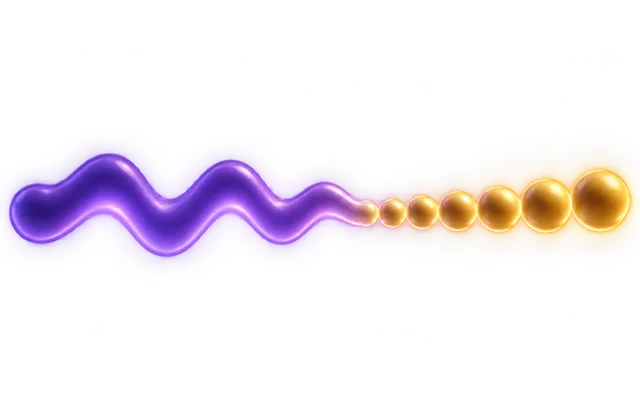
Wave-particle duality is the principle that fundamental entities, such as photons and electrons, act as either particles or waves depending on the experiment used to study them. Classical ideas cannot fully describe quantum objects because they do not stick to a single identity. Instead of having one fixed position, an unmeasured particle is described by a wave of probabilities, and it shows up at a single spot only when it is detected.
By the edgi team We find the most surprising true thing about an idea and build a 60-second lesson around it.
Imagine an electron. When nobody is watching, it acts like a ripple in a pond, spreading out in all directions. But the second you install a detector to see exactly where it is, it stops acting like a wave.
A single water droplet creates ripples on a dark, reflective water surface. Sven Hoppe, CC BY-SA 3.0, via Wikimedia Commons
It instantly snaps into a single, solid dot, like a billiard ball. The act of measuring it forces the universe to pick a state.
The great debate
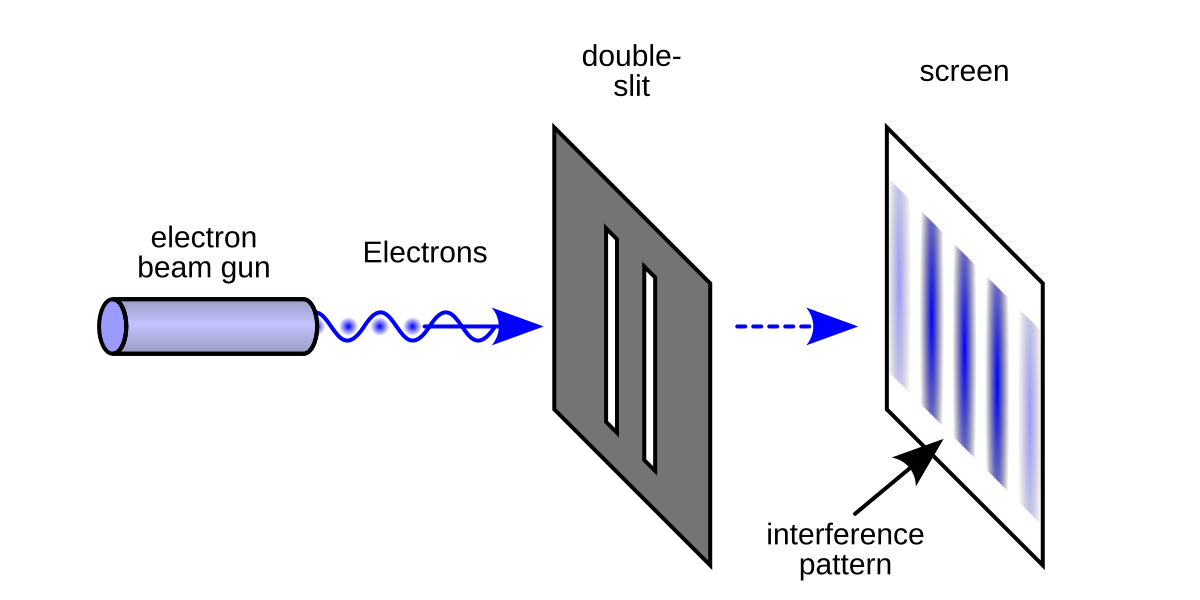
For centuries, scientists fought over whether light was a stream of particles or a wave. In 1801, Thomas Young proved it was a wave using the Double-Slit Experiment, showing light creating an Interference Pattern.
Illustration of the double-slit experiment, showing an electron beam gun emitting electrons that pass through a double-slit barrier. Original: NekoJaNekoJa Vector: Johannes Kalliauer, CC BY-SA 4.0, via Wikimedia Commons
A century later, Albert Einstein proved light was made of discrete packets called Photons using the Photoelectric Effect. They were both right. Light, and all matter, is both at once.
Why it matters
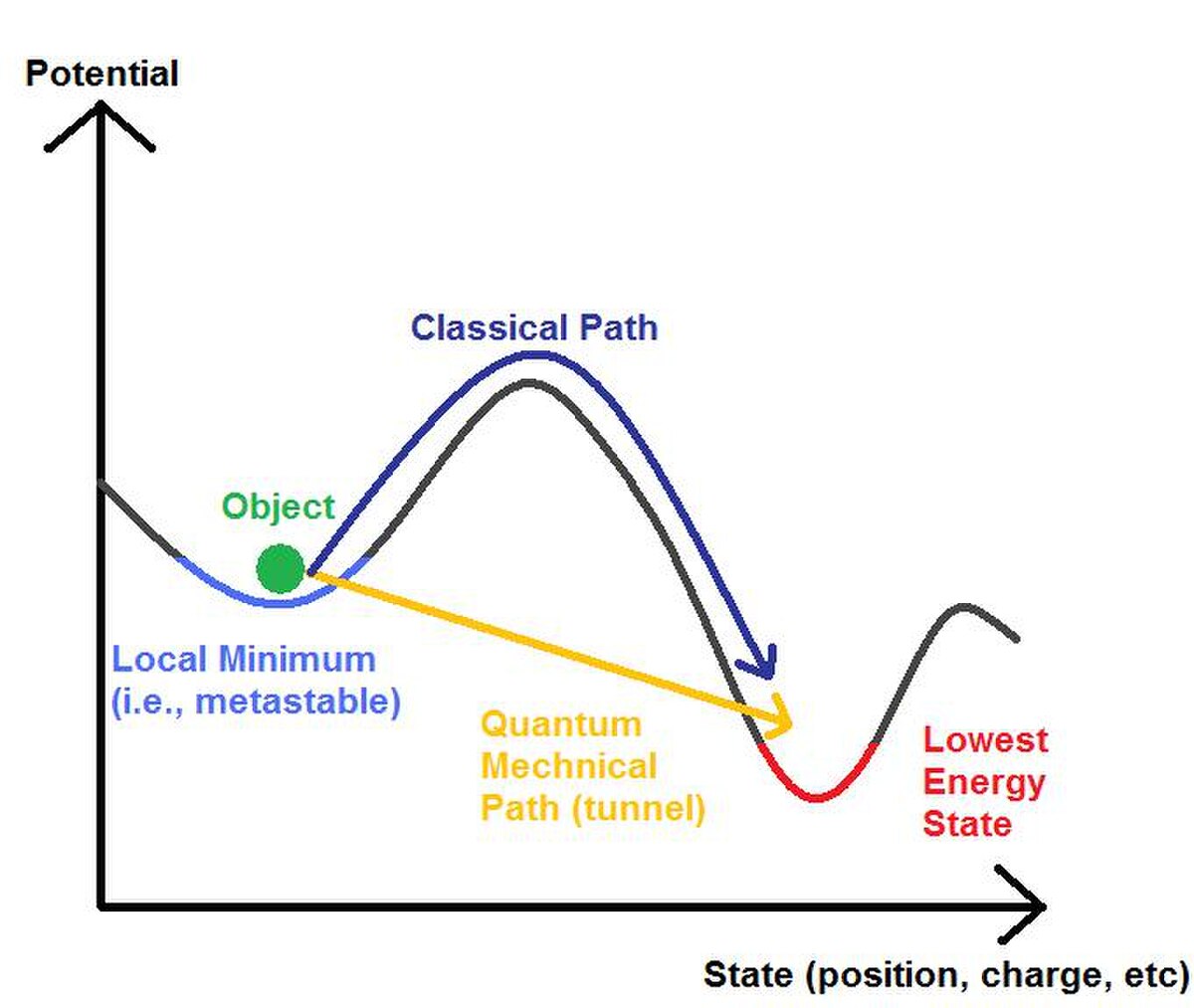
This duality explains why Quantum Tunneling is possible. Because particles act like waves, they don't have a single, pinpoint location. They exist as a probability of being in many places.
A simplified diagram of quantum tunneling, plotting Potential on the Y-axis against State (position, charge, etc.) on the X-axis. Cranberry, Public domain, via Wikimedia Commons
Occasionally, a particle's wave-like nature allows it to simply ghost through a solid barrier, like a ripple passing through a fence.
How light revealed particle behavior
In the 17th century, Isaac Newton argued that light was made of particles, while Christiaan Huygens described it as a wave. Thomas Young seemed to settle the debate in 1801 when his experiments produced interference, a hallmark of wave behavior where peaks and troughs combine to make alternating bands.
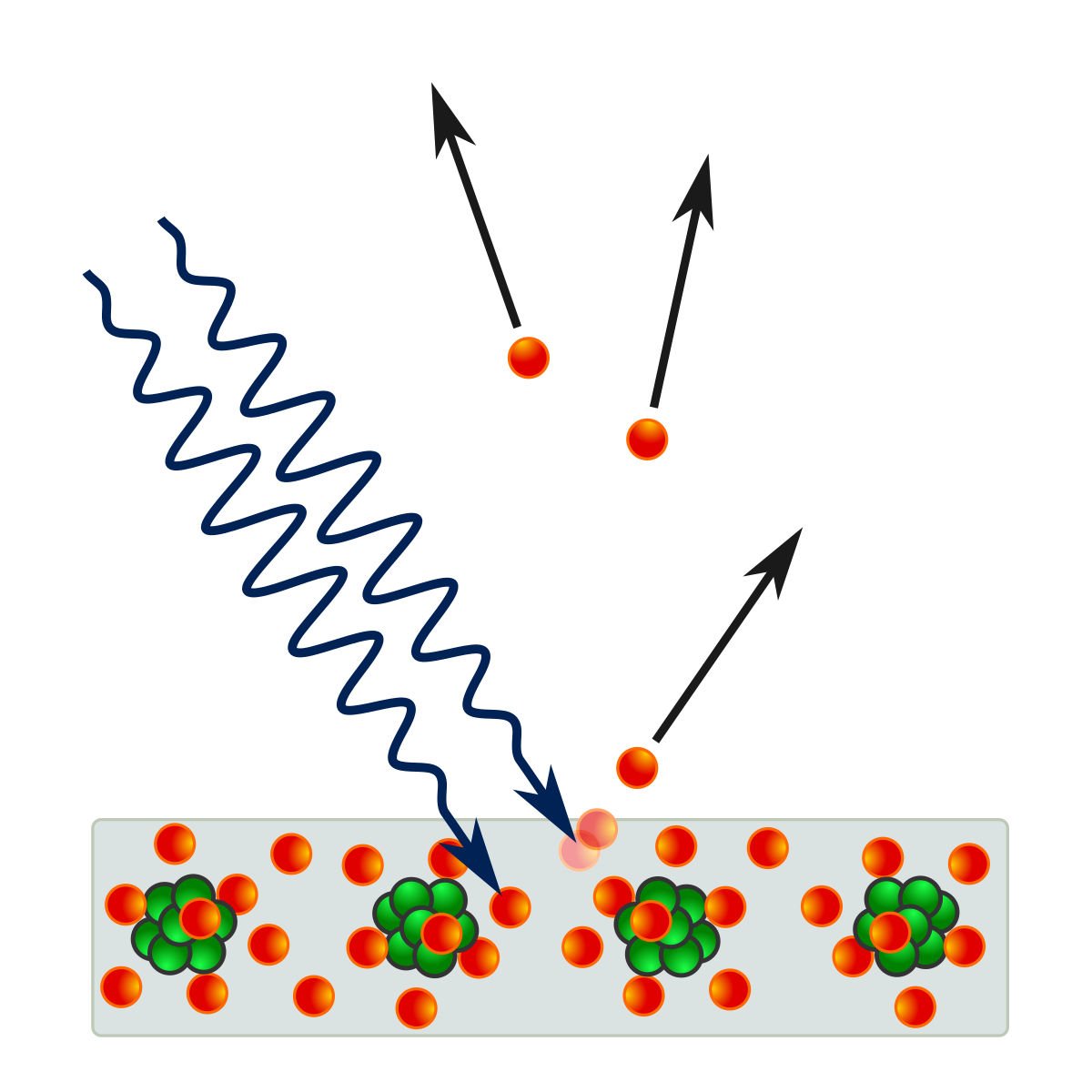
This diagram of the photoelectric effect shows how incoming light knocks electrons out of a solid as individual packets of energy. Ponor, CC BY-SA 4.0, via Wikimedia Commons
In 1901, Max Planck explained black-body radiation by assuming that the oscillators producing it could change energy only in minimum steps proportional to frequency. Albert Einstein built on this in 1905 to explain the photoelectric effect, showing light transfers energy in discrete packets called photons. Arthur Compton later confirmed this particle behavior in experiments between 1922 and 1924 by demonstrating that light carries momentum during collisions.
How matter acts like a wave
Electrons were initially classified as particles after J. J. Thomson measured their charge-to-mass ratio in 1897. In 1924, Louis de Broglie proposed that all matter could also be viewed as waves, suggesting that an electron around a nucleus could be pictured as a standing wave and that particles are bundles of waves called wave packets.
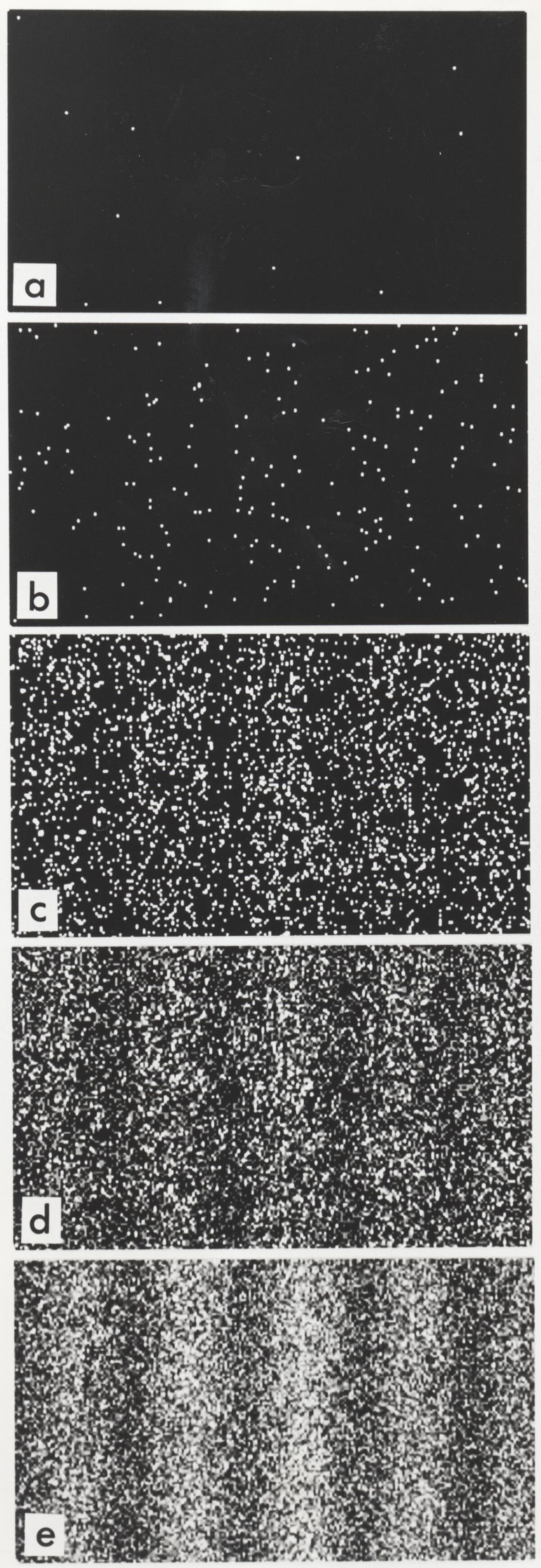
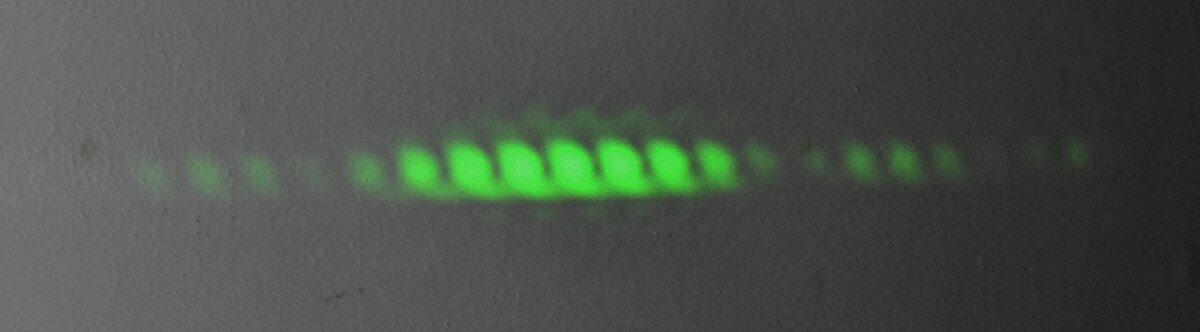
This electron interference pattern shows alternating bright and dark fringes produced by particles diffracting like waves. Roger Bach et al 2013 New J. Phys. 15 033018 DOI 10.1088/1367-2630/15/3/033018, CC BY 3.0, via Wikimedia Commons
Erwin Schrödinger developed the wave equation of motion for electrons shortly after. In 1927, Clinton Davisson and Lester Germer scattered electrons off nickel surfaces, while George Paget Thomson and Alexander Reid passed them through thin nickel films. Thomson and Reid saw concentric diffraction rings, and both experiments showed electrons diffracting like waves. In the 1930s, Otto Stern confirmed this wave nature in larger matter by diffracting beams of helium atoms and hydrogen molecules.
Why duality enables quantum tunneling
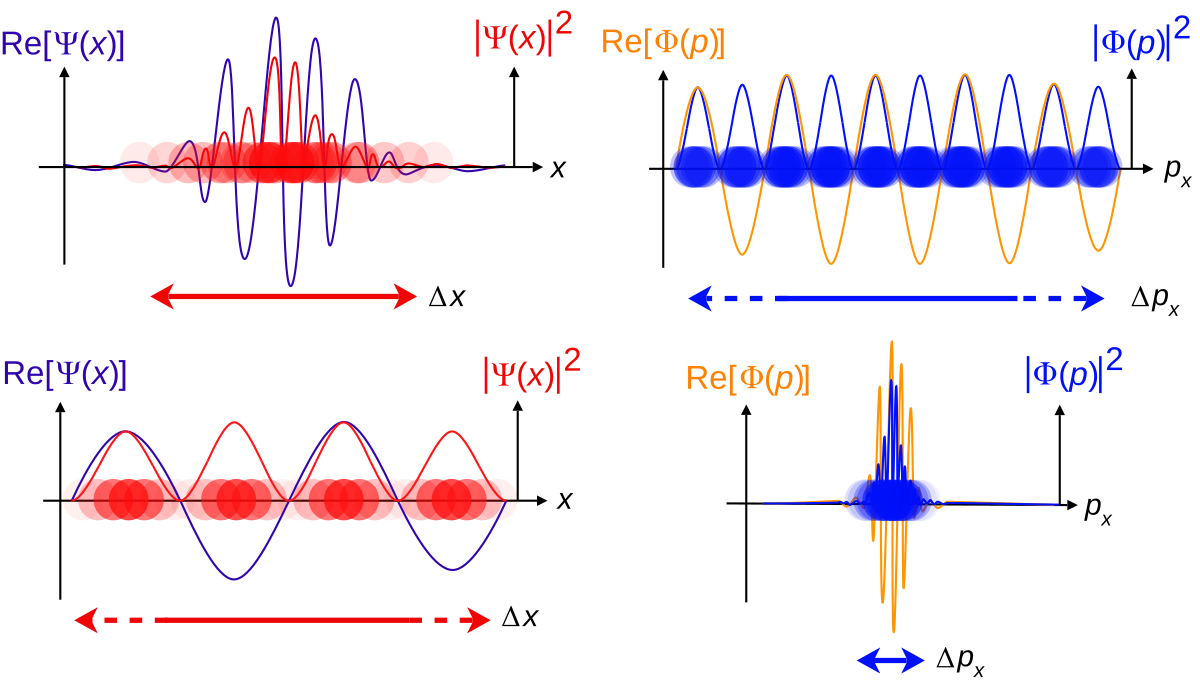
Classical particles follow defined paths and have specific locations, while classical waves spread out in space and interfere with one another. Quantum systems combine both: their wave equations describe a spread of probabilities for where a particle will land.
Because an unmeasured particle is spread across multiple probable locations, it does not occupy a single pinpoint point in space. This wave-like spread allows a particle to pass through energy barriers it classically could not cross, an effect called quantum tunneling, similar to a ripple ghosting past an obstacle.
Test yourself
In wave-particle duality, what determines which properties an electron reveals?
The experimental context. Different experimental setups reveal wave-like or particle-like properties; conscious observation is not what selects them.
In a two-slit test, what would an interference pattern indicate about electrons?
Their behavior includes wave-like properties. An interference pattern is evidence of wave-like behavior, even though electrons can also show particle-like properties in other experimental contexts.
When an electron travels unobserved through space, how does it move?
As a spreading wave of probability. Unobserved particles do not travel along a single, definite trajectory. Instead, they act like ripples, spreading out until an interaction forces them to localize.
Play the lesson in edgi and the card is yours. It lands on your Map next to the ideas it connects to, and turns from matte to foil to gold as you learn more around it.
What happens when you measure an electron in motion?
While an electron travels, its behavior is described by a spreading wave. A detector registers it at one definite spot, the way a particle would land.
Did scientists discover wave behavior in light or matter first?
Light was proven to be a wave by Thomas Young in 1801 before showing particle properties in the 1900s. Matter followed the reverse path, starting as particles before electron diffraction confirmed its wave properties in 1927.
Is wave-particle duality limited to electrons and photons?
No, wave-particle duality applies to all matter. In the 1930s, experiments by Otto Stern confirmed that whole helium atoms and hydrogen molecules also produce diffraction patterns.